Exposition: 1 John 3:1-10
Posted: November 30, 2008 Filed under: Sundays with Spurgeon Leave a comment“Whosoever abideth in him sinneth not: whosoever sinneth hath not seen him, neither known him.”
This plain, simple verse, has been twisted by some who believe in the doctrine of perfection, and they have made it declare that it is possible for some to abide in Christ, and therefore not to sin. But you will remark that it does not say, that some that abide in Christ do not sin; but it says that nonewho abide in Christ sin. “Whosoever abideth in him sinneth not.” Therefore this passage is not to be applied to a few who attain to what is called by our Arminian friends the fourth degree—perfection; but it appertains to all believers; and of every soul in Christ it may be said, that he sinneth not. In reading the Bible, we read it simply as we would read another book. We ought not to read it as a preacher his text, with the intention of making something out of every word; but we should read it as we find it written: “Whosoever abideth in Christ sinneth not.” Now we are sure that cannot mean that he does not sin at all, but it means that sins not habitually, he sins not designedly, he sins not finally, so as to perish. The Bible often calls a man righteous; but that does not mean that he is perfectly righteous. It calls a man a sinner, but it does not imply that he may not have done some good deeds in his life; it means that that is the man’s general character. So with the man who abides in Christ: his general character is not that he is a sinner, but that he is a saint—he sinneth not openly wilfully before men. In his own heart, he has much to confess, but his life before his fellow creatures is such a one that it can be said of him: “Whosoever abideth in him sinneth not; but whosoever sinneth [the sins of this world. in which the multitude indulge] hath not seen him, neither known him.”
Calvinism & Arminianism
Posted: November 29, 2008 Filed under: Calvinism, Mark Driscoll, Video of the Week Leave a commentJohn Owen on Apostasy – Part One
Posted: November 28, 2008 Filed under: Apostasy, John Owen on Apostasy Leave a commentWhy John Owen, the Puritan?
Puritans – you know, those people with crazy hair, wearing black and white outfits with some type of white ruffle around their neck, perhaps wearing a goofy looking cap, always making large families, and living in villages all by themselves as they tried to reform the Church of England… at least, that’s what may come to mind for some people. However, truthfully it seems that there has never been another group of individuals in history that can quite compare to the Puritans, who, spanning for over 200 years, knew the Scriptures, loved the Scriptures, and lived them out as they did. Their work ethic makes many of those today who are in seminaries, ministries, and even those in the pulpit, look lazy. The lives of the Puritans confirmed them as believers that were sold on a purifying doctrine and worship to the Christ. This they took extremely seriously as they continued to bring about the Reformation that Luther, Zwingli, and Calvin had started so fervently. With the intentions that the Puritans had – that is, for the Scriptures to spread to all of mankind – they did not take apostasy lightly. John Owen explains the problem of apostasy best when he addresses the reader to The Nature and Causes of Apostasy from the Gospel. He states:
Religion is the same that it ever was, only it suffers by them that make profession of it. What disadvantage it falls under in the world, they must at length answer for those in whose misbelief and practice it is corrupted. And no man can express greater enmity unto or malice against the gospel, that he that’s should assert or maintain that the faith, profession, lives, ways, and walkings of the generality of Christians are a just representation of its truth and holiness.
If one would want to further study the topic of apostasy, it is always best to look at those who have gone before them and written reliable material on the subject. There are a number of different men such as Samuel Eyles Pierce, A. W. Pink, Horatius Bonar, Gardiner Spring, and today’s Richard Phillips, that have written thorough pieces and dealt with the topic correctly, and are well worth the time to read. As for the Puritans’ writings on the topic, one may easily go in a number of different directions. It would be good to take the time to look at Thomas Brooks, Ebenezer Erskine, Thomas Boston, and Richard Sibbes. However, when delving into the topic of apostasy it is most important to spend some time on the greatest work done on it by the “Master” of it himself: John Owen. In the seventh volume of his works (printed by Banner of Truth Trust), Owen has a massive 259 pages dealing with apostasy.
Today in the 21st century John Owen is known for a number of different topics and areas like, Mortification of Sin, Biblical Theology, Communion with God, The Glory of Christ, The Holy Spirit, his seven-volume work on the book of Hebrews, and his sixteen-volume set of works. Additionally, people may often think of Justin Taylor’s passion for Owens’ works, namely, Communion with the Triune God and Overcoming Sin and Temptation. On top of all that, Own is also known to be the cause of almost every seminarian’s complaint, “I cannot read his lengthy sentences!” No matter how many degrees one has, what seminary one graduated from, or how brilliant one is, it is always hard to grasp the long-winded mind and thought of John Owen brought forth through the ink of his pen. But that is exactly why this chapter is being written – so that you, the reader, will get a review of the often-overlooked writing on apostasy that Owen did, and how then to relate that to any man living today.
 With that said, there is not much of an introduction needed in describing John Owen. A man of Welsh decent, born in the town of Stadhampton, Oxfordshire, and a student of Queen’s College, he was born and raised a Puritan. John Owen was a husband, father, and, most of all, a man of God who spent his whole life studying the Scriptures. He lost 10 of his 11 children at birth, and later his 11th to drinking herself to death. John Owen knew suffering – that is for certain. The importance of John Owens’ sufferings in this matter (Apostasy) is to see how easily Owen himself could have turned hard-hearted toward the gospel and become an apostate. However, John Owen never lost sight of his victor, Jesus Christ. He took his work, ministry, and study very seriously – living out his faith in Christ.
When one speaks or hears about the Puritans, it is hard to not think or have at least one mention of the most popular one: John Owen. The church, throughout her life, has been given a number of gifted and talented individuals with minds like nothing else, and which are even more powerfully seen when they use it while suffering for the kingdom of Christ – as John Owen did. Owens’ work can still be used today for all who may be dealing with apostasy or an apostate, as many living in this postmodern culture claim the title of “Christian” but show no fruit or sign and are then branded “Apostate!” For that very reason, the Nature and Causes of Apostasy from the Gospel should not be overlooked when dealing with Owens’ works. In the world we live in today, Owens’ tremendous work on apostasy brings much aid in helping one see the importance of the power of apostasy and how to deal with those that have become apostates.
Learning From John Owens’ work on Apostasy
Often times, people overlook those who lived before them and have deeply studied the Scriptures. Some think with culture change – times passing away – what one had said hundreds of years ago is not needed or not “good enough” for today’s times. People even say that what may have been true then is not true now. That is exactly why John Owens’ work is a “must read” for our culture, as Christianity continues through the paths of time that tries to consume those who are a part of it.
For the one who is solid in their walk and is living a life that is pleasing to the Lord according to His law, this is particularly important in mainly two ways. First, in times where the world is progressing, it is vital to know the truths of the Word and have proper doctrine that is in obedience to what God has intended for His people through His Word given to them. Secondly, in a culture where people call themselves “believers” by their own standard and own beliefs – and not that of what God has intended – one must be able to discern what is and is not the true mark of a believer who lives out the Scriptures in accordance with them, practicing them in obedience.
John Owen wrote 13 different chapters/sections focusing on the nature and causes of apostasy. To deal with them all here could easily lead to a book in itself; maybe even multiple volumes on each area. However, this short chapter’s aim is to bring out the main points of John Owens’ work on apostasy and show the importance of the truths of it today. In each of John Owens 13 sections I plan to give a thesis, outline and summary, of John Owens work on dealing with apostasy.
Click below on the “Read More” for the footnotes.
RHB Deal
Posted: November 27, 2008 Filed under: Uncategorized Leave a commentCheck out RHB’s deal, only left for four more hours!
To Bad Thanksgiving ain’t Like it Used to Be…
Posted: November 26, 2008 Filed under: Quotes Leave a commentSo once in every year we throng Upon a day apart, To praise the Lord with feast and song In thankfulness of heart. ~ Arthur Guiterman, The First Thanksgiving
Twitter Me
Posted: November 25, 2008 Filed under: Just for Fun Leave a commentJust started finally to figure this out, and like it! If you twitter, hit-me-up so that I can follow you as well. You can follow me here.

Looking for Books on Apostasy
Posted: November 24, 2008 Filed under: Apostasy Leave a commentWorking on a chapter of a book that I plan to have done in the next two years on Apostasy.
Asking you, for help. If you have an idea of a book, that I may not know of, please give me the title and author so that I can get it, and take a look! I am looking for books namely on the topics of Man’s Mind and Apostasy, worship and apostasy, the pastor and apostasy, and defenses against apostasy.
PS- Do not tell me John Owen, vol. 7… I already know that!
Want some Amazon Cash?
Posted: November 24, 2008 Filed under: Uncategorized Leave a commentFind out more here.
Black Friday
Posted: November 24, 2008 Filed under: You Might be a Calvinist if... 3 CommentsYou might be a Calvinist if… you have no clue what “Black Friday” is.

Acquiring Perseverance
Posted: November 23, 2008 Filed under: Sundays with Spurgeon Leave a commentThe Lord thy God will put out those nations before thee by little and little. (Deuteronomy 7:22)
We are not to expect to win victories for the Lord Jesus by a single blow. Evil principles and practices die hard. In some places it takes years of labor to drive out even one of the many vices which defile the inhabitants. We must carry on the war with all our might, even when favored with little manifest success.
Our business in this world is to conquer it for Jesus. We are not to make compromises but to exterminate evils. We are not to seek popularity but to wage unceasing war with iniquity. Infidelity, popery, drink, impurity, oppression, worldliness, error; these are all to be “put out.”
The Lord our God can alone accomplish this. He works by His faithful servants, and blessed be His name. He promises that He will so work. “Jehovah thy God will put out those nations before thee.” This He will do by degrees that we may learn perseverance, may increase in faith, may earnestly watch, and may avoid carnal security. Let us thank God for a little success and pray for more. Let us never sheathe the sword till the whole land is won for Jesus.
Courage, my heart! Go on little by little, for many littles will make a great whole.
John Owens Definition of the Gospel
Posted: November 22, 2008 Filed under: John Owen, The Gospel 1 CommentJohn Owen giving his definition of the Gospel.
1. The mystery of its doctrine, which is the object of faith;
2. The holiness of its precepts, which are the matter of our obedience; and,
3. The purity of its institutions of worship, which is the trial of our faith and obedience as to their profession.[1]
Question that Came to Mind
Posted: November 21, 2008 Filed under: Questions that begged to be asked 2 CommentsHow can a Reformed Theologian take an allegorical approach to the Prophets, Song of Solomon, and Revelation but yet when another person approaches the Book of Genesis using the same approach they are called a Liberal Theologian?
Puritan Reformed Journal, Vol. 1
Posted: November 20, 2008 Filed under: PRTS 4 Comments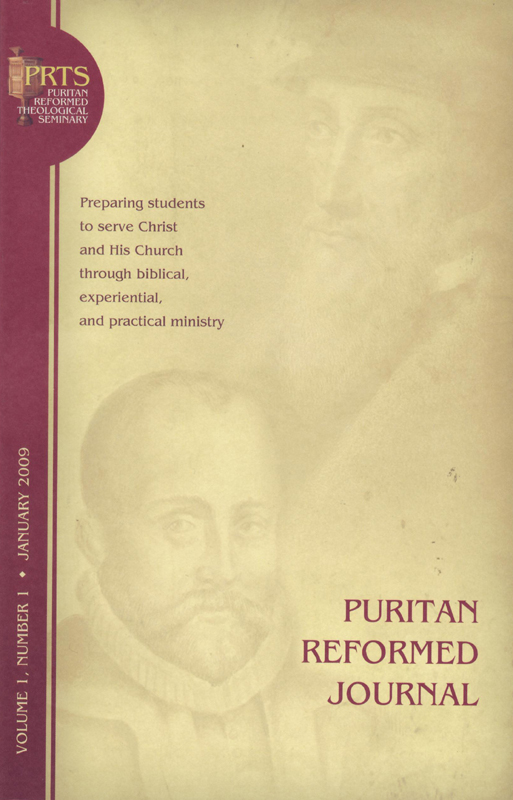 In this inaugural issue of the Puritan Reformed Journal, Joel R. Beeke provides the appropriate doorway of introduction by emphasizing our great need for God-centered ministry.
Contributors include: PRTS professors, Dr. David Murray on “Preaching Christ from the Old Testament” and Dr. Gerald Bilkes on “Ezra as a Model of Continuing Reformaiton; PRTS students, Antoine Theron on “The Christology of Adolphe Monod, Jonnie Serafini on “The Command against Eating Blood” and Daniel Hyde on “Preaching the Heidelberg Catechism”; there are also articles by Michael Haykin, John J. Murray and others.
We pray that this unique journal, which is aimed at both scholars and laymen will add to the body of rich literature that has been used to build the Body of Christ
Gospel Watered down by Tradition
Posted: November 19, 2008 Filed under: Gospel Quote of the Week, John Owen Leave a comment“So today in many churches gospel silver has become nothing else but dross, its pure wine watered down by the traditions and reason of the church.” – John Owen
It seems that John Owen had a few of the same problems that legalistic people in the church still tend to do today to the gospel…
The Sabbath Texts, Thought #2
Posted: November 18, 2008 Filed under: Sabbath Study Leave a commentI did NOT expect the number of readers that actually read my first thought on the Sabbath, which is fine I guess. The thoughts I plan on to mention in the writing below are only a short one to two sentences over the Pentateuch’s mentioning of the Sabbath and what the Sabbath is literally. I think it is good at times to know what exactly this Sabbath is in order to know what we are talking about for future reference when dealing with it, and defining it accordingly to Scriptures definition and not some confession or some opinion, or even dictionary.
Ex. 23:12 – This here is the first session of the giving of the Law and only but a brief mention of the Sabbath is given, and might I add that it seems to include a social concern as reason in mentioning it. In context here, first the Sabbath is mention among the regulations that govern Israel’s social behavior among the other nations. Second, it seems as if this mention of the Sabbath here is giving a transition to the celebration of feast and in the offering of sacrifices, hence the reason that the Sabbath was incorporated as a celebration for the nation of Israel.
Ex. 31:12-17 – Here God concludes his list of instructions on the building of the tabernacle by the repeating the Sabbath Law. Here it must be kept or death. Here the Sabbath is shown as a type/sign of the covenant showing what God had done in His creation work in resting. Might I add that this sign was for only God and His people to cease work, or death.
Ex. 34: 21 – This here is one reminder that is given in the second tablets of the Moral Law.
Ex. 35:2-3 – Here the Sabbath has been reminded as a contribution of building the temple, and is mostly shown in law keeping more than any of the other mentions, allowing the woman to cook, bake, etc. most likely referring to Ex. 16:23.
Lev. 19:3,30 – Here in its shortest form, and here God claims for the first time as the Sabbath “my sabbaths.”
Lev. 23:3 – Here shows that the feasts begin with the Sabbath.
Lev. 26:2 – Repeats the theology and doctrine of the Sabbath from Lev. 19:30.
Duet. 5:12-15 – Here the Sabbath is done in repetition of the Decalogue, however here the Sabbath instead of being told to “remember” it is said to “observe.” In addition here the Law of the Sabbath is told to not use an “ox or ass” in its list of workers, as well as “menservants and maidservants.”
Concluding Thoughts I have made from this:
#1 The Sabbath in these passages is now introduce, the Law of it, and the keeping’s of it for the first time.
#2 All daily work must cease for everyone on the Sabbath.
#3 Those that break the law of the Sabbath must die.
#4 No fire can be made in the homes on the Sabbath.
Changing Hymns
Posted: November 17, 2008 Filed under: You Might be a Calvinist if... 1 CommentYou might be a Calvinist if… you have ever purposefully sung a different word in a hymn to conform to scripture.
Speaking of Calvinist, check out the PRTS’s new website!
The Causes and Decay of Holiness
Posted: November 16, 2008 Filed under: John Owen Leave a commentJohn Owen on the Causes and Decay of Holiness
“In these things consisted the mystery of iniquity, the springs and occasions of that great apostasy which was in the worldunder the Papacy.
1. The doctrine of the gospel (as to its peculiar nature, the causes, motives, and ends of it) was generally lost, partly through the horrible ignorance of some, and partly through the pernicious errors of others, whose duty it was to have preserved it. And how impossible it is to maintain the life and power of obedience when this spring of it is dried up orcorrupted, when this root is withered and decayed, is not hard to apprehend. Sometimes truth is lost first in a church, and then holiness, and sometimes the decay or hatred of holiness is the cause of the loss of truth; but where either is rejected, the other win not abide, as we have declared. And so it fell out in that fatal apostasy; these evils promoted and furthered each other.”
The Sabbath Commandments, Thought #1
Posted: November 15, 2008 Filed under: My Life, Sabbath Study 4 CommentsThe past two years I have attended Puritan Reformed Theological Seminary for my Masters of Arts (MAR). Realizing I now only have 13 months to go, I am starting now to think about what is it that I’ll be doing in January of 2010. But for the past two, and still this next one to go, I have had to study personally and number of areas of theology because my lack of wisdom from North-Central Ohio, or my pervious under grads that I had attended. Doctrines like going over the human soul, the humanity of Christ, to baptism, church government, and end times… They have all been a path that I have enjoyed dearly studying beside my reformed brothers that at often times may disagree with me on a number of issues (Baptism, Church Government, End Times) but still respect me and what I hold to from the Scriptures. Over the past year I have read numerous books, heard a number of debates and listen to many people on how the Sabbath carries over to that of the Church in the New Testament.
I hear:
“The Moral Law still exists”
“The Sabbath was made before the Moral Law was given”
“The Sabbath was given at creation”
“The Moral Law cannot be fulfilled”
“The Sabbath is a Law given to all of creation”
“The Sabbath was a type of Christ and now looks back to Christ”
“The Sabbath is a clear distinction of seeing who the Lord’s people are”
“The Sabbath has now transferred to Sunday”
“It’s not Sunday, It’s Sabbath Day!”
“We have Sabbath-school, not Sunday-school…”
I hear a number of comments, sayings, sides, etc. Now since this is my own personal blog hopefully this post nor the numbers that will come that I plan to write on the Sabbath/Lord’s Day will not get me into trouble with my seminary nor my work. These post that I plan are only and will be only my thoughts as this next 3 months I plan to study the other side (against the keeping of the Sabbath) and just place them up for whoever wants to read, whoever wants to comment, and whoever wants to bash me. I plan NOT to respond back due to the lack of argument I want to create but just give my opinion and my thoughts as I study this area of Theology out, and please do leave whatever thoughts you may have.
Thought #1
Exodus 16:22-30
22 On k the sixth day they gathered twice as much bread, two omers each. And when all the leaders of the congregation came and told Moses, 23 he said to them, “This is what the Lord has commanded: ‘Tomorrow is a day of l solemn rest, a holy Sabbath to the Lord; bake what you will bake and boil what you will boil, and all that is left over lay aside to be kept till the morning.’” 24 So they laid it aside till the morning, as Moses commanded them, and m it did not stink, and there were no worms in it. 25 Moses said, “Eat it today, for l today is a Sabbath to the Lord; today you will not find it in the field. 26 Six days you shall gather it, but on the seventh day, which is a Sabbath, there will be none.”
27 On the seventh day some of the people went out to gather, but they found none. 28 And the Lord said to Moses, n “How long will you refuse to keep my commandments and my laws? 29 See! The Lord has given you the Sabbath; therefore on the sixth day he gives you bread for two days. Remain each of you in his place; let no one go out of his place on the seventh day.” 30 So the people o rested on the seventh day.
Exodus 16:22-30 is the 1st occurrence of the actual term and/or concept of the Sabbath. The passage clearly allows one to believe that the institution of the Sabbath was unknown to the people of God (Israel) at this time. Before this actual mention of the Sabbath, the Israelites had been holding to the Egyptian 10-day week calendar. Matter of fact the narrative seems to be preparing the Israelites for the Sabbath which would then be commanded to then in the next coming months, namely Exodus 20 (Decalogue). Matter of fact verse 30 of this section says, “so the people ceased to gather on the seventh day.” Which clearly shows us that this celebration was not on the cultic aspect yet, but a human preparation.
Spirit’s work about the New Covenant?
Posted: November 14, 2008 Filed under: Seminary Questions Leave a commentWas Asked – Is the Spirit’s work that which is new about the New Covenant?
My Answer was – Yes! I simply do not see one can argue the fact that the work of the New Covenant is not established today! I have heard a number of times by mainly classical dispensationalist (who have made up their minds that no covenant is given to the church) that this is not in order today for the local church. I think to show how the New Covenant is consummate by the pouring of the Spirit on and in man is best to go to the Scriptures which seem at least to myself in making this clear.
The New Covenant as the Law of God in the human mind
Ezekiel 36: 26-27 – A new heart I will give you, and a new spirit I will put within you; and I will remove from your body the heart of stone and give you a heart of flesh. I will put my spirit within you, and make you follow my statutes and be careful to observe my ordinances.
The New Covenant as a gift from the Holy Spirit
Galatians 5:22-23 – By contrast, the fruit of the Spirit is love, joy, peace, patience, kindness, generosity, faithfulness, gentleness, and self-control. There is no law against such things.
The New Covenant as a fulfillment by the Spirit
Romans 8:4 – so that the just requirement of the law might be fulfilled in us, who walk not according to the flesh but according to the Spirit.
Living for God’s Glory: An Introduction to Calvinism
Posted: November 14, 2008 Filed under: Dr. Joel Beeke Leave a comment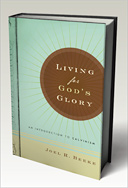
Living for God’s Glory: An Introduction to Calvinism, by Joel R. Beeke retails at $24.00. Today for the next 4 hours from this post, will be sold for 50% off at only $12.00 from RHB.
In this introduction to the doctrinal system known as Calvinism, Joel Beeke—with contributions from Sinclair Ferguson, Michael Haykin, Derek Thomas, Ray Pennings, and others—displays the biblical, God-centered, winsome, comprehensive, and practical nature of Calvinism.
In this comprehensive survey of Reformed Christianity, Dr. Beeke and eight fellow contributors offer twenty–eight chapters that trace the history of Calvinism; explore its key doctrinal tenets, such as the so-called five points of Calvinisms and the solas of the Protestant Reformation; reveal how Calvinists have sought to live in devotion to God; and survey Calvinism’s influence in the church and in the world at large. In the end, the book asserts that the overriding goal of Calvinism is the glory of God. Saturated with Scripture citations and sprinkled with quotations from wise giants of church history, this book presents Calvinism in a winsome and wondrous fashion.
Sammy and His Shepherd
Posted: November 13, 2008 Filed under: Book Review, Sammy and His Shepherd Leave a comment 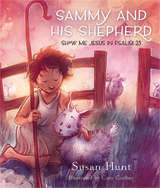
Sammy and His Shepherd by Susan Hunt (and illustrated by Cory Godbey) is a delightful story centered around the 23rd Psalm. The book tells of Sammy – a sheep who is tended by a loving and protective shepherd who befriends another sheep on the other side of the fence. The sheep across the fence has no name and is very neglected and sickly. Sammy soon sees what it is like not to be under the loving care of a kind shepherd. As the story progresses, the sickly sheep ends up in the care of the good shepherd and is loved as he should be.
At the beginning of each chapter Hunt features a line from the 23rd Psalm and then her main character – Sammy – lays out the focal concepts of that line in fun, witty, and heart-tugging conversations with his friend. The chapters are short and energetic enough to capture the imagination of small children. At the end of book there is an interactive portion for deeper knowledge of what the book captures in fictional tales. There are 3 parts to the interactive portion that includes: “The Bible Tells us…” – where there is a cross-reference to a New Testament passage on the specific topic of the chapter and a brief explanation of the passage’s message. The next part is “Something to talk about…” – where it gives pointed questions that pick out the main biblical themes to live by, drawn from each chapter. The last part of the interactive section is “Something to do…” – where there is a practical action brought out that can be shown in one’s life, which is taken from the moral focused on in each chapter. The entire story and the activity section is a wonderful way to teach children deep biblical truths that they can easily understand and apply to their daily lives!
I also found the illustrations completely enrapturing and perfect – very much displaying what the reader’s mind would imagine! The beautiful colors and lovable characters portrayed are sure to be a winner in any child’s eye. This book will be a wonderful tool in a parent’s library to help their child gain a deeper knowledge of the love that Christ bestows upon his “sheep” – his beloved children.
Ancient Near East Text
Posted: November 11, 2008 Filed under: Fill in the Blank 1 CommentYou fill in the blank.
Ancient Near East Text _______________ when trying to interpret the Scripture, namely the Old Testament.
Homework on Sunday’s
Posted: November 10, 2008 Filed under: You Might be a Calvinist if..., You might be a Fundamentalist if Leave a commentYou might be a Calvinist if… you do not do homework on Sundays
You might be a Fundamentalist if… you do not get the joke above
Set Aside
Posted: November 9, 2008 Filed under: Sundays with Spurgeon Leave a commentIt seems Spurgeon had then same issues we deal with today?
Those who set aside the atonement as a satisfaction for sin, also murder the doctrine of justification by faith. They must do so. There is a common element which is the essence of both doctrines; so that, if you deny the one, you destroy the other. Modern thought is nothing but an attempt to bring back the legal system of salvation by works. Our battle is the same as that which Luther fought at the Reformation. If you go to the very ground and root of it, grace is taken away, and human merit is substituted. The gracious act of God in pardoning sin is excluded, and human effort is made all in all, both for past sin and future hope. Every man is now to set up as his own savior, and the atonement is shelved as a pious fraud. I will not foul my mouth with the unworthy phrases which have been used in reference to the substitutionary work of our Lord Jesus Christ; but it is a sore grief of heart to note how these evil things are tolerated by men whom we respect.

 Gospel-Centered Musings