John by Dr. R.C. Sproul
Posted: December 24, 2009 Filed under: R.C. Sproul, Reformation Trust Leave a comment
In John, the second volume in the St. Andrew’s Expositional Commentary series, Dr. Sproul deals with major themes in his easily understandable style. Readers will find invaluable insights into the goals John had in writing his Gospel, the background for Jesus’ time, and the meanings of some of John’s most difficult passages. This introduction to the Gospel of John is packed with insights and exhortations that will draw the reader closer to the Savior and encourage him or her to a greater depth of love and devotion to Him.
John presents the fruits of Dr. R. C. Sproul’s lifetime of biblical study as expressed in his most recent calling. After a long and distinguished ministry as a teacher in various settings, Dr. Sproul accepted a call in 1997 to preach at St. Andrew’s in Sanford, Florida. There, he adopted the ancient practice of preaching through books of the Bible, eventually working his way through several of them. He has now begun to adapt those sermon series in book form, and the result is the St. Andrew’s Expositional Commentary series.
Listening to 1,500 Lectures by R.C. Sproul in One-Year
Posted: December 23, 2009 Filed under: Ligonier 1 Comment About 2-weeks ago I got an (what I thought was a joke) email from Ligonier ministries about doing some part-time work for them while I finish my Th.M. at Puritan Reformed Theological Seminary. I was a little stunned in some ways, but was overly filled with joy in the fact that I could be able to help Ligonier ministry in someway, being in how much debt I am already to them for their work of the gospel ministry today.
Now to what it is exactly I’ll be doing? I’ll be listening to over 1,500 lectures on various topics of theology from Dr. R.C. Sproul, and writing brief descriptions of them for their Teaching Series section on the New Ligonier website. Yes, 1,500 lectures, in one year, 6-hours a day, 5 days a week, for near 60 weeks. That’s a lot of lectures by one person! But if I had to listen to one man, R.C. it would be.
If you are interested in buying the complete collection of MP3 teaching series by Dr. Sproul on MP3 DVD ROM discs for a special discounted price at 70% off! This special collection includes five different categories filled with all the MP3 series available on that topic. See individual collection pages for included series. Over 1500 Messages regular $3000, for only $700!
Be sure to asked me questions from time to time on how the lectures are going, what series of lecturers am I on, how it is going, etc. I’m sure after 3 to 4 months I’ll need some help to keep on going. I’ll be sure to twitter some thoughts and maybe even write up some blog post here and there to review how the process is going as I make my very long walk through the trail of RC’s teaching.
Wish me luck God’s providence in this!
8 Reasons Why People Don’t Preach Christ from the Old Testament
Posted: December 21, 2009 Filed under: Christ in the Old Testament 3 Comments(Post from David P. Murray)
1. Liberalism
Firstly, there has been a prolonged and sustained critical attack on the Old Testament by Liberal scholars. This has shaken the confidence of preachers and hearers alike in this part of the Holy Scriptures.
2. Ignorance
It is almost impossible to preach from large parts of the Old Testament without a knowledge of the historical context and geographical setting. However, while this knowledge was once widespread in many churches, most hearers now know little or nothing of biblical history, and preachers find it hard to interest their hearers in it.
3. Relevance
In addition, the historical and geographical details mentioned above seem to distance the preacher and hearer from modern reality. The fact is that we stand approximately 6,000 years from the earliest recorded Old Testament event and over 2,000 years from the most recent. This opens up a “relevance gap” in the minds of many modern preachers and hearers. This is widened further by the fact that the New Testament makes it clear that many Old Testament practices are now terminated. So, why study them?
4. Dispensationalism
Dispensational theology, with its rigid division of Scripture into different eras and methods of salvation, tends to relegate the Old Testament to a minor role in the life of the Church and of the individual Christian. However, it has been surprising to me how many even in Reformed circles have a latent dispensationalism, which becomes patent in their confused and inconsistent view of Old Testament salvation – with ideas ranging from salvation by works, through salvation by faith in the sacrificial rituals, to salvation by a general faith in God plus a sincere attempt to obey His law. These legalistic views of Old Testament salvation inevitably produce less preaching from the Old Testament, and certainly less preaching of Christ and His grace from the Old Testament.
5. Bad practice
It must be admitted that one of the reasons why so many, even in Reformed and Evangelical Churches, have minimized Christ in the Old Testament is because they have seen so many bad examples of preaching Christ from the Old Testament – examples which expose the whole exercise to the just ridicule of a mocking and cynical world. However, the malpractice of some should not lead to the non-practice of others.
6. Laziness
I concede that preaching Christ from the Old Testament is more demanding than preaching Him from the New Testament. It requires greater mental and spiritual labor to prepare and present Christ-centered Old Testament sermons in a comprehensible and engaging way – especially when we are not practiced in the art. For a busy pastor with two or three sermons to prepare each week, the well-worn paths of the New Testament seem much more inviting than Leviticus, 2 Chronicles, or Nahum!
7. Lack of models
Many sincere and devout pastors want to preach from the Old Testament, and they feel guilty about their failure to do so. However, when they look around for preaching models to follow, they find few men whose practice they can learn from. Then, in the absence of the living practice, they look for principles of interpretation that would teach them the practice, and this too is largely lacking.
8. Academic credibility
Finally, there has been a tendency in academic circles, even in Reformed and Evangelical academic circles, to minimize the place of the Son of God in the Old Testament. Passage after Old Testament passage is being evacuated of Christ to the nodding approval of the scholarly community, and few are brave enough to stick their heads above the parapet and question this trend. Little surprise then that preachers turn away from the Old Testament and towards the New in order to “find Jesus” and “preach Christ crucified”.
Books I am Looking Forward to in 2010
Posted: December 16, 2009 Filed under: Uncategorized 1 Comment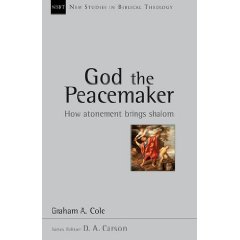 #5 God the Peacemaker: How Atonement Brings Shalom (New Studies in Biblical Theology), by Graham Cole, published by InterVarsity Press. What does God intend for his broken creation? In this book Graham A. Cole seeks to answer this question by setting the atoning work of the cross in the broad framework of God’s grand plan to restore the created order, and places the story of Jesus, his cross and empty tomb within it. Since we have become paradoxically the glory and garbage of the universe, our great need is peace with God and not just with God, but also with one another. Atonement brings shalom by defeating the enemies of peace, overcoming both the barriers to reconciliation and to the restoration of creation through the sacrifice of Christ. The “peace dividend” that atonement brings ranges from the forgiveness of sins for the individual to adoption into the family of God.
 #4 An Exposition of the Apostles’ Creed, by Casper Olevianus, Published by Reformation Heritage Books. Olevianus’s Exposition of the Apostles’ Creed is a collection of sermons he preached on the basic articles of the Christian faith. It serves as a reminder that the Reformed tradition did not see itself as separate from the universal church, though it was principally opposed to Rome. Rather, Olevianus and his tradition argue for a Reformed catholicity rooted in the ancient confession of the church. This new translation by Lyle D. Bierma, along with R. Scott Clark’s historical introduction, will benefit both scholarly and general readers. Charged with federal language, An Exposition explains the Christian faith as the believer’s fellowship with God in the covenant of grace. Thus, it is significant for its contribution to the development of Reformed covenantal theology. In addition to exhibiting its historical value within the Reformed tradition, readers will be “directed,” as Olevianus had intended, “toward edification in true and sound piety.”
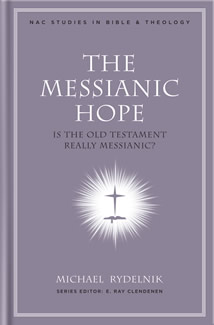 #3 The Messianic Hope: Is the Old Testament Really Messianic?, by Michael Rydelnik, published by B&H Publishing. In The Messianic Hope, book eight of the New American Commentary Studies in Bible & Theology series, Jewish Studies professor Michael Rydelnik puts forth a thesis that the Old Testament was intended by its authors to be read as a messianic primer. He explains at length how the text reveals significant direct messianic prophecy when read in its final form. Users will find this topical study an excellent extension of the long-respected New American Commentary series.
 #2 Evangelicalism: What Is It and Is It Worth Keeping?, by D. A. Carson, published by Crossway. What defines today’s evangelicals? Are they people who fit an empirical, social-science profile? Have historical roots in the Reformation? Hold to certain theological priorities or fall within particular parameters? Is the term evangelical even useful anymore? D. A. Carson responds to all of these questions and more in Evangelicalism. Carson defines and upacks the term, advocating a biblical/theological foundation that is built on the description of the gospel found in 1 Corinthians 15. First establishing that evangelicalism is Christological, biblical, historical, theological, apostolic, heraldic, and personal, he proceeds to demonstrate its continuing relevance and our need for its scripturally defined boundaries. Carson then critiques Mark Noll’s book Is the Reformation Over? and draws examples from Catholic doctrine, Christian experience, and modern scholarship to illustrate that the issues at stake in the Reformation are not settled. Carson’s book will be welcomed by readers concerned about the future of evangelicalism and thinking about evangelicalism’s place in today’s religious forums.
#1 Set to release February 18th of 2010, Welcome to a Reformed Church, by Rev. Daniel Hyde, published by my ever favorite publisher, Reformation Trust. “Who are these guys?” That was the question the teenage Daniel R. Hyde posed to his father when he first encountered “Reformed” believers. With their unique beliefs and practices, these Christians didn’t fit any of the categories in his mind. Not so many years later, Hyde is now Rev. Daniel R. Hyde, a pastor of a Reformed church. Recognizing that many are on the outside looking in, just as he once was, he wrote Welcome to a Reformed Church: A Guide for Pilgrims to explain what Reformed churches believe and why they structure their life and worship as they do. In layman’s terms, Rev. Hyde sketches the historical roots of the Reformed churches, their scriptural and confessional basis, their key beliefs, and the ways in which those beliefs are put into practice. The result is a roadmap for those encountering the Reformed world for the first time and a primer for those who want to know more about their Reformed heritage.
Why is this #1? Simply, because today’s evangelicalism NEEDS to know what really is Reformed? What is the Reformed Confessional Faith? What is a Reformed Church? NOT New Reformed/Calvinism! I know Danny Hyde as my seminary brother at Puritan Reformed Theological Seminary, and I am ever looking forward to being able to give this book to those that think they are “Reformed”.
Looking to get into Biblical Theology? Read the following…
Posted: December 15, 2009 Filed under: Biblical Theology Leave a commentBartholomew, Craig. “Babel and Derrida: the Challenge of Postmodernism for Biblical Interpretation. TynB 49.2 (1998): 305-28.
Bartholomew, Craig. “Reading the Old Testament in Postmodern Times.” TynB 49.1 (1998): 91-114.
Goldingay, Old Testament Theology, I: Israel’s Gospel (Downers Grove, Ill.: InterVarsity, 2003).
Green, Joel B. “Afterword: Rethinking History (and Theology).” Pages 237-42 in Between Two Horizons: Spanning New Testament Studies and Systematic Theology. Edited by Joel B. Green and Max Turner. Grand Rapids: Eerdmans, 2000.
Greenspahn, Frederick E. (ed.). The Hebrew Bible: New Insights and Scholarship. Jewish Studies in the Twenty-First Century. New York: NYU Press, 2007.
Harrisville, Roy A., and Walter Sundberg. The Bible in Modern Culture: Baruch Spinoza to Brevard Childs. 2d ed. Grand Rapids: Eerdmans, 2002.
Hayes, J. H., and F. Preussner. Old Testament Theology: Its History and Development. Atlanta: John Knox, 1985.
Helmer, Christine. “Biblical Theology: Bridge Over Many Waters.” Currents in Biblical Research 3 (2005) 169-96.
Knight, G. A. F. A Christian Theology of the Old Testament. London: SCM, 1958; reprint Carlisle, Cumbria: Paternoster, 1998.
Linnemann, Eta. Biblical Criticism on Trial. Translated by R. Yarbrough. Grand Rapids: Kregel Academic and Professional, 2001.
Linnemann, Eta. Historical Criticism of the Bible: Methodology or Ideology. Translated by R. Yarbrough. Grand Rapids: Kregel Academic and Professional, 2001.
Maier, G. The End of the Historical-Critical Method. Translated by Edwin W. Leverenz and Rudolf F. Norden. St. Louis: Concordia, 1977.
Moberly, R. W. L. From Eden to Golgotha: Essays in Biblical Theology. Atlanta: Scholars, 1992.
Perdue, Leo G. The Collapse of History: Reconstructing Old Testament Theology. Overtures to Biblical Theology. Minneapolis: Fortress, 1994.
Rendtorff, Rolf. The Canonical Hebrew Bible: A Theology of the Old Testament. Tools for Biblical Study 7. Leiderdorp, The Netherlands: Deo, 2005.
Reventlow, H. Graf, “Theologie und Hermeneutik des Altentestaments,” TRu 61.1-2 (1996): 48-102, 123-76.
Reventlow, Problems of Biblical Theology in the Twentieth Century (Philadelphia: Fortress, 1986).
Schreiner, J. Theologie des Alten Testaments. NEchtB ; Ergänzungsband zum Alten Testament, I ; Würzburg : Echter, 1995.
Watson, Text and Truth: Redefining Biblical Theology. Grand Rapids: Eerdmans, 1997.
My Top 2009 Reads
Posted: December 15, 2009 Filed under: My Top 2009 Reads 1 Comment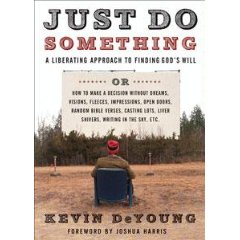 #10 Just Do Something: How to Make a Decision Without Dreams, Visions, Fleeces, Open Doors, Random Bible Verses, Casting Lots, Liver Shivers, Writing in the Sky, etc., by Kevin DeYoung, published by Moody Publishing. Hyper-spiritual approaches to finding God’s will don’t work. It’s time to try something new: Give up. Pastor and author Kevin DeYoung counsels Christians to settle down, make choices, and do the hard work of seeing those choices through. Too often, he writes, God’s people tinker around with churches, jobs, and relationships, worrying that they haven’t found God’s perfect will for their lives. Or—even worse—they do absolutely nothing, stuck in a frustrated state of paralyzed indecision, waiting . . . waiting . . . waiting for clear, direct, unmistakable direction. But God doesn’t need to tell us what to do at each fork in the road. He’s already revealed his plan for our lives: to love him with our whole hearts, to obey His Word, and after that, to do what we like. No need for hocus-pocus. No reason to be directionally challenged. Just do something.
 #9 In the Beginning Was the Word: Language–A God-Centered Approach, by Vern Sheridan Poythress, published by Crossway. With scriptural teaching and broad-ranging application, this follow-up to Redeeming Science builds a Christian theology of language and reforms our thinking about words. Language is not only the centerpiece of our everyday lives, but it gives significance to all that we do. It also reflects and reveals our all-sustaining Creator, whose providential governance extends to the intricacies of language.
 #8 The Righteous Shall Live by Faith: Romans, by R.C. Sproul, Published by Crossway. How exciting! Thousands of us have long been indebted to Sproul the teacher, and now, through the St. Andrew’s Expositional Commentary series, we are indebted to Sproul the preacher, whose sermons are thoroughly biblical, sound doctrinal, warmly practical, and wonderfully readable. This series of volumes is an absolute must for every Reformed preacher and church member who yearns to grow in the grace and knowledge of Christ Jesus. Tolle lege, and buy these volumes for your friends.
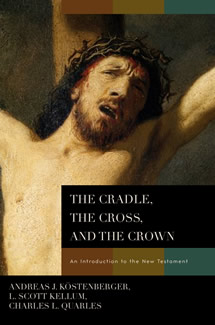 #7 The Cradle, the Cross, and the Crown: An Introduction to the New Testament, by Andreas J. Köstenberger, L. Scott Kellum, Charles L. Quarles, published by B&H Publishing. Although Scripture cannot be reduced to a mere piece of human writing, there is much to gain by paying careful attention to the historical, literary, and theological dimensions of the biblical text. For this reason, The Cradle, the Cross, and the Crown is offered to the serious New Testament student who seeks to better understand and share God’s “word of truth” (2 Timothy 2:15). Across nearly one thousand pages, it thoroughly introduces all twenty-seven New Testament books and closely examines Christ’s incarnation and virgin birth, the heart of His ministry shown so vividly in the Gospels’ Passion Narratives, and the triumphant return of Jesus and our eternal reign with Him as depicted in Revelation.
 #6 Gospel-Driven Life, The: Being Good News People in a Bad News World by Michael Horton, published by Baker Book House. In his well-received Christless Christianity Michael Horton offered a prophetic wake-up call for a self-centered American church. With The Gospel-Driven Life he turns from the crisis to the solutions, offering his recommendations for a new reformation in the faith, practice, and witness of contemporary Christianity. This insightful book will guide readers in reorienting their faith and the church’s purpose toward the good news of the gospel. The first six chapters explore that breaking news from heaven, while the rest of the book focuses on the kind of community that the gospel generates and the surprising ways in which God is at work in the world. Here is fresh news for Christians who are burned out on hype and are looking for hope.
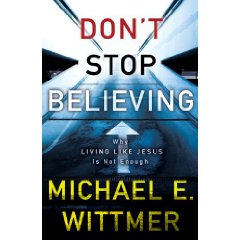 #5 Don’t Stop Believing: Why Living Like Jesus Is Not Enough, by Michael Wittmer, publishing by Zondervan. Evangelicals who reject the narrow fundamentalism of previous generations are in danger of over-correction. Don’t Stop Believing is an urgent call for both right practice and right belief. Our concern for social issues must not diminish the core doctrines of our faith. We must not stop believing.
 #4 The End of the Law: Mosaic Covenant in Pauline Theology, by Jason Meyer, published by B&H Publishing. Commonly understood as the first theologian of the Christian faith, Paul set forth the categories by which we describe our relationship with Christ. Did he understand the new covenant Jesus announced at the Last Supper primarily as a replacement of the old Mosaic covenant God made with Israel, or as a renewal and completion of the old? Jason Meyer surveys the various differences that have been argued between the two covenants in The End of the Law, carefully and inductively performing a semantic, grammatical, and contextual analysis of all the Pauline texts dealing with covenant concepts.
 #3 Baptism in the Early Church: History, Theology, and Liturgy in the First Five Centuries, by Everett Ferguson, published by Eerdmans. Everett Ferguson’s work here is a compendium of almost everything that is currently known about the Christian ritual of baptism, with extensive citations to the primary and secondary literature, and as such is destined to be an extremely valuable reference work.
 #2 Our Secure Salvation: Preservation and Apostasy, by Robert A. Peterson, published by P&R Publishing. Can believers lose their faith? Robert Peterson addresses an age-old question crucial to an insecure modern world. Tracing preservation and apostasy throughout the Bible, he illustrates how God saves and keeps his people, giving them confidence to live for his glory.
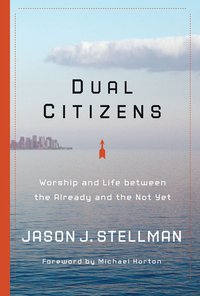 #1 Dual Citizens: Worship and Life Between the Already and the Not Yet, by Jason Stellman, publishing Reformation Trust. New covenant believers live between “the already” and “not yet,” a point in redemptive history between the partial and complete fulfillment of God’s promises. This means they are exiles and pilgrims in the divinely ordained overlap of the ages. As Rev. Jason J. Stellman argues in his book Dual Citizens: Worship and Life Between the Already and the Not Yet, this biblical motif shapes the identity of Christians at every turn and affects their every activity in both the sacred and secular realms. Stellman explores the Christian pilgrimage with deep biblical insight, humor, and relevance to our contemporary context, revealing how Christians are to think of themselves and their role this side of heaven.
***Honorable Mentions:
- Tim Keller: Counterfeit Gods
- J. V. Fesko: The Rule of Love
- Robert Letham: The Westminster Assembly, Reading Its Theology in Historical Context
- John Colquhoun, A Treatise on the Law and Gospel
- Who Made God? by Edgar Andrews
- Warren Cole Smith: A Lover’s Quarrel with the Evangelical Church
- Four Views on Moving beyond the Bible to Theology ~ Gary T. Meadors (Editor), Stanley N. Gundry (Series Editor), Walter C. Kaiser Jr., Daniel M. Doriani, Kevin J. Vanhoozer, William J. Webb, Mark L. Strauss, Al Wolters, Christopher J. H. Wright
My Favorite Books Published on Calvin in 2009
Posted: December 14, 2009 Filed under: Just for Fun Leave a comment #5 The Calvin Handbook, by Herman J. Selderhuis, published by Eerdmans. Research on French theologian John Calvin is flourishing around the world today, and Calvin’s quincentennial this year has lent such research even greater momentum. The Calvin Handbook is designed to support and stimulate this research. An international team of renowned scholars here offers a comprehensive view of Calvin’s biography, his theology, and the history of his reception. The Calvin Handbook is a uniquely helpful resource on Calvin for readers of every interest level.
 #4 Friends of Calvin, by Machiel A. van den Berg, Reinder Bruinsma (translator), published by Eerdmans. In two dozen short biographies of John Calvin’s friends — including some who turned into enemies — Machiel A. van den Berg paints an intimate portrait of the great Reformer’s life and circle that most of us have never seen. In these pages we accompany Calvin from his early boyhood in Noyon to his student days in Paris and Orleans, to his pastorate in and exile from Geneva, all the way to his deathbed. We meet his famous Reformer friends, such as Martin Bucer, William Farel, Heinrich Bullinger, Theodore Beza, and John Knox, but also friends whose names are more obscure: his cousin Pierre Robert Olivétan, the first translator of the Bible into French; René de France of French royalty; Laurent de Normandie, the mayor of Noyon who later escaped to Geneva; Pierre Viret, his “best friend of all”; and Idelette van Buren, his beloved wife during their brief but “blissful” marriage.
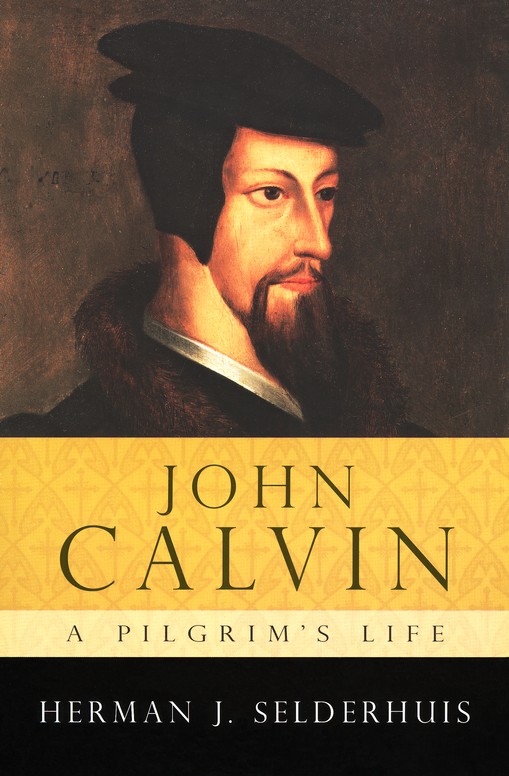 #3 John Calvin: A Pilgrim’s Life, by Herman J. Selderhuis, published by InterVarsity Press. Selderhuis draws on Calvin’s own publications and commentary on the biblical figures with whom he strongly identified to describe his theology in the context of his personal development. Throughout we see a person who found himself alone at many of the decisive moments of his life–a fact that echoed through Calvin’s subsequent sermons and commentaries. Selderhuis’s unique and compelling look at John Calvin, with all of his merits and foibles, ultimately discloses a man who could not find himself at home in the world in which he lived.
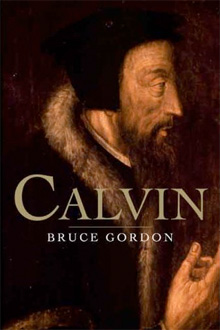 #2 Calvin, by Bruce Gordon, Published by Yale Press. During the glory days of the French Renaissance, young John Calvin (1509-64) experienced a profound conversion to the faith of the Reformation. For the rest of his days he lived out the implications of that transformation-as exile, inspired reformer and ultimately the dominant figure of the Protestant Reformation. Calvin’s vision of the Christian religion has inspired many volumes of analysis, but this engaging biography examines a remarkable life. Bruce Gordon presents Calvin as a human being, a man at once brilliant, arrogant, charismatic, unforgiving, generous and shrewd.
 #1 John Calvin: Pilgrim and Pastor, by W. Robert Godfrey, published by Crossway. An introduction to the essential life and thought of one of history’s most influential theologians, who considered himself first and foremost a pilgrim and a pastor.
July 10, 2009, marks the five-hundredth anniversary of the birth of John Calvin. As controversial as he was influential, his critics have named a judgmental and joyless attitude after him, while his admirers celebrate him as the principal theologian of Reformed Christianity. Yet his impact is unmistakable-a primary developer of western civilization whose life and work have deeply affected five centuries’ worth of pastors, scholars, and individuals. What will surprise the readers of this book, however, is that Calvin did not live primarily to influence future generations. Rather, he considered himself first and foremost a spiritual pilgrim and a minister of the Word in the church of his day. It was from that “essential” Calvin that all his influence flowed. Here is an introduction to Calvin’s life and thought and essence: a man who moved people not through the power of personality but through passion for the Word, a man who sought to serve the gospel in the most humble of roles.
Honorable Mention: Institutes of the Christian Religion: The First English Version of the 1541 French Edition, by John Calvin, Elsie Anne McKee (translator), and anything in the “Calvin500 Series” (8 Volume set) by P&R Publishing.
A Divorce Bibliography
Posted: December 12, 2009 Filed under: bibliography on Divorce, Divorce Leave a commentSome people had seen my Twitter and Facebook updates during the month of November when I was writing a paper on Divorce for an Ethics class. They had asked me what I was studying, where I was looking and what was my take on the subject of divorce. I spent about a week after writing the paper researching for the best resources on the topic of Divorce, and what would be best for those that wanted to study the topic. You can read my bibliography here.
Are You SAD?
Posted: December 11, 2009 Filed under: David Murray 1 CommentAfter waiting nearly two months for another post, David Murray finally gets back to vloggin’.
Is Divorce Okay?
Posted: December 11, 2009 Filed under: Divorce Leave a commentIs it really? I’m still not exactly sure… but this is what I wrote. You can read my paper for New Testament Ethics here.
New Covenant Presbyterian Church
Posted: December 10, 2009 Filed under: Nicholas T. Batzig Leave a commentWho is New Covenant Presbyterian Church?
LIGONIER’s New Site!
Posted: December 10, 2009 Filed under: Ligonier Leave a commentThey released their new site here!
God Harden Israel Himself to Send Forth the Gospel to You
Posted: December 10, 2009 Filed under: Romans 11 Leave a commentThe Apostasy of Israel and the Mission to the Gentiles. Many at times have no idea in how God bought forth redemption to the Gentiles. However Romans 11 shows the beauty of the Gospel in that God harden His own nation of Israel so that the Gentiles may know, see, hear, taste and partake in the Gospel – that they might become apart of Israel as well.
Romans 9:6-13 states,
“But it is not as though the word of God has failed. For not all who are descended from Israel belong to Israel, and not all are children of Abraham because they are his offspring, but “Through Isaac shall your offspring be named.” This means that it is not the children of the flesh who are the children of God, but the children of the promise are counted as offspring. For this is what the promise said: “About this time next year I will return, and Sarah shall have a son.” And not only so, but also when Rebekah had conceived children by one man, our forefather Isaac, though they were not yet born and had done nothing either good or bad—in order that God’s purpose of election might continue, not because of works but because of him who calls— she was told, “The older will serve the younger.” As it is written, “Jacob I loved, but Esau I hated.”
You can read my paper that I wrote for Missions in the Old and New Testaments at PRTS here.
Dr. Joel Beeke Gives His Top Reads of 2009
Posted: December 9, 2009 Filed under: Uncategorized Leave a comment #10 A Treatise on the Law and Gospel, by John Colquhoun, published by Soli Deo Gloria a Division of Reformation Heritage Books. In this book, Colquhoun helps us understand the precise relationship between law and gospel. He also impresses us with the importance of knowing this relationship. Colquhoun especially excels in showing how important the law is as a believer’s rule of life without doing injury to the freeness and fullness of the gospel. By implication, he enables us to draw four practical conclusions: 1) the law shows us how to live, 2) the law as a rule of life combats both antinomianism and legalism, 3) the law shows us how to love, and 4) the law promotes true freedom.
 #9 Princeton Sermons, by The Princeton Faculty, published by Solid Ground Christian Books. This rare volume contains sixteen powerful sermons preached in the chapel at Princeton Theological Seminary during the academic year of 1891-92. One needs only to read these addresses to understand why Princeton had a worldwide influence for the Gospel of Christ during these years. This volume was especially prized because of two of the beloved professors, Caspar W. Hodge and Charles A. Aiken, were removed by death in the midst of that academic year.
 #8 Wise Counsel: John Newton’s Letters to John Ryland, Jr., by Grant Gordon, published by The Banner of Truth Trust. John Newton (1725-
1807) has rightly been called ‘the letter-writer par excellence of the Evangelical Revival’. Newton himself seems to have come to the conclusion, albeit reluctantly, that letter-writing was his greatest gift. In a letter to a friend he confessed, ‘I rather reckoned upon doing more good by some of my other works than by my ‘Letters’, which I wrote without study, or any public design; but the Lord said, ‘You shall be most useful by them,’ and I learned to say, ‘Thy will be done! Use me as Thou pleasest, only make me useful.’ Indeed, he wrote to his close friend William Bull that if the letters were ‘owned to comfort the afflicted, to quicken the careless, to confirm the wavering, I may rejoice in the honour He has done me’, and not envy the greatest writers of the age.
 #7 The Fading of The Flesh and the Flourishing of Faith, by George Swinnock, published by Reformation Heritage Books. Interest in the Puritans continues to grow, but many people find the reading these giants of the faith a bit unnerving. This series seeks to overcome that barrier by presenting Puritan books that are convenient in size and unintimidating in length. Each book is carefully edited with modern readers in mind, smoothing out difficult language of a bygone era while retaining the meaning of the original authors. Books for the series are thoughtfully selected to provide some of the best counsel on important subjects that people continue to wrestle with today. What will satisfy you when your flesh and heart fail?
 #6 The Westminster Assembly: Reading its Theology in Historical Context, by Robert Letham, published by P&R Publishing. Drawing on new primary source material, it considers the Assembly’s theology in terms of the unfolding development of doctrine in the Reformed churches, in connection with the preceding and current events in English history, and locates it in relation to the catholic tradition of the western church. The book asks exactly what the divines meant at each stage of their task. At a time when claims are made that particular theologies represent historic Reformed doctrine, it is particularly important to grasp what this actually is.
 #5 Concise Reformed Dogmatics, by J. van Genderen and W.H. Velema, published by P&R Publishing. A full treatment of Reformed systematic theology that is accessible to church officers and interested lay readers, as well as teachers and students of theology. Formatted in two visually distinct levels of discussion for use as an introduction or for more in-depth study. The appearance of this work in English is most welcome. Written from a confessionally Reformed perspective, with a special affinity for the work of Calvin and Herman Bavinck, it is alert to contemporary issues and problems without obscuring its primary concern to show the biblical basis of doctrines. Without sacrificing depth, it succeeds admirably with the wider circle of readers it has in view—other theologically interested persons as well as pastors, and teachers and students of theology
 #4 Calvin, by Bruce Gordon, Published by Yale Press. During the glory days of the French Renaissance, young John Calvin (1509-64) experienced a profound conversion to the faith of the Reformation. For the rest of his days he lived out the implications of that transformation-as exile, inspired reformer and ultimately the dominant figure of the Protestant Reformation. Calvin’s vision of the Christian religion has inspired many volumes of analysis, but this engaging biography examines a remarkable life. Bruce Gordon presents Calvin as a human being, a man at once brilliant, arrogant, charismatic, unforgiving, generous and shrewd.
 #3 The Righteous Shall Live by Faith: Romans, by R.C. Sproul, Published by Crossway. How exciting! Thousands of us have long been indebted to Sproul the teacher, and now, through the St. Andrew’s Expositional Commentary series, we are indebted to Sproul the preacher, whose sermons are thoroughly biblical, sound doctrinal, warmly practical, and wonderfully readable. This series of volumes is an absolute must for every Reformed preacher and church member who yearns to grow in the grace and knowledge of Christ Jesus. Tolle lege, and buy these volumes for your friends.
 #2 The Calvin Handbook, by Herman J. Selderhuis, Published by Eerdmans. Research on French theologian John Calvin is flourishing around the world today, and Calvin’s quincentennial this year has lent such research even greater momentum. The Calvin Handbook is designed to support and stimulate this research. An international team of renowned scholars here offers a comprehensive view of Calvin’s biography, his theology, and the history of his reception. The Calvin Handbook is a uniquely helpful resource on Calvin for readers of every interest level.
 #1 The Happiness of Heaven, by Maurice Roberts, published by Reformation Heritage Books. While belief in heaven is essential to the Christian faith, the fact that pilgrim believers have not yet experienced heaven leaves us with many questions about what it will be like. In The Happiness of Heaven, Maurice Roberts surveys Holy Scripture to tell us what heaven is all about. In his characteristic style, Roberts discusses the biblical data clearly and relevantly, making soul-searching application at every turn. This is not just a book of interesting facts about what heaven is like; it is an appeal to men and women to find their happiness in the eternal comfort of God in Christ.
In Dr. Beeke’s own words,
“I have seldom heard a minister preach with more relish, glow, and frequency about heaven than Rev. Maurice Roberts. In The Happiness of Heaven, Roberts shows that same giftedness in writing about the glorious state of eternal bliss. He writes with warmth, conviction, and longing, while not fearing to address biblically the difficult questions in masterful chapters such as ‘Children and Heaven’ and ‘The Dark Side of Heaven.’ This is one of the author’s best books yet. If you’re a believer, it will move you deeply and make you more homesick. Read it repeatedly to lift your soul up above the sin and mundane trivialities of this world and to set your affections on the Triune God and things above.”
Wanna Get to know Walther Eichrodt? Reading the Following
Posted: December 8, 2009 Filed under: Biblical Theology Leave a commentEichrodt, Walther. Ezekiel: A Commentary, trans. Cosslett Quinn, Old Testament Library Philadelphia: Westminster Press, 1970.
___________. Man in the Old Testament, Studies in Biblical Theology 4, trans. K. and R. Gregor Smith. Chicago: Henry Regnery, 1951.
___________. The Flowering of Old Testament Theology. “Covenant” SBTS 1. 1st ed. Winona Lake: Eisenbrauns, 1992, pp. 30-42.
___________. The Flowering of Old Testament Theology. “Does Old Testament Theology Still Have Independent Significance within Old Testament Scholarship?” SBTS 1. 1st ed. Winona Lake: Eisenbrauns, 1992 pp. 43-57.
___________. Theology of the Old Testament, 5th rev. ed., 2 vols., trans. J. A. Baker Philadelphia: Westminster Press, 1961-7; trans. of Theologie des Alten Testaments, 3 vols. Leipzig: Hinrichs, 1933-1939.
Spriggs, D. G. Two Old Testament Theologies: A Comparative Evaluation of the Contributions of Eichrodt and von Rad to our Understanding of the Nature of Old Testament Theology. Naperville, IL: Alec R. Allenson, 1974.
Read his bio. here.
The Manhattan Declaration: Why didn’t you sign it, R.C.?
Posted: December 8, 2009 Filed under: R.C. Sproul Leave a commentR.C. Sproul writes on The Manhattan Declaration,
“The Manhattan Declaration confuses common grace and special grace by combining them. While I would march with the bishop of Rome and an Orthodox prelate to resist the slaughter of innocents in the womb, I could never ground that cobelligerency on the assumption that we share a common faith and a unified understanding of the gospel.”
Read the rest here.
Pink on 1 John 2:2, “but also for the sins of the whole world”
Posted: December 8, 2009 Filed under: Calvinism 1 CommentPink writes,
THERE is one passage more than any other which is I appealed to by those who believe in universal redemption, and which at first sight appears to teach that Christ died for the whole human race. We have therefore decided to give it a detailed examination and exposition.
“And He is the propitiation for our sins: and not for ours only, but also for the sins of the whole world” (1 John 2:2). This is the passage which, apparently, most favors the Arminian view of the Atonement, yet if it be considered attentively it will be seen that it does so only in appearance, and not in reality. Below we offer a number of conclusive proofs to show that this verse does not teach that Christ has propitiated God on behalf of all the sins of all men.
In the first place, the fact that this verse opens with “and” necessarily links it with what has gone before. We, therefore, give a literal word for word translation of I John 2 :1 from Bagster’s Interlinear: “Little children my, these things I write to you, that ye may not sin; and if any one should sin, a Paraclete we have with the Father, Jesus Christ (the) righteous”. It will thus be seen that the apostle John is here writing to and about the saints of God. His immediate purpose was two-fold: first, to communicate a message that would keep God’s children from sinning; second, to supply comfort and assurance to those who might sin, and, in consequence, be cast down and fearful that the issue would prove fatal. He, therefore, makes known to them the provision which God has made for just such an emergency. This we find at the end of verse 1 and throughout verse 2. The ground of comfort is twofold: let the downcast and repentant believer (1 John 1:9) be assured that, first, he has an “Advocate with the Father“; second, that this Advocate is “the propitiation for our sins” Now believers only may take comfort from this, for they alone have an “Advocate“, for them alone is Christ the propitiation, as is proven by linking the Propitiation (“and”) with “the Advocate”!
In the second place, if other passages in the New Testament which speak of “propitiation,” he compared with 1 John 2:2, it will be found that it is strictly limited in its scope. For example, in Romans 3 :25 we read that God set forth Christ “a propitiation through faith in His blood“. If Christ is a propitiation “through faith”, then He is not a “propitiation” to those who have no faith! Again, in Hebrews 2:17 we read, “To make propitiation for the sins of the people.” (Heb. 2:17, R. V.)
In the third place, who are meant when John says, “He is the propitiation for our sins“? We answer, Jewish believers. And a part of the proof on which we base this assertion we now submit to the careful attention of the reader.
In Galatians 2:9 we are told that John, together with James and Cephas, were apostles “unto the circumcision” (i.e. Israel). In keeping with this, the Epistle of James is addressed to “the twelve tribes, which are scattered abroad” (1:1). So, the first Epistle of Peter is addressed to “the elect who are sojourners of the Dispersion” (1 Pet. 1:1, R. V.). And John also is writing to saved Israelites, but for saved Jews and saved Gentiles.
Some of the evidences that John is writing to saved Jews are as follows. (a) In the opening verse he says of Christ, “Which we have seen with our eyes . . . . and our hands have handled“. How impossible it would have been for the Apostle Paul to have commenced any of his epistles to Gentile saints with such language!
(b) “Brethren, I write no new commandment unto you, but an old commandment which ye had from the beginning” (1 John 2:7). The “beginning” here referred to is the beginning of the public manifestation of Christ-in proof compare 1:1 ; 2:13, etc. Now these believers the apostle tells us, had the “old commandment” from the beginning. This was true of Jewish believers, but it was not true of Gentile believers.
(c) “I write unto you, fathers, because ye have known Him from the beginning” (2:13). Here, again, it is evident that it is Jewish believers that are in view.
(d) “Little children, it is the last time: and as ye have heard that Antichrist shall come, even now are there many antichrists; whereby we know that it is the last time. They went out from us, but they were not of us” (2:18, 19).
These brethren to whom John wrote had “heard” from Christ Himself that Antichrist should come (see Matthew 24). The “many antichrists” whom John declares “went out from us” were all Jews, for during the first century none but a Jew posed as the Messiah. Therefore, when John says “He is the propitiation for our sins” he can only mean for the sins of Jewish believers.*
In the fourth place, when John added, “And not for ours only, but also for the whole world”, he signified that Christ was the propitiation for the sins of Gentile believers too, for, as previously shown, “the world” is a term contrasted from Israel. This interpretation is unequivocally established by a careful comparison of 1 John 2:2 with John 11:51, 52, which is a strictly parallel passage: “And this spake he not of himself: but being high priest that year, he prophesied that Jesus should die for that nation; And not for that nation only, but that also He should gather together in one the children of God that were scattered abroad“. Here Caiaphas, under inspiration, made known for whom Jesus should “die“. Notice now the correspondency of his prophecy with this declaration of John’s:
“He is the propitiation for our (believing Israelites) sins.“
“He prophesied that Jesus should die for that nation.“
“And not for ours only.” “And not for that nation only.“
“But also for the whole world“-That is, Gentile believers scattered throughout the earth.
“He should gather together in one the children of God that were scattered abroad.“
In the fifth place, the above interpretation is confirmed by the fact that no other is consistent or intelligible. If the “whole world” signifies the whole human race, then the first clause and the “also” in the second clause are absolutely meaningless. If Christ is the propitiation for every-body, it would be idle tautology to say, first, “He is the propitiation for our sins and also for everybody“. There could be no “also” if He is the propitiation for the entire human family. Had the apostle meant to affirm that Christ is a universal propitiation he had omitted the first clause of verse 2, and simply said, “He is the propitiation for the sins of the whole world.” Confirmatory of “not for ours (Jewish believers) only, but also for the whole world“-Gentile believers, too; compare John 10:16; 17:20.
In the sixth place, our definition of “the whole world” is in perfect accord with other passages in the New Testament. For example: “Whereof ye heard before in the word of the truth of the Gospel; which is come unto you, as it is in all the world” (Col. 1:5,6). Does “all the world” here mean, absolutely and unqualifiedly, all mankind? Had all the human family heard the Gospel? No; the apostle’s obvious meaning is that, the Gospel, instead of being confined to the land of Judea, had gone abroad, without restraint, into Gentile lands. So in Romans 1:8: “First, I thank my God through Jesus Christ for you all, that your faith is spoken of throughout the whole world”. The apostle is here referring to the faith of these Roman saints being spoken of in a way of commendation. But certainly all mankind did not so speak of their faith! It was the whole world of believers that he was referring to! In Revelation 12:9 we read of Satan “which deceiveth the whole world”. But again this expression cannot be understood as a universal one, for Matthew 24 :24 tells us that Satan does not and cannot “deceive” God’s elect. Here it is “the whole world” of unbelievers.
In the seventh place, to insist that “the whole world” in 1 John 2:2 signifies the entire human race is to undermine the very foundations of our faith. If Christ is the propitiation for those that are lost equally as much as for those that are saved, then what assurance have we that believers too may not be lost? If Christ is the propitiation for those now in hell, what guarantee have I that I may not end in hell? The blood-shedding of the incarnate Son of God is the only thing which can keep any one out of hell, and if many for whom that precious blood made propitiation are now in the awful place of the damned, then may not that blood prove inefficacious for me! Away with such a God-dishonoring thought.
However men may quibble and wrest the Scriptures, one thing is certain: The Atonement is no failure. God will not allow that precious and costly sacrifice to fail in accomplishing, completely, that which it was designed to effect. Not a drop of that holy blood was shed in vain. In the last great Day there shall stand forth no disappointed and defeated Saviour, but One who “shall see of the travail of His soul and be satisfied” (Isa. 53:11). These are not our words, but the infallible assertion of Him who declares, “My counsel shall stand, and I will do all My pleasure” (Isa. 64:10). Upon this impregnable rock we take our stand. Let others rest on the sands of human speculation and twentieth-century theorizing if they wish. That is their business. But to God they will yet have to render an account. For our part we had rather be railed at as a narrow-minded, out-of-date, hyper-Calvinist, than be found repudiating God’s truth by reducing the Divinely-efficacious atonement to a mere fiction.
* It is true that many things in John’s Epistle apply equally to believing Jews and believing Gentiles. Christ is the Advocate of the one, as much as of the other. The same may be said of many things in the Epistle of James which is also a catholic, or general epistle, though expressly addressed to the twelve tribes scattered abroad.”
Sola Scriptura: The Protestant Position on the Bible
Posted: December 7, 2009 Filed under: Reformation Trust 1 Comment Sola Scriptura, the formal principle of the Protestant Reformation, is essential to genuine Christianity, for it declares that the Bible is the inspired word of God, the church’s only rule of faith and practice. Yet this doctrine is under assault today as never before, both from outside and and inside the church.
In this book, several leading Reformed pastors and scholars, including Joel Beeke, Sinclair Ferguson, Robert Godfrey, Ray Lanning, John MacArthur, R.C. Sproul, Derek W. H. Thomas, and James White, unpack the meaning of the doctrine of sola Scriptura (“Scripture alone”). They also explain where the attacks on the Bible are coming from and show how those who accept the Bible as God’s inspired Word should respond. Sola Scriptura: The Protestant Position on the Bible is a treasure trove of information and a comfort to those who grieve to see the twenty-first-century church wandering away from the safe harbor of the Bible.
Christ did not lay down His life to atone for the sins of all of mankind!
Posted: December 1, 2009 Filed under: Westminster Confession of Faith 4 Comments8:7 Christ, in the work of mediation, acts according to both natures, by each nature doing that which is proper to itself;[37] yet, by reason of the unity of the person, that which is proper to one nature is sometimes in Scripture attributed to the person denominated by the other nature.[38]
Thoughts: Christ did not lay down His life to atone for the sins of all of mankind, nor for an indefinite number of saints. His sacrifice was indeed sufficient to save the whole world, had it been designed to do so; but in the purpose of God and in the undertaking of Christ, it was determined that He should make atonement for those who were elected in Him to everlasting life; these only He represented, and these only shall be saved through His redemption. This truth is commonly called limited atonement or what seems to be a better term in my book, particular redemption.

 Gospel-Centered Musings