John Owen on Apostasy – Part Nine
Posted: February 13, 2009 Filed under: John Owen on Apostasy Leave a commentVIII. Apostasy from the Holiness of the Gospel; The Occasion and Cause of It- Of that which is gradual, on the pretence of somewhat else in its room
Theses:
“There is… a falling away from the gospel with respect unto the holiness of its precepts, which are to be the matter, as they are the rule, of our obedience… yea, an apostasy from the holiness of the gospel is, on many accounts, more dreadful and dangerous than a partial apostasy from its truth; for as it is more spreading and catholic than that is, and of less observation or esteem, so it is usually more irrecoverable, most men under it being greatly hardened through the deceitfulness of sin.”[1]
Summary:
In chapter eight Owen deals with how man does not follow the commands that the gospel makes clear, which then results in apostasy. In several sections, Owen begins the chapter with explaining the dangers that lie in apostasy when one leaves the gospel. He makes his case with showing, first, how the gospel calls one to live a life of holiness, and secondly, how living a life of holiness is a requirement of the gospel. Owen then discusses several topics: the forms in which apostasy can occur, different areas of the Roman Catholic Church, issues in human morality, and how man tries to make himself perfect in order to live for the gospel, but falls without the Spirit of truth of the gospel. He uses these points to show the way that man lives in order to tell themselves that they are in right standing with the gospel, and yet fall short of what it requires. That is why once again Owen ends with gospel- gleaming truths that bring the believer to read the importance of the gospel and what it requires in the heart and in the life of ones who claims to know it. To finish, Owen brings forth three areas that are required by the one who confesses to believe in the gospel of Jesus Christ:
1. The gospel requires maintaining a life of holiness in the world.
2. The gospel requires maintaining a continual life that lives out holiness.
3. The gospel requires maintaining a life that fights for holiness in the world.[2]
Outline:
I. Apostasy from the Commands of the Gospel
A. The Dangers of Apostasy from the Gospel
1. Living for the Gospel leads to Holiness
2. Holiness is Required From the Gospel
B. Two Forms of Apostasy
C. Apostasy in the Church of Rome
D. Apostasy from Morality
E. Apostasy from Perfectionism
F. Holiness Required from the Gospel
1. Not Loving the World
2. Habitual Obedience
3. Leaving the Gospel, becomes closer to the World
Devotional(s)
Posted: February 12, 2009 Filed under: Devotional(s) Leave a commentSomeone asked me the other day, “What do you do or use for a devotional? They went on to ask, “What I would recommend doing for a devotions?” So, I have decided to turn it into a blog post and give my answers here.
#1 Morning – My Bible reading plan for this year I found of Justin Taylor’s blog, and use it because I can read, I can listen to it and have it directly sent to my RSS feeder. You can as well see here. Emily and I decided this year to read through the Bible chronologically because we had never done it, so that is what I picked for this year. If I was to suggust one to anyone, it would be first and foremost this, The ESV: Chronological Reading Guide.
#2 Noon – I read the Ligonier Ministries Blog because of the number of articles that are often deep in theological matter and mind stimulating. They often place a number of R.C. Sproul’s past works in shorter segments that are easily readable and thought provoking that one can easily learn much from.
#3 Afternoon – I listen to the The Al Mohler Program. I am however a day behind because I download them by podcast on iTunes, but enjoy being up-to-date on “hot” issues dealing with the culture and church today.
#4 Evening – A book… either reading, skimming, or speed reading through something that I either have to write a review for, or a paper on for seminary. I’ll quickly read a book or part of one in the evening.
#5 Weekly – Just recently (last week) did I start working my way through a few books that I want to read only once a week, to learn from that are easily done in a weekly format. These tend to be Lord’s Day reading in which I learned from my roommate who tends to do the same thing, spending the day reading material after church during the afternoons. I however am taking these next 8 to 7 months before I get married to spend reading once a week a book on marriage and on doctrine.
Weekly read with Emily – This Momentary Marriage, by John Piper (14-weeks)
Weekly read for myself – A Sketch of the Christian Catechism, by William Ames (52-weeks)
Servants & Stewards: 2009 Band of Bloggers Fellowship
Posted: February 11, 2009 Filed under: Band of Bloggers Leave a commentGoing to The Gospel Coalition Conference in April? You blog? Hope to see you there! Click below for more information.

Marriage Gift Set
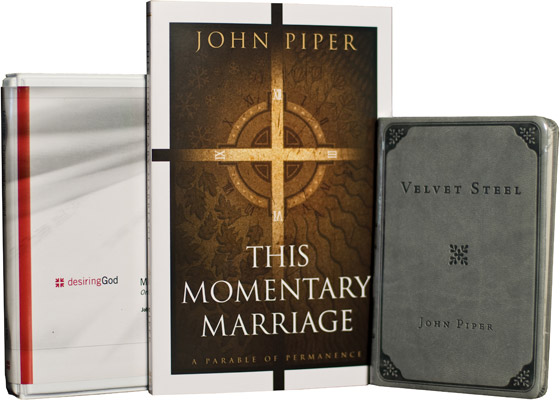
Posted: February 10, 2009 Filed under: John Piper Leave a commentBeing that I just got engaged a month ago yesterday, Em and I decided to pick up this set by Desiring God and work through for the next 14 weeks. Take a look here below.
“Covenant keeping, not the effects of being ‘in love’, is the main point of marriage…and tough-minded covenant keeping is the best soil for the long-term flourishing of tender affections.” – John Piper
The Desiring God Marriage Gift Set brings together a biblical call for an unyielding commitment to covenant keeping and a tender display of John Piper’s affections for his wife Noël.
The set Includes
- This Momentary Marriage: A Parable of Permanence (Book)
- Velvet Steel (Poetry Book)
- Marriage, Christ, and Covenant: One Flesh for the Glory of God(Audio CDs)
Heidelberg Catechism
Posted: February 9, 2009 Filed under: Reformation Heritage Books Leave a comment
You might be a Calvinist if… your going to buy this! (Release Date: February 11, 2009)
In The Church’s Book of Comfort, Willem van ’t Spijker and his team of scholars present an introductory investigation into the history, theology, and impact of the Heidelberg Catechism. The authors give careful attention to the background of the Reformation in Germany, the production of the Catechism, and the lives of those involved in making the Catechism. Interesting details are given about the practice of using catechisms before 1563, and the reception of the Heidelberg Catechism among the Reformed churches. Emphasis is also placed on the practice of Catechism preaching and the efforts to increase theological education among congregations. Readers will see the rich theological dimensions of the Catechism and its call for experiential religion. The Heidelberg Catechism has long been known for its warm display of orthodox doctrines, and this helpful book further displays the importance of this classic confessional statement.
The Heidelberg Catechism has always been and continues to be one of the best-known confessional statements of the Western church. Many associate it with catechetical instruction or the broader teaching role of the church. How did this particular Catechism acquire and retain such popularity? The present volume answers this question in an easy-to-follow and user-friendly manner by exploring the historical background and theology of this book of the church’s comfort. It offers the reader new and exciting insights. For the first time ever all persons involved in its compilation are portrayed. Particular attention is given to its reception and influence in the Netherlands through preaching and catechetical instruction. In addition this book addresses the question as to why this Catechism continues to be enormously relevant. This splendidly illustrated edition is eminently suitable as a guide to the use of the Heidelberg Catechism.
Joyful Security
Posted: February 8, 2009 Filed under: Sundays with Spurgeon 2 CommentsI will uphold thee with the right hand of my righteousness. (Isaiah 41:10)
Fear of falling is wholesome. To be venturesome is no sign of wisdom. Times come to us when we feel that we must go down unless we have a very special support. Here we have it. God’s right hand is a grand thing to lean upon. Mind, it is not only His hand, though it keepeth heaven and earth in their places, but His right hand: His power united with skill, His power where it is most dexterous. Nay, this is not all; it is written, “I will uphold thee with the right hand of my righteousness.” That hand which He uses to maintain His holiness and to execute His royal sentences—this shall be stretched out to hold up His trusting ones. Fearful is our danger, but joyful is our security. The man whom God upholds, devils cannot throw down.
Weak may be our feet, but almighty is God’s right hand. Rough may be the road, but Omnipotence is our upholding. We may boldly go forward. We shall not fall. Let us lean continually where all things lean. God will not withdraw His strength, for His righteousness is there as well. He will be faithful to His promise, and faithful to His Son, and therefore faithful to us. How happy we ought to be! Are we not so?
Coming Back in Print The Freedom of the Will
Posted: February 7, 2009 Filed under: Jonathan Edwards 1 Comment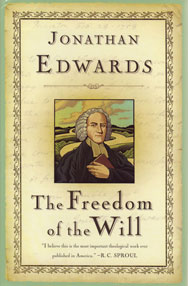 The Freedom of the Will set to RELEASE Feb. 11th. RHB’s line of SDG titles are being one by one reprinted for those who loved great work. This one however is going to be released in the next month! Also if you would like a PDF of their newest catalog, here ya go… Feb. 2009 Tolle Lege.
Many scholars believe this work, published in 1754, is the most important argument against Arminianism published in America. Freedom of the Will is divided into four parts. The first deals with terminology; the nature and determi- nation of the will; the meaning of necessity, impossibility, and contingency; the distinction between natural and moral necessity; and the nature of moral agency and liberty. The second considers the possibility of self-determination. The third analyzes divine agency regarding human beings and the world. In the conclusion, Edwards anticipates the recep- tion the work will receive.
Noteworthy is Edwards’s essential agreement with the empiricist John Locke that the question of whether or not the will was “free” was badly posed; the real issue, he said, is whether the person is free. The majority of the work, however, deals with the will’s freedom (in contrast to the freedom of the whole person) as it seeks to refute the Arminian notion of the will. For Edwards, the errors of the Arminians essentially resulted from denying God’s absolute sovereignty; in contrast to Calvinist orthodoxy, Arminians insisted that secondary causes could operate in the individual apart from the influence of the divine will. This notion of the will’s freedom had Pelagian roots, which Edwards rightly exposed. Furthermore, the refusal of the Arminians to acknowledge the individual’s total corrup- tion promoted further error. The will cannot be free as the Arminians would have it, Edwards argued, for true free- dom can only belong to God, who is self-sustaining and therefore free from other influences.
John Owen on Apostasy – Part Eight
Posted: February 6, 2009 Filed under: John Owen on Apostasy Leave a commentVII. Instance of a peculiar defection from the truth of the gospel; With the reasons of it
Theses:
“Besides the reasons insisted on, which have a general influence into all apostasies from the doctrine or mystery of the gospel, each especial defection in every kind hath reasons and causes peculiarly suited unto its rise and furtherance… And every age giveth us, in one place or another, renewed evidence, that, — where either secular interest or weariness of the truth, through the love of the present world and hatred of holiness or strict evangelical obedience, doth give a propensity unto a declension from any doctrines of the gospel unto persons whose grandeur and outward advantages are sufficient to attract a compliance from the minds of men under the power of ambition, or any importunate desire of earthly things, — multitudes of all sorts suppose there is nothing left for them but to crowd who shall come nearest the leaders in the apostasy. And it is not seldom that, meeting with new temptations, they outrun both them and themselves also into such extremes as at first they designed not; for hence it is that so many do even at present issue their recessions from the truth, under the conduct of those “ignes fatui” or erratic exhalations of countenance and favor, in the undesigned bogs of Popery on the one hand, or Socinianism on the other.”[1]
Summary:
Chapter seven shows the gospel as the center of belief. Simply put into five main sections, Owen gives a number of doctrines that he is convinced are impossible to ignore, or not believe, by anyone who calls themselves a believer of the gospel. Owen deals with the person (namely Rome) who makes less of the need of Christ as their priest and mediator in order to lift man’s religion higher. He takes the time to show how Christ’s work and victory over sin is a necessity in order to receive the great grace of God to wash away sins. Halfway through this chapter is found the greatest gospel truth, as Owen takes the time to explain that the ignorance of man often forgets the importance of the righteousness of God. Given here are three key thoughts of living a gospel-centered life, which are important for one to continue in obedience everyday so as not to fall into apostasy:
1. Owen gives a section describing exactly what God’s righteousness is.
2. How the Law of God requires righteousness from man.
3. Then how the righteousness of Christ is provided in the gospel because of the work of Jesus Christ.
Owen then ends with a brief section on the importance of knowing the Scriptures so that one does not fall away from these truths that lie in it.[2]
Outline:
I. Apostasy from the Truths of the Gospel
A. Ignorance of the Need of Christ
B. Ignorance of Christ Work
C. Ignorance of Christ Grace over Sin
D. Ignorance of God’s Righteousness
1. The Law Requires
2. The Gospel Gives
E. Ignorance of Knowing the Scriptures
What is Immortality?
Posted: February 5, 2009 Filed under: Questions & Answers Leave a commentWhich of the following definitions best answers the question?
Ligonier Academy of Theological and Biblical Studies
Posted: February 4, 2009 Filed under: Just for Fun Leave a commentAnyone have an extra 10k laying around? Introducing Ligonier Academy of Biblical and Theological Studies! I want to go!!!
preaching the gospel you substitute your knowledge…
Posted: February 4, 2009 Filed under: Gospel Quote of the Week Leave a commentIf in preaching the gospel you substitute your knowledge of the way of salvation for confidence in the power of the gospel, you hinder people from getting to reality. – Oswald Chambers
What does it mean practically to keep the Sabbath holy?
Posted: February 3, 2009 Filed under: John Piper, Mark Driscoll, Video of the Week 5 CommentsAlso, read Mark Driscoll’s post yesterday on the Sabbath.
Presby Spears
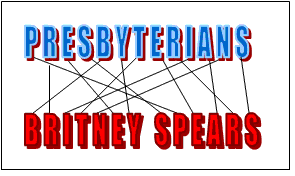
Posted: February 2, 2009 Filed under: You might be a Presbyterian if Leave a commentYou might be a Presbyterian if… you have something in common with Brittany Spears.
God Always Hears
Posted: February 1, 2009 Filed under: Sundays with Spurgeon Leave a commentMy God will hear me. (Micah 7:7)
Friends may be unfaithful, but the Lord will not turn away from the gracious soul; on the contrary, He will hear all its desires. The prophet says, “Keep the doors of thy mouth from her that lieth in thy bosom. A man’s enemies are the men of his own house.” This is a wretched state of affairs; but even in such a case the Best Friend remains true, and we may tell Him all our grief.
Our wisdom is to look unto the Lord and not to quarrel with men or women. If our loving appeals are disregarded by our relatives, let us wait upon the God of our salvation, for He will hear us. He will hear us all the more because of the unkindness and oppression of others, and we shall soon have reason to cry, “Rejoice not against me, O mine enemy!”
Because God is the living God, He can hear; because He is a loving God, He will hear; because He is our covenant God, He has bound Him-self to hear us. If we can each one speak of Him as “My God,” we may with absolute certainty say, “My God will hear me.” Come, then, O bleeding heart, and let thy sorrows tell themselves out to the Lord thy God! I will bow the knee in secret and inwardly whisper, “My God will hear me.”

 Gospel-Centered Musings