What Is a Healthy Church Member?
Posted: June 20, 2008 Filed under: Book of the Week Leave a commentThis weeks, Book of the Week is of a book that is to be released June 30th by Crossway. Below is a review done by one of my co-workers, the Director of Publications at Reformation Heritage Books, Jay T. Collier.
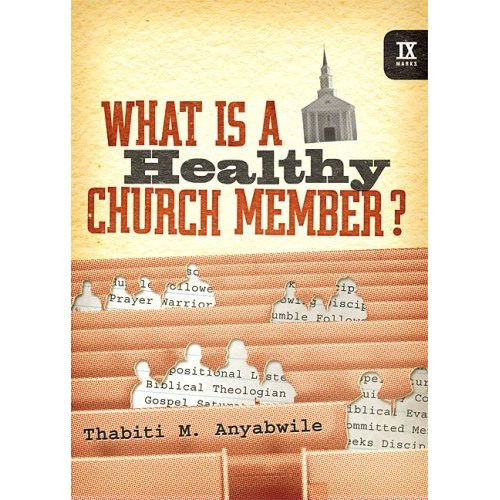 Although not out, Thabiti M. Anyabwile’s new book is set for release of June 30th. Jay T. Collier of Reformation Heritage Books has done a wonderful review of the book. You can pre-order a copy of this at Reformation Heritage Books for their low price of $9.00. Below is the review.
Books on church vitality and health have largely been directed toward pastors. I suppose this is wise, for a church with ill-informed leadership is bound to be riddled with problems. Yet the church is more than just its pastors. The whole congregation makes up the body of Christ, and every member carries a certain responsibility in that body. Thabiti M. Anyabwile’s What Is a Healthy Church Member? is a welcome addition to books addressing the health of the church.
Anyabwile’s book is part of Crossway’s 9Marks series, and as such, seeks to address the concerns of Mark Dever’s Nine Marks of a Healthy Church from yet another angle. In fact, Anyabwile’s chapters mirror those nine characteristics that Dever discusses, focusing them on the common member, and adding one. Here is a summary of Anyabwile’s 10 marks of a healthy Christian.
Mark 1: Where Dever’s first mark of a healthy church is expositional preaching, Anyabwile encourages Christians to perform expositional listening. That is, it is not good enough to attend a church with solid preaching. Believers should be active in listening to the sermon to discern the meaning of the Scripture, accept it, and apply it to their lives. Anyabwile goes on to discuss the benefits of such listening skills and gives practical suggestions for cultivating this mark.
Mark 2: Since a healthy church adheres to biblical theology, healthy church members should be biblical theologians. They should desire to know God more and know the overarching themes of the Bible. Here, Anyabwile shows why biblical theology promotes vitality in Christians and how to become theologically informed members.
Mark 3: If a healthy church is committed to a proper understanding of the gospel, healthy church members are gospel saturated. They will think about the good news of Jesus Christ, strive to understand it more, continually draw comfort and strength from it, and boast in it. In an age where the gospel is treated as if it were only good for addressing the unconverted, it is comforting to read that the gospel is good news for the Christian, too!
Mark 4: Because a healthy church has a biblical understanding of conversion, the healthy members will be genuinely converted. They will dig past the presumptive, easy-believism that inundates the evangelical scene, and exercise self-examination. Anyabwile encourages a better understanding of conversion and gives valuable directions for knowing better the state of one’s own soul.
Mark 5: A church having a biblical understanding of evangelism will have members that are biblical evangelists. They take delight in the gospel and share it with others.
Mark 6: While churches should seek to implement a biblical understanding of church membership, healthy Christians will likewise seek to be committed members of a local congregation. They will dedicate themselves to loving the brethren and building them up in the Lord. Here we see a thoughtful description of what committed church members look like.
Mark 7: If practicing biblical church discipline faithfully is a mark of a healthy church, healthy church members will seek discipline. They will be open to biblical guidance and correction from others, and lovingly seek to provide them to others. Anyabwile helpfully describes what discipline looks like among members and shows how they can joyfully seek it.
Mark 8: A healthy church has a concern for discipleship and growth, so healthy church members must be growing disciples. Rather than being satisfied with nominal Christianity, they progressively increase in spiritual maturity. Here Anyabwile discusses problems in our thinking that hinder our growth, and the means God has given us to cultivate godliness.
Mark 9: Dever stresses the need for churches to implement biblical church leadership, so Anyabwile calls church members to be humble followers. This section addresses how members are to honor and love their leaders with a teachable spirit, and proposes actions they should take in order to follow the leadership of their local church.
Mark 10: Dever never stated prayer as a mark of a healthy church, since he did not see it as something that was being challenged. However, Anyabwile sees this as a point worth making, describing healthy Christians as prayer warriors. He talks about how and when church members should pray, and addresses things for which they should pray.
Throughout the book, Anyabwile presents a picture of the church as a gathering of those glorying in the gospel to represent “the body of Christ” to this world. By addressing the relationship of the individual believer to the congregation, he enables us to see that the health of the church is stunted if reform is confined to the level of leadership. Christ is interested in the whole body being built up.
I heartily recommend this book. Its greatness lies not in novelty of insight. Rather, it is found in its ability to address the everyday basics in a clear, concise, and compelling way. The sad fact is that we easily overlook simple responsibilities, and someone has to recall them to our attention. Anyabwile does this in a winsome fashion.
Furthermore, this is not simply a book to be read by individuals. Its short, well-organized chapters with questions “for further reflection” make it helpful for study groups. This is a book for Sunday Schools, Bible studies, and other church groups to discuss together. I, for one, look forward to reading this book again, but next time reflecting upon it with my fellow church members.
—Jay T. Collier

 Gospel-Centered Musings