My Thanks to PRTS
Posted: May 14, 2010 Filed under: PRTS 1 Comment Not sure how many are interested in reading my short graduation speech. However, I thought I’d post it for the few of you that would like to read it. I am posting this at 5:15pm, 2 hours before I’ll actually be giving it.
PRTS Graduation Speech May 14th, 2010
On behalf of the graduating class of 2010, I have been asked to spend the next few minutes thanking Dr. Beeke and the seminary (PRTS) for what they have done in the past two to four years in our lives. Needless to say the time is not nearly sufficient, and we owe a great debt to all of you who make up the PRTS community. We would like to say thanks to all of those who have helped us along our way at seminary.
#1 First, we would like to thank Reformation Heritage Books. We cannot even imagine what PRTS would be without having RHB right there. It’s like Luther and Melanchthon, Calvin and Beza, and Ursinus and Olevianus – they go hand and hand in ministry. We would like to thank Steve, Jay, and others that run the store on a daily basis; we thank you for your hours and ministry that you have put into RHB. We thank you for ordering our text books, we thank you for the discounts you give, and yes, Steve we thank you for the times that we can barter back and forth and get just a little more of a discount from time to time.
#2 The PRTS Board. We know you do a lot of work behind the scenes, and we are most certainly thankful for the decisions you make in leadership, the guidance you bring and the direction, and the scholarships you help distribute among the PRTS students. Thank you.
#3 We would also like to thank all the supporters of PRTS. Many of you are here tonight. Without your prayers and your faithful generosity, PRTS would not exist, and we would not stand here tonight. It’s our prayer that God will richly bless you and your gifts, perhaps even through the ministry of some of us who have benefitted from your support. So thank you for your generous giving.
#4 The Library Staff . Where would we students have been without the library staff? We thank Fred, Laura, Kim and the others for all of the countless hours you have put into categorizing our library. For without your help, we would have been in seminary for eight, nine, maybe ten years and would still be using the JRB system. We thank you for making out studies easier.
#5 The Food pantry volunteers, what would we have done with out the food pantry, I honestly have no idea. Thank you for serving us while we were in seminary.
#6 The PRTS Staff – Chris Englesma, We thank you for your countless hours and headaches that you have put into the growth of the distance-learning program while we have been here. Chris Hanna, we thank you for all that you do in development, marketing and helping the seminary to continue to grow. Ann Dykema, we thank you for all that you do behind the scenes, working away in front of your computer. From managing time sheets, paying bills, to even giving us our bills, and reminding us that we need to have them paid in order to graduate. Henk Kleyn, Henk, if it were not for you, I honestly do not know what a good number of us would have done from time to time. You are simply the glue that holds PRTS together. From figuring out my GPA 10 times a semester, to helping new students find a place to live, to preparing that place yourself, the scheduling of classes, speakers, and adjunct professors, you simply seem to do it all for us. No matter what we may have needed as students, we knew that you were the one to go to.
#7 PRTS Adjunct Professors. We thank the adjunct faculty, including the various ministers from the Heritage Congregation and the Free Reformed denomination, for the time they make in their own schedules to come and teach us God’s Word and to prepare us for our future ministry.
#8 Dr. Murray, a number of us (Maarten, Marty, Scott, Tim and myself) of this graduating class knew what PRTS was before you came. However we would never want to remember PRTS without you. We thank you for your preaching, and no, it is not only your accent that captures our attention, but it is your words of wisdom and proclaiming the gospel that captures our hearts and we pray will forever change both our lives and future ministry. Dr. Murray, thank-you especially for teaching us the importance of preaching Christ from the Old Testament.
#9 Dr. Bilkes, right away I think of your witty 3-point sermons that you can just makeup on the spot after reading a text from the Bible. We all wish we had a mind like that. No matter what the issue – our grades, scheduling classes, praying together about a matter, or simply to talk about life, we thank you for always having an open office. Dr. Bilkes thank you for teaching us the importance of staying true to the text, and preaching what is in the text and not wondering away from the text.
#10 Dr. Beeke, thank you for your zeal in making preachers of the gospel. Your warm and gracious heart has taught many of us how to preach the Bible with application, which we have all come to know as experiential preaching. Dr. Beeke thank you for your example of workmanship for the gospel. Your work ethic as a minster and teacher, we are grateful for – was there ever a night that we as students ever had to worry about who would turn the lights at seminary? Most nights, you were always the last one out the door.
#11 Lastly we want to give thanks to our precious Lord and Savior, Jesus Christ. Who has allowed sinners like us, to know him, study His Word, and forever serve Him until our blessed hope. Thanks be to God for allowing us to study at PRTS and thanks to all of you who help and make PRTS what it is today. Thank you.
On behalf of the graduating glass of 2010, I would like to present this donation to the PRTS library, so that it can continue to purchase the books that fuel much of the study at PRTS. Thank you.
Podcast Interview with Dr. Haykin
Posted: May 14, 2010 Filed under: Baptist, Michael Haykin Leave a comment
Steve Weaver writes,
“I recently had the opportunity to record a series of podcasts with Dr. Michael A. G. Haykin. The first of these is attached to this post. It focuses on the Center’s upcoming conference “Baptists and the Cross: Contemporary and Historical Perspectives”. Forthcoming podcasts will feature a discussion of Dr. Haykin’s upcoming book ‘The Empire of the Holy Spirit’ and an interview by Dr. Haykin with Dr. Stephen Wellum about his upcoming presentation at our conference on “Baptism and Crucicentrism”.
Do You Like John Calvin?
Posted: May 13, 2010 Filed under: Calvinism Leave a comment
If you do, be sure to check out the updated blog from Logos called Calvin500 which I’ll be bloggin regularly.
Or you can follow us on Twitter
The Support of Free Will Refuted
Posted: May 12, 2010 Filed under: Calvinism Leave a comment Absurd fictions of opponents first refuted, and then certain passages of Scripture explained. Answer by a negative. Confirmation of the answer.
Enough would seem to have been said on the subject of man’s will, were there not some who endeavour to urge him to his ruin by a false opinion of liberty, and at the same time, in order to support their own opinion, assail ours. First, they gather together some absurd inferences, by which they endeavour to bring odium upon our doctrine, as if it were abhorrent to common sense, and then they oppose it with certain passages of Scripture (infra, sec. 6). Both devices we shall dispose of in their order. If sin, say they, is necessary, it ceases to be sin; if it is voluntary, it may be avoided. Such, too, were the weapons with which Pelagius assailed Augustine. But we are unwilling to crush them by the weight of his name, until we have satisfactorily disposed of the objections themselves. I deny, therefore, that sin ought to be the less imputed because it is necessary; and, on the other hand, I deny the inference, that sin may be avoided because it is voluntary. If any one will dispute with God, and endeavour to evade his judgment, by pretending that he could not have done otherwise, the answer already given is sufficient, that it is owing not to creation, but the corruption of nature, that man has become the slave of sin, and can will nothing but evil.D43 For whence that impotence of which the wicked so readily avail themselves as an excuse, but just because Adam voluntarily subjected himself to the tyranny of the devil? Hence the corruption by which we are held bound as with chains, originated in the first man’s revolt from his Maker. If all men are justly held guilty of this revolt, let them not think themselves excused by a necessity in which they see the clearest cause of their condemnation. But this I have fully explained above; and in the case of the devil himself, have given an example of one who sins not less voluntarily that he sins necessarily. I have also shown, in the case of the elect angels, that though their will cannot decline from good, it does not therefore cease to be will. This Bernard shrewdly explains when he says (Serm. 81, in Cantica), that we are the more miserable in this, that the necessity is voluntary; and yet this necessity so binds us who are subject to it, that we are the slaves of sin, as we have already observed. The second step in the reasoning is vicious, because it leaps from voluntary to free; whereas we have proved above, that a thing may be done voluntarily, though not subject to free choice.
Welcome to a Reformed Church
Posted: May 11, 2010 Filed under: Book Review, Danny Hyde, Reformation Trust Leave a commentReview: Daniel R. Hyde, Welcome to a Reformed Church: A Guide for Pilgrims. Reformation Trust: Orlando, 2010. pp.
 URC church planter Daniel Hyde felt the need for a clear, concise, and cogent piece of literature to give out to the droves of visitors, inquirers, and curious onlookers that would wander into his church. In order to create something like this, Hyde started over 7 years ago, writing and planning a book that would be more than a mere booklet or a small pamphlet, yet not intimidating to those that did not know of the Reformed faith. The result became Welcome to the Reformed Church, which is trying to get across exactly that—Welcome! Rev. Hyde would like to see those that have specific questions, tend to wonder, or would like to understand what Reformed Church truly is, to be able to get some answers in less than 150 pages. But what makes Rev. Hyde’s book different from those that have tried to do the same in the past, is that Hyde follows the emphases that his own confessions hold, and writes as a former outsider of the Reformed faith in a conversational way. This is extremely helpful to the non-Reformed or the New-Reformed individuals as they are able to see the distinctions of the Reformed Church and differences that had once stood out to Rev. Hyde himself before he became Reformed in confession and practice.
The purpose behind Rev. Hyde’s book is to show exactly what the “roots” are of the Confessional Reformed church—from what they believe and how they live, to where they came from and how they worship God. Hyde lets his thesis be known right from his introduction on pages xxv-xxvi, saying:
“While there are variations from one Reformed church to another, what I hope to communicate to you in this basic welcome to the Reformed churches as a whole can be summarized in three points. First, Reformed churches are Christian churches. They are Christian churches because they believe the Bible is the Word of God, that there is only one God who exists eternally as a Trinity, and that Jesus Christ our Savior is both God and man. Reformed churches hold these beliefs in common with all Christians in all times and places. In the words of Vincent of Lerins (d. 450), “We hold that faith which has been believed everywhere, always, by all.” Second, Reformed churches are Protestant churches along with Lutheran churches because they reject the claims of the pope to be the head of the church, acknowledging instead that Jesus Christ is the Head of His church, and that He rules and governs His church by His Word and His Spirit, not by the dictates of men. Third, Reformed churches are just that—Reformed churches. They are a subset of Protestant churches in that they believe sinful humans are saved by grace alone, from eternity past to eternity future, and that we experience this grace of God earned for us by Christ alone when the Holy Spirit uses certain means that God has appointed in the church: the preaching of the Word of God, which is the Bible, and the celebration of the sacraments of baptism and the Lord’s Supper.”
Rev. Hyde then supports his thesis by focusing on the most important issues dealing with the Reformed Church through its history, such as: What are their roots? Why does the church have confessions? Scripture as the final authority, God’s making of covenants with mankind, What is Justification? What is sanctification? What makes a church? What is worship? and How are preaching and the sacraments the means of grace today?
Rev. Hyde starts the first chapter of his book with a brief history—or “roots” as he calls them—saying to his readers, “Although you may never have been in a Reformed church, we did not just come out of nowhere. We’ve been around the block a few times.” After this, Rev. Hyde shows the importance of why it is necessary to explain what the Reformed Church’s creeds and confessions are, and then details their doctrinal emphases for the reader in chapter two. Moving on throughout the book, another chapter which stands out is chapter 5: “Justification: Grace Alone, Faith Alone, Christ Alone.” This is the article upon which the church stands or falls; the hinges upon which true religion turns; the heartbeat of heaven; and the pulse of the pilgrim.
Two other chapters that also stand out from the others are chapters 8 (on worship) and chapter 9 (on the means of grace in the Reformed Church). As Rev. Hyde told me recently when I asked him about these two chapters in an interview I had with him:
“Not only is evangelicalism a churchless phenomenon—meaning, that the doctrine and nature of the church is utterly neglected—but much of what is passing itself off as “Reformed” today has no real semblance of ecclesiology. Sure there are great preachers out there and people who believe in the so-called five points of Calvinism, but it’s just evangelicalism with the doctrine of election added on. All this to say that I want visitors to my church, and those who may visit other churches, to know that we have a high regard for the church. Worship is our chief end as the Westminster Catechisms state and it is the context in which God meets with his people through the means he has appointed: Word and sacraments.”
Rev. Hyde finishes his book on the Reformed Church with a little extra for those that read beyond chapter 9. He includes 2 appendixes that are most useful for the reader to further study about the Reformed Church. Appendix 1 is a basic “question and answer” of the some of the remaining questions one may have about the Reformed Church. Appendix 2 is a bibliography for those that wish to seek further study on a number of different areas in relationship to the Reformed Church, including theology, covenant, God, Jesus Christ, Holy Spirit, history, liturgy, and community. Rev. Hyde hopes to settle the dispute today among American evangelicalism of what Reformed really is in 3-points: Reformed is Christian, Reformed is Protestant, and Reformed is only Reformed churches, nothing else.
A Methodist would never call himself a Baptist, nor would a Lutheran ever called himself Catholic; it simply would make no sense at all. More still, a Lutheran would never call himself a Reformed-Lutheran for only agreeing on John Calvin’s Soteriology. Today in American evangelicalism, with the growth of John Calvin’s Soteriology in many different circles, comes the title in which many New-Calvinists claim to be: “Reformed.”
Rev. Hyde provides the much-needed definition and historical value, and what it truly means to be a part of a Confessional/Historical Reformed Church. In less than 150-pages, Hyde defines and gives proof of the much used word “Reformed”—what it truly means in its’ historical setting and what the Reformed Church was, and is still today. Additionally, Hyde lays out the foundation and the history of the Reformed Church, examines why they use confessions, and what key doctrines make up the identity of the Reformed Church in today’s culture. If one is new to the term Calvinism, this book should surely help them understand the historical/confessional Reformed faith that lies in churches today. If one is a New-Calvinist, this book is a must read so as to understand what it means to be truly Reformed in its’ historical definition and identity. If one is in a Reformed Church already, this book will give a great reminder of who you are, what it is you came from, and why you believe the truths of the gospel in the way you do.
No matter where you are at in the Christian Faith, Welcome to a Reformed Church must be read for its defining of what and why the Reformed Church truly is what it is today. Furthermore, reading this book will—if nothing else—make you consider and reflect on why you are what you are, and what you believe in the Christian faith.
“They Drank & Were ‘Merry’ with Him”
Posted: May 10, 2010 Filed under: Beer, Just for Fun 4 CommentsFor those that say drinking alcohol is okay, how much alcohol is too much is the question? Maybe 1, or 2, or even 3, 4, 5… why not 10?
 In Genesis 43 we find the story where Joseph’s brothers return to Egypt. What I find most intriguing to me is the very end of the chapter in verse 34. However for the context of the passage let’s start by reading at Genesis 43: 26-34. It reads,
“When Joseph came home, they brought into the house to him the present that they had with them and bowed down to him to the ground. And he inquired about their welfare and said, “Is your father well, the old man of whom you spoke? Is he still alive?” They said, “Your servant our father is well; he is still alive.” And they bowed their heads and prostrated themselves. And he lifted up his eyes and saw his brother Benjamin, his mother’s son, and said, “Is this your youngest brother, of whom you spoke to me? God be gracious to you, my son!” Then Joseph hurried out, for his compassion grew warm for his brother, and he sought a place to weep. And he entered his chamber and wept there. Then he washed his face and came out. And controlling himself he said, “Serve the food.” They served him by himself, and them by themselves, and the Egyptians who ate with him by themselves, because the Egyptians could not eat with the Hebrews, for that is an abomination to the Egyptians. And they sat before him, the firstborn according to his birthright and the youngest according to his youth. And the men looked at one another in amazement. Portions were taken to them from Joseph’s table, but Benjamin’s portion was five times as much as any of theirs. And they drank and were merry with him.“
The ESV Study Bible puts this simply that “Joseph’s feelings for Benjamin result in his being given portions that are five times those given to his brothers.” However I am not as concerned with Joseph’s feelings as much as I am with the issue that is not mentioned in verse 34 in the ESV Bible reads, “Benjamin’s portion was five times as much as any of theirs. And they drank and were merry with him.” But yet in the NET Bible it reads, “They drank with Joseph until they all became drunk.” Now there is quite a difference between being merry and drunk, isn’t there?
Merry – means cheerful and lively.
Drunk – means affected by alcohol to the extent of losing control of one’s faculties or behavior.
Here I see two questions that need to be addressed.
1. What is the hebrew word here in the text that is translated to merry or drunk?
The Hebrew word that is used here in the text that the ESV translates as “merry” and the NET translates as “drunk” is “shikkaron.” Here is the entry in Brown Driver-Briggs Hebrew and English Lexicon , p.1016. Hope the Hebrew letters come out OK. You can also check it up in Strongs, if you want. First ,this is the entry for the verb “shikkaron” or “shachaar” or “sjahaar” or however you want to transliterate it into English. (The entry in Strongs is number 7937)
I. [שָׁכַר] vb. be, or beocme, drunk, drunken (NH id., der. spec. and deriv.; Ecclus 40:18, 40:20 שכר strong drink; Ar.sakira be drunken, also be full, sakara fill; As. šikaru; = שֵׁכָר, šikaru, drunken, perhaps also vb. šakâru; Eth.sacra:: Aram. שִׁכְרָא, šakroÀ = שְׁכָר, esp. date-wine (Löw p. 125), cf. škar be drunken, usu. (der. spec.) defle, deform, etc.; from שֵׁכָר, Egypt. tøaÂ-k-av-k-ïra WMM As. u. Eur. 102, Gk. σικερα, Lewy Fremdw, 81);—Qal Pf. 3 pl. שָֽׁכְרוּ Is 29:9; Impf. 3 ms. וַיִּשְׁכָּ֑ר Gn 9:21, 3 mpl. יִשְׁכָּר֑וּן Is 49:26, etc.; Imv. mpl. שִׁכְרוּ Je 25:27 Ct 5:1; Inf. cstr. Hg 1:6; Pt. pass. שְׁכֻרַת Is 51:21 (Ges:§ 130 b Lag:BN 60);—become drunken Gn 9:21 (J), of social drinking 43:34 (J), Ct 5:1, token of plenty Hg 1:6; fig. of nations staggering helplessly under calamity Je 25:27, 51:21(וְלאֹ מִיָּ֑יִן), of Na 3:11; of infatuation Is 29:9 (וְלאֹ יַיִן), of disgrace La 4:21, self-destruction, כֶּעָסִיס דָּמָם יִשׁ׳: Is 49:26. Pi. make drunken: Impf. 3 ms. sf. וַיְשַׁכְּרֵהוּ 2 S 11:13, lit.; fig. 1 s. (sf. of people) וַאֲשַׁכְּרֵם (read וָ׳:) Is 63:6 (subj. י׳:) I made them drunk in my wrath (but MSS Ges Hi Ew Che Kit Marti al. וָאֲשַׁבְּרֵם I brake them in pieces); Pt. fs., of Bab., מְשַׁכֶּרֶת בָּל־הָרֶץ Je 51:7; cf. Inf. abs. שַׁכֵּר Hb 2:15 (i. e. terrorizing nations; read prob. הַשְׁקֵה וְאַף שׁ׳: We Now). Hiph. id.: Pf. 1 s. וְהִשְׁכַּרְתִּ֫י Je 51:27 (subj. י׳:) i.e. make princes helpless, וְהִשְׁכַּרְתִּים v:39; Imv. mpl. sf. הַשְׁכִּירֻהוּ obj. Moab, i.e. make helpless and disgraced 48:26; Impf. 1 s מִדָּם אַשְׁכִּיר חְצַּי Dt 32:42.—Ruben:JQ xi (1889), 446 prop. מַשְׁכִּירוֹת Ho 7:5 for משׁך ידו את. Hithp. Impf. 2 fs. תִּשְׁתַּכָּרִין 1 S 1:14 how long wilt thou make thyself drunken [a drunken spectacle] ?
II. And here is, on the same page 1016 of Brown Driver-Briggs, the entry for the related NOUN, sheechar or sjeehar or however you want to transliterate it. ( (The entry in Strongs is number 7941)
שֵׁכָר n[m.] intoxioating drink, strong drink (Ba:NB § 71);—alw. שׁ׳: abs.; usu. || וַיִן (exc. Psalm 69:13): Is 29:8; usu. condemned, Is 5:11, 5:22, 28:7, 28:7, 28:7, 56:12 (נִסְבְּאָה שׁ׳:), Mi 2:11, 1 S 1:15, Pr 20:1; forbidden to priests on duty Lv 10:9 (P) ; not for princes Pr 31:4; nor Nazirite Nu 6:3, Ju 13:4, 13:7, 13:14, cf. חֹמֶץ שׁ׳: Nu 6:3; שׁוֹתֵי שׁ׳: Psalm 69:13 drunkards; but שׁ׳: as common drink Dt 29:5 (opp. to miraculous), allowable in sacrif. meal 14:26, commended for weak and weary Pr 31:4; נֶסֶךְ שׁ׳: Nu 28:7(P; for יַיִן v:14); v. further Kennedy:Ency. Bib. iv. 5309 f.—On form cf. Lag:M ii. 357; BN 51.
III. And here is, still on the same page 1016, the entry for the adjective, shichar or sjihar : (The entry in Strongs is number 7910)
שִׁכֹּר, שִׁכּוֹר adj. drunken (Ba:NB § 134 b);—abs. שִׁכֹּר 1 S 25:36, שִׁכּוֹר 1 K 16:9 +, f. שִׁכֹּרָה, 1 S 1:13, pl.שִׁכּוֹרִים Jo 1:5, cstr. שִׁכֹּרֵי Is 28:1, 28:3;—drunken: 1 S 25:36, אִישׁ שׁ׳: Je 23:9, שֹׁתֶה שׁ׳: 1 K 16:9 drinking (and) drunken, 20:16; as subst. = drunken one, drunkard Is 28:1, 28:3, Pr 26:9, pl. Jo 1:5 (|| שֹׁתֵי יַיִן); in sim. Is 19:14, Jb 12:25, Psalm 107:27, and (of earth) Is 24:20; f. of drunken woman 1 S 1:13.
If you don not understand, In the simplest of words, Joseph (many claim a type of Christ) found it okay in giving Benjamin 5-times the amount as the rest. “And they drank and *became drunk* with him.”
From: שׁכר : (verbal infinitive): to inebriate
2. Lastly how much was a Portion?
One glass, one pint, one gallon, one shot? I am not sure what a portion was then, but I do know what they are now, not as if that really matters. A standard serving of wine is 5 floz., A standard serving of beer is 12 floz., A standard serving of liquor is 1.5 floz. Let’s say that a portion was one glass of wine and that Joseph gave everyone one portion = one glass. This would only mean that Benjamin would then had 5 Portions or glasses of 25 oz.’s. How much is too much? This is never rebuked, at least not in Scripture. I’m looking forward to reading your comments for those that leave them and would appreciate your comments if you have any.
Do you know Charles Spurgeon?
Posted: May 9, 2010 Filed under: Just for Fun, Sundays with Spurgeon Leave a comment (Thanks Jesus is Savior.com)
Charles Haddon Spurgeon is history’s most widely read preacher (apart from the biblical ones). Today, there is available more material written by Spurgeon than by any other Christian author, living or dead.
One woman was converted through reading a single page of one of Spurgeon’s sermons wrapped around some butter she had bought.
Spurgeon read The Pilgrim’s Progress at age 6 and went on to read it over 100 times.
The New Park Street Pulpit and The Metropolitan Tabernacle Pulpit – the collected sermons of Spurgeon during his ministry with that congregation – fill 63 volumes. The sermons’ 20-25 million words are equivalent to the 27 volumes of the ninth edition of the Encyclopedia Britannica. The series stands as the largest set of books by a single author in the history of Christianity.
Spurgeon’s mother had 17 children, nine of whom died in infancy.
When Charles Spurgeon was only 10 years old, a visiting missionary, Richard Knill, said that the young Spurgeon would one day preach the gospel to thousands and would preach in Rowland Hill’s chapel, the largest Dissenting church in London. His words were fulfilled.
Spurgeon missed being admitted to college because a servant girl inadvertently showed him into a different room than that of the principal who was waiting to interview him. Later, he determined not to reapply for admission when he believed God spoke to him, “Seekest thou great things for thyself? Seek them not!”
Spurgeon’s personal library contained 12,000 volumes – 1,000 printed before 1700. The library, 5,103 volumes at the time of its auction, is now housed at William Jewell College in Liberty, Missouri.
Before he was 20, Spurgeon had preached over 600 times.
Spurgeon drew to his services Prime Minister W. E. Gladstone, members of the royal family, members of Parliament, as well as author John Ruskin, Florence Nightingale, and General James Garfield, later president of the United States.
The New Park Street Church invited Spurgeon to come for a 6-month trial period, but Spurgeon asked to come for only 3 months because “the congregation might not want me, and I do not wish to be a hindrance.” When Spurgeon arrived at The New Park Street Church, in 1854, the congregation had 232 members. By the end of his pastorate, 38 years later, that number had increased to 5,311. Altogether, 14,460 people were added to the church during Spurgeon’s tenure. The church was the largest independent congregation in the world.
Spurgeon typically read 6 books per week and could remember what he had read, and where, even years later.
Spurgeon once addressed an audience of 23,654 without a microphone or any mechanical amplification.
Spurgeon began a pastors’ college that trained nearly 900 students during his lifetime -nd it continues today.
In 1865, Spurgeon’s sermons sold 25,000 copies every week. They were translated into more than 20 languages.
At least 3 of Spurgeon’s works, including the multi-volume Metropolitan Tabernacle Pulpit series, have sold more than 1,000,000 copies. One of these, All of Grace, was the first book ever published by Moody Press (formerly the Bible Institute Colportage Association) and is still its all-time bestseller.
During his lifetime, Spurgeon is estimated to have preached to 10,000,000 people.
Spurgeon once said he counted 8 sets of thoughts that passed through his mind at the same time while he was preaching.
Testing the acoustics in the vast Agricultural Hall, Spurgeon shouted, “Behold the Lamb of God which taketh away the sin of the world.” A worker high in the rafters of the building heard this and became converted to Christ as a result.
Susannah Thompson, Spurgeon’s wife, became an invalid at age 33 and could seldom attend her husband’s services after that.
Spurgeon spent 20 years studying the Book of Psalms and writing his commentary on them, The Treasury of David.
Spurgeon insisted that his congregation’s new building, The Metropolitan Tabernacle, employ Greek architecture because the New Testament was written in Greek. This one decision has greatly influenced subsequent church architecture throughout the world.
The theme for Spurgeon’s Sunday morning sermon was usually not chosen until Saturday night.
For an average sermon, Spurgeon took no more than one page of notes into the pulpit, yet he spoke at a rate of 140 words per minute for 40 minutes.
The only time that Spurgeon wore clerical garb was when he visited Geneva and preached in Calvin’s pulpit.
By accepting some of his many invitations to speak, Spurgeon oft preached 10 times in a week
Spurgeon met often with Hudson Taylor, the well-known missionary to China, and with George Mueller, the orphanage founder.
Spurgeon had two children – twin sons – and both became preachers. Thomas succeeded his father as pastor of the Tabernacle, and Charles, Jr., took charge of the orphanage his father had founded.
Spurgeon’s wife, Susannah, called him Tirshatha, a title used of the Judean governor under the Persian Empire, meaning “Your Excellency.”
Spurgeon often worked 18 hours a day. Famous explorer and missionary David Livingstone once asked him, “How do you manage to do two men’s work in a single day?” Spurgeon replied, “You have forgotten that there are two of us.”
Spurgeon spoke out so strongly against slavery that American publishers of his sermons began deleting his remarks on the subject.
Occasionally Spurgeon asked members of his congregation not to attend the next Sunday’s service, so that newcomers might find a seat. During one 1879 service, the regular congregation left so that newcomers waiting outside might get in; the building immediately filled again.
Book Review: Calvin for Today
Posted: May 6, 2010 Filed under: Book Review, Reformation Heritage Books Leave a comment
Review: Edited by Joel R. Beeke, Calvin for Today. Reformation Heritage Books: Grand Rapids, 2010. 279 pages.
Calvin for Today is an edited compilation of the addresses given at the 1st Puritan Reformed Conference, which was hosted by Puritan Reformed Theological Seminary (Grand Rapids, Michigan), in August 2009. The theme of the conference was “Calvin for the 21st Century,” and was attended by a diverse group of people with interest in the Reformed faith. The addresses in Calvin for Today reflect the richness of Reformed theology as they examine a number of different ways in how John Calvin’s ministry continues to be relevant to the 21st century. Furthermore, the articles do not need to be read in their specific order, which makes it an excellent topical resource for theological libraries.
Calvin for Today contains both information and practical applications of how to use Calvin’s thought in the world and culture in which we live today. Written for the man or woman in the pew, yet retaining a flavor of the spoken style, it is informative to the mind, stimulating in thought, and practical for one’s life. The book begins as the conference did, with an introduction sermon by Dr. David Murray, entitled “What Kind of Love is This.” From there, the book is broken into five different overarching topics dealing with John Calvin and his theology:
- Calvin and the Bible
- Calvin the Theologian
- Calvin and the Church
- Calvin the Ethicist
- Calvin and His Contemporary Impact

Within these five topics are addresses which focus on a number of different subjects including Calvin on preaching Christ from the Old Testament, missions, the church, Scripture, the Spirit’s work, redemption, ethics, believers’ benefits, the early church, reprobation, marriage, reforming the church, the resurgence of Calvinism in America, and why Calvin is important for the 21st century. The contributors of these addresses include Jerry Bilkes, Michael Haykin, Nelson Kloosterman, David Murray, Joseph Pipa, Neil Pronk, Donald Sinnema, Derek Thomas, and Cornel Venema.
Calvin for Today is particularly good for the resurgence of Calvinism in American evangelicalism. In this day and age, as Calvinism has been growing more than ever in the last 150-years, it is important to know Calvinism in its entirety and not limit one’s self merely to the doctrines of grace or God’s sovereignty. Here readers will see that Calvin was more than just 5-points; that Calvinism actually affects all areas of life. For example, John Calvin’s high-view of the Scriptures and his view of family and marriage, to his view on how the Spirit works, and the role, doctrine, and reforming of the Church, are all best seen as they are put together in the book’s conclusion which looks at Calvin’s contemporary impact in the 21st century. “The Resurgence of Calvinism in American” by Ligon Duncan runs through the nine influences over the last 150-years in the American culture that has helped bring about the resurgence of Calvinism, both old and new. Concluding the book is Joel Beeke’s “Twelve Reasons Why Calvin is Important Today.” In his typical systematic approach, Beeke spends his time addressing what he believes to be the 12 major reasons that John Calvin is still contemporary and important to the Church today.
Out of the number of books that have been published in the past couple of years, this title stands out in a way like none other which I have read. Calvin for Today deals not just with the light issues of Calvinism—that is, not only the doctrines of grace—but digs deep, showing that Calvinism is more than soteriology. Furthermore, it does so in great depth, yet in a way that is understandable and applicable for the layman in the pew. The book—being that the chapters are edited addresses—is easy to read and comprehend, but still has the level of richness and information as a lecture in a seminary class, for example. I don’t know of a book that exists which consists of scholars and pastors like those listed above that deal with Calvin, and better yet, relate his theology to the 21st century Church. Regardless if one is an old or new Calvinist, this book will help shed light on how to properly understand and learn Calvin’s theology, and how to apply and reform the Church today.
Coming from RHB in October
Posted: May 5, 2010 Filed under: Reformation Heritage Books Leave a comment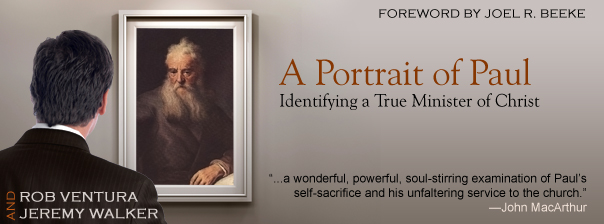
Paperback, 256 pages
Page size, 6 x 9 inches
Retail Price: $18.00
RHB Price: $14.00
Description: What does a true pastor look like, and what constitutes a faithful ministry? How can we identify the life and labors of one called by God to serve in the church of Jesus Christ? To address these questions, Rob Ventura and Jeremy Walker examine how the apostle Paul describes his pastoral relation to the people of God in Colossians 1:24–2:5. By discussing these essential attitudes, qualities, and characteristics of a faithful minister of Christ, A Portrait of Paul provides gospel ministers an example of what they should be, and demonstrates for churches the kind of pastors they will seek if they desire men after God’s own heart.

Chapters in Book:
1. The Joy of Paul’s Ministry
2. The Focus of Paul’s Ministry
3. The Hardships of Paul’s Ministry
4. The Origin of Paul’s Ministry
5. The Essence of Paul’s Ministry
6. The Subject of Paul’s Ministry
7. The Goal of Paul’s Ministry
8. The Strength of Paul’s Ministry
9. The Conflict of Paul’s Ministry
10. The Warnings of Paul’s Ministry
Endorsements:
“The apostle Paul has always been a hero whom I look to as a model for my ministry. His unrelenting faithfulness in the worst kinds of trials is a remarkable example to every pastor and missionary. In the midst of suffering, hardship, and (in the end) the abandonment of his own friends and fellow workers, Paul remained steadfast, dynamic, and utterly devoted to Christ. This invaluable study of Paul’s life from Rob Ventura and Jeremy Walker is a wonderful, powerful, soul-stirring examination of Paul’s self-sacrifice and his unfaltering service to the church. It will both motivate and encourage you, especially if you’re facing trials, opposition, or discouragement in your service for Christ.” —John MacArthur
“For the first two decades of my life as a Christian, I had an abundance of role models who seemed to enflesh for me how a minister of God should live. I realize now that I even took their presence and consistent example for granted. I looked forward to the future under the protection of their mature lives of patience, wisdom, and many kindnesses. The labors of most of those men have come to an end and today I face another situation. There are now numbers of fine younger men in training and starting out on their own ministries. What grace and zeal they have, but there appears to be less role models than the company with which I was favored. What Walker and Ventura have done in this splendid book is to return to the fountainhead of Christianity, to the apostle Paul with the authority the Lord Christ gave to him, his wisdom and compassion, and examine the apostle’s relationship with one congregation, how he advised and exhorted them concerning the demands of discipleship and their relationship with fellow believers. Paul became Christ’s servant and mouthpiece to them and he has left us with a timeless inspired example. He exhorted his readers more than once to be followers of him as he followed God. With a refreshing contemporary style, and with humble submission to the Scripture, these two ministers have given to us a role model for pastoral life. This is a very helpful book and a means of grace to me.” —Geoff Thomas
“What is A Portrait of Paul Identifying a True Minister of Christ? It is, first, the effort of two young pastors to teach themselves and their churches what it means to be a true minister of Christ. It is, second, an exposition of Colossians 1:24–2:5 which attempts to understand how Paul’s ministry gives them and their churches a paradigm of faithful ministry. It is, third, biblical exposition of Scripture in the best historic and Reformed tradition with careful exegesis, sound doctrine, popular appeal and practical application. As such, it is a very challenging book to read as Rob and Jeremy lay before us, for instance, the selflessness and suffering true ministry requires. It is, however, a good, useful, and profitable book to read. It can, and I hope it will, do much good!” —Sam Waldron
Target Readership:
- Churches looking for a pastor will find guidance in what a faithful man of God will look like.
- Christians looking for a church will find a tool by which they can assess the pastors of the flock in the light of God’s Word, finding men to whom they can commit the care of their souls.
- Christians already in a church will be better equipped to pray for their pastors and will further understand what it really means to be shepherded by a man after God’s own heart.
- Ministerial students pursuing the work of the ministry will see a picture of a man they should seek to imitate.
- Pastors will be encouraged to persevere in the high calling of gospel ministry.
About the Authors: Rob Ventura is a pastor of Grace Community Baptist Church in Cumberland, Rhode Island. Jeremy Walker is a pastor of Maidenbower Baptist Church in Crawley, England.
God’s Plan for Israel
Posted: May 4, 2010 Filed under: The Apostasy of Israel Leave a comment Here Paul sets forth that the mission of God will come back to His chosen nation, offering salvation once again to His people.[1] For the last three chapters (9, 10 & 11) Paul has focused upon the salvation of His people and what that meant for Israel. Now in verses 25-32 we come to what Horner calls the “climatic thrust”[2] of what Paul has been trying to get across. I agree with R.C. Sproul when he says,
“Her temple (Israel’s temple) was removed block by block, and her holy city was devastated and given over to the control of the Gentiles, but not forever, according to Luke 21 and Romans 11. There is a future for ethnic Israel and the city of Jerusalem.”[3]
But what becomes the issue in Christianity is the question of how exactly God’s mission will go back to His ethical nation of Israel. Is it being done now? Has that remnant come back now? Is it all of the nation, or only some, that will come back?[4] This chapter in the book of Romans is to show exactly what we have been looking at: how God’s mission was to harden His nation Israel into apostasy to that the gospel would then be sent to the Gentiles.[5] However, it would be recognizing only half of things if we don’t remember that God’s mission will in fact one day go back to Israel, and will bring in those who then will see Jesus as Christ. Paul quotes Isaiah, saying, “Israel will be saved, as it is written, ‘The Deliverer will come from Zion, he will banish ungodliness from Jacob; and this will be my covenant with them when I take away their sins.’” God’s mission now is in sending out the gospel among His elect (spiritual Israel) but, as Isaiah and Paul say, the physical Israel still has a future.[6] There is importance in Paul’s quoting of Isaiah when he says that a “Deliverer” will come. Who might this Deliverer be? Paul answers this in 1 Thessalonians 1:10, naming Christ as mankind’s Deliverer who came to save His people. It is crucial for the Gentiles to understand that God’s mission of redemption is not finished. As Sproul states, we are seeing “the next step of redemptive history-God’s work with ethnic Israel.”[7] It is important that God’s mission is seen in the “fullness of the Gentiles” (Romans 11:25), and also that God’s mission will still move further yet, as “God is not finished with the Jews.”[8]
This is why Paul ends with his glorious doxology; a text which many are so familiar with that they can easily recite it, yet may not even know where it is cited:
“Oh, the depth of the riches and wisdom and knowledge of God! How unsearchable are his judgments and how inscrutable his ways! For who has known the mind of the Lord, or who has been his counselor? Or who has given a gift to him that he might be repaid? For from him and through him and to him are all things. To him be glory forever. Amen.”
Schreiner calls this “the thematic connection to Romans 9-11”[9] because Paul’s theology looks at how God’s mission is played out among both the nation of Israel and the Gentiles; the importance lies in the truth that God has an exact plan and all that has happened, and will happen, is His thought, mind, and wisdom – and oh, how great it is! It is a glorious thing that the Gentiles can enjoy the mission of God’s great gospel which came forth to them; that He would allow such a gift that they may partake of is an indescribable goodness.
Paul’s point in ending Romans 11 is not to keep the mind of the Romans – nor the reader today – in awe of how Israel fell away, allowing Gentiles to be grafted in, and then looking forward to Israel’s return. This is not Paul’s overall focus. Instead, his focus is on the greatness of God! Schreiner states this perfectly as he says,
“The theme of Romans emerges clearly at the end of the discussion on the relationship between the Jews and Gentiles in salvation history (God’s Mission). The salvation of the Jews and Gentiles is penultimate. What is ultimate is the glory of God… The “amen” in the text indicates Paul’s intense wish that God’s purpose to receive glory and praise will be realized.”
Just as Paul did, today’s believers of the gospel ought to stand in awe that God uses all things for His mission of His gospel, in order that His people may come to His Son, Jesus Christ, and enjoy His mission for life here on earth, and eternity. For it is Israel’s God whom the Gentiles and Jews alike serve – a God who, in all things, directs a mission that is perfect in giving His people exactly what they need. I can’t help but wonder: How, when knowing this God and tasting His goodness, can one ever apostatize?
[1] Romans 11:25-32 has become on of the most debated text among theologians today. My suggestion for further study is what I believe to be a proper understanding of the future of Israel, and study on this text. Barry Horner, Future of Israel: Why Christian Anti-Judaism Must Be Challenged. (B&H Publishing: Nashville, 2004), especially pages 253-290. These pages here give what I believe the proper view in the Future of Israel.
[2] Horner, Future of Israel, p. 259.
[4] To what extent of Israel will come back? Cf. For all of Israel: Moo, Romans. p. 710-39. For those elected of Israel that come to Christ at the end of time: Schreiner, Romans. p. 611-30. For those today who are Israel being brought into Christianity: Hodge, Romans. p. 371-82.
[5] Here lies much debate in Reformed and Covenant Theology in Israel’s Future. There are mainly three views; 1. Salvation of Jews and Gentiles today. 2.The saving of a remnant of Jews throughout history, and 3. The salvation of the end-time generation of the Jewish people in the future. Cf. The ESV Study Bible, p. 2177 for a quick understanding on these three views.
[6] I must make mention of the importance of seeing Jesus Christ as Prophet, especially in Luke 21, Matthew 16, 24 & 25 will help shed much light of His prophecy of God’s mission for the nation of Israel.
[9] Schreiner, Romans. p. 635. Cf. Pp. 635-38 on Schreiner’s concluding thoughts on Romans 11:33-36. Here lies the important of Paul using the Old Testament to conclude His thought in how the greatness of God’s mission and plan for all of Israel, both the Jews and Gentiles.
What Made You Who You Are?
Posted: May 3, 2010 Filed under: Country Lyrics, Just for Fun 1 CommentFor the last 2, maybe 3-years I have listened to Montgomery Gentry’s song titled, “Long Line of Losers.” I had loved it, and still do, however it was not till about a week ago that something hit me while being in the library studying and listening to the song. Something so simple, but yet so glorious in the Gospel that I had over looked in this song.
 Here are the lyrics,
“Granddaddy was Irish Cherokee, Ran moonshine from here to Tennessee, Spent half his life in the Montgomery county jail. Grandma she got drunk and left, All her kids on her mamas front steps, Nobody´s heard from her since she hightailed.
I come from a long line of losers, Half outlaw half boozers , I was born with a shot glass in my hand, I´m part hippie a little red neck, I´m always a suspect, My blood line made me who I am.
Daddy never finished school, But he shot one mean game of pool, Took a bullet for stealin´ cars down in Birmingham. Mama always went to church. But we soon found out what her reasons were. She got caught at the local motel with the preacher man
I come from a long line of losers, Half outlaw half boozers , I was born with a shot glass in my hand, I´m part hippie a little red neck, I´m always a suspect, My blood line made me who I am. (3X’s)
I come from a long line of losers……”
Now I am sure the many of you that read this blog cannot see how possibly such song lyrics as this could be enjoyable, let alone mean anything to you personally. However for myself, I love it. I love the beat, the words speak to my own life, where I came from and where I spent the most part of my life growing up back home in Ashland Ohio, I simply love hearing about what made me who I am today, where I came from and actually songs that speak about where people really come from in life.
Yet what hit me last week is that the long line of losers in my own family (not all of them), the outlaw half boozers on the one side, to my own hippie aunt, from my little red neck family on the east side of Kentucky (where the grass is really blue), my suspect past history and yes even my family had for so long been my identification, who I was, what made me, me. However they did not make me who I am.
For setting in the library studying writing and working on my thesis it dawn on me that who I am is found in Jesus Christ and not that of my human history and human nature.
I am adopted, justified, chosen, forgiven, and have direct access to the throne of grace:
- John 1:12 – I am God’s Child.
- John 15:15 – As a disciple, I am a friend of Jesus Christ.
- Romans 5:1 I have been justified.
- 1 Corinthians 6:17 I am united with the Lord, and I am one with Him in spirit.
- 1 Corinthians 6:19-20 I have been bought with a price and I belong to God.
- 1 Corinthians 12:27 I am a member of Christ’s body.
- Ephesians 1:3-8 I have been chosen by God and adopted as His child.
- Colossians 1:13-14 I have been redeemed and forgiven of all my sins.
- Colossians 2:9-10 I am complete in Christ.
- Hebrews 4:14-16 I have direct access to the throne of grace through Jesus Christ.
I am secure, saved, sealed and filled with the Spirit:
- Romans 8:1-2 I am free from condemnation.
- Romans 8:28 I am assured that God works for my good in all circumstances.
- Romans 8:31-39 I am free from any condemnation brought against me and I cannot be separated from the love of God.
- 2 Corinthians 1:21-22 I have been established, anointed and sealed by God.
- Colossians 3:1-4 I am hidden with Christ in God.
- Philippians 1:6 I am confident that God will complete the good work He started in me.
- Philippians 3:20 I am a citizen of heaven.
- 2 Timothy 1:7 I have not been given a spirit of fear but of power, love and a sound mind.
- 1 John 5:18 I am born of God and the evil one cannot touch me.
I am significant, seated with Christ, and I am a workmanship of the Lord’s Kingdom:
- John 15:5 I am a branch of Jesus Christ, the true vine, and a channel of His life.
- John 15:16 I have been chosen and appointed to bear fruit.
- 1 Corinthians 3:16 I am God’s temple.
- 2 Corinthians 5:17-21 I am a minister of reconciliation for God.
- Ephesians 2:6 I am seated with Jesus Christ in the heavenly realm.
- Ephesians 2:10 I am God’s workmanship.
- Ephesians 3:12 I may approach God with freedom and confidence.
I guess after thinking about it, the past history of a man means nothing after they have called out from the world by God. I then sit there in the library thinking, that it was not my human blood line that made me who I am, but Hebrews 9:14, “how much more will the blood of Christ, who through the eternal Spirit offered himself without blemish to God, purify our conscience from dead works to serve the living God.” For it was Christ blood that purchased me that made me who I am.
In case you actually wanted to hear the song I have posted it below.
Take Them OUT of the World
Posted: May 2, 2010 Filed under: Sundays with Spurgeon Leave a comment “I pray not that thou shouldst take them out of the world.” — John 17:15
“It is a sweet and blessed event which will occur to all believers in God’s own time—the going home to be with Jesus. In a few more years the Lord’s soldiers, who are now fighting “the good fight of faith” will have done with conflict, and have entered into the joy of their Lord. But although Christ prays that his people may eventually be with him where he is, he does not ask that they may be taken at once away from this world to heaven. He wishes them to stay here. Yet how frequently does the wearied pilgrim put up the prayer, “O that I had wings like a dove! for then would I fly away and be at rest;” but Christ does not pray like that, he leaves us in his Father’s hands, until, like shocks of corn fully ripe, we shall each be gathered into our Master’s garner. Jesus does not plead for our instant removal by death, for to abide in the flesh is needful for others if not profitable for ourselves. He asks that we may be kept from evil, but he never asks for us to be admitted to the inheritance in glory till we are of full age. Christians often want to die when they have any trouble. Ask them why, and they tell you, “Because we would be with the Lord.” We fear it is not so much because they are longing to be with the Lord, as because they desire to get rid of their troubles; else they would feel the same wish to die at other times when not under the pressure of trial. They want to go home, not so much for the Saviour’s company, as to be at rest. Now it is quite right to desire to depart if we can do it in the same spirit that Paul did, because to be with Christ is far better, but the wish to escape from trouble is a selfish one. Rather let your care and wish be to glorify God by your life here as long as he pleases, even though it be in the midst of toil, and conflict, and suffering, and leave him to say when “it is enough.”
Warning to the Gentiles
Posted: April 29, 2010 Filed under: The Apostasy of Israel Leave a comment When coming to Romans 11:17, Martyn Lloyd-Jones states, “This is a tremendous statement on the most important subject. From the standpoint of the future of the Christian church, and the future of the Jews as a nation, nothing is more important than this.” Romans 11:17-24[1] can get very complicated[2] in a number of ways, however, at the moment we are only dealing with it in how it relates to the mission of God being sent to the Gentiles, and therefore is somewhat simpler to understand.
Romans 11:17-24 reads:
“17 But if some of the branches were broken off, and you, although a wild olive shoot, were grafted in among the others and now share in the nourishing root of the olive tree, 18 do not be arrogant toward the branches. If you are, remember it is not you who support the root, but the root that supports you. 19 Then you will say, Branches were broken off so that I might be grafted in. 20 That is true. They were broken off because of their unbelief, but you stand fast through faith. So do not become proud, but stand in awe. 21 For if God did not spare the natural branches, neither will he spare you. 22 Note then the kindness and the severity of God: severity toward those who have fallen, but God’s kindness to you, provided you continue in his kindness. Otherwise you too will be cut off. 23 And even they, if they do not continue in their unbelief, will be grafted in, for God has the power to graft them in again. 24 For if you were cut from what is by nature a wild olive tree, and grafted, contrary to nature, into a cultivated olive tree, how much more will these, the natural branches, be grafted back into their own olive tree.”
Paul is explaining to the Romans here that the gospel coming to the Gentiles is not because of anything that they have done or deserved. He takes this time to warn the Gentiles that are being brought into God’s covenant people that although God’s mission has come to them, they are not to be boastful of themselves in any way. This warning to the Gentiles is to remind them that, like Israel’s apostasy which made them broken off from God, He can do the same to them. Moo mentions in his commentary that “Gentile believers were apparently convinced that they belonged to a new people of God that had simply replaced Israel.” Jason Meyer also makes mention of this issue, saying, “Paul highlights God ability to graft Israel in order to expose and eliminated Gentile boasting.”[3] Paul does not want the Gentiles to receive God’s mission of the gospel only to see them become prideful or think that Israel is now done with forever. This is very apparent in Paul’s words as he says in verse 17 that the Gentiles “now share in the nourishing root of the olive tree.” This is Paul’s way of getting across that the Gentiles are in no state to boast because they are in dependence upon three things: (1) the root, (2) Christ, and (3) God.[4]
However, there is another major importance to this verses which is crucial to the understanding of what exactly God’s mission was in bringing forth the gospel to the Gentiles. This is found in Paul’s words: “Although a wild olive shoot, were grafted in among the others and now share in the nourishing root of the olive tree.” The gospel which God allowed the Gentiles to partake of comes from the same root which Israel does; in other words, God’s mission to both Israel and the Gentiles benefited from the same “root” – their historical promises, blessings, commands, and identity were from the same place. This now makes all the more sense as we go back to read Paul’s words given before in Romans 9:6 when he stated: “For not all who are descended from Israel belong to Israel.” Lloyd-Jones says in relation to this that “the sixth verse of the ninth chapter is the key to the understanding of the whole of these three chapters.”[5] The importance which is based upon this is the understanding that the New Testament Church, who now reaps the benefits of God’s mission to all the Gentiles, reaps the same covenant keeping God who promised a nation to Abraham and gave seed to Isaac. The “Doctor” refers to this in his message on Romans 11:17 saying,
“Here is the answer: For they are not all Israel, which are of Israel. In other words, as we were taught there and as, indeed, the whole of the Bible in a sense reminds us, two nations came out of Abraham as the father and the root. Abraham leads two to two nations; one of them is a natural nation of people and people, the other is a spiritual nation and people. You remember that he goes on there in the ninth chapter and says, “Neither, because they are the seed of Abraham, are they all children: but, in Isaac shall thy seed by called”.”[6]
Just as Lloyd-Jones saw this importance,[7] it is crucial for us today to understand that the mission of God sending forth the gospel was not to separate His elect! Let me say this again for those who may not understand this due to mere wishy-washy theology, or even the lack thereof: God did not plan two separate plans; He did not have plan A and plan B. He did not plan that His mission be sent out to the Gentiles, but that they reap from a different root. The Gentiles nourish off the same root that Israel did – one root, one covenant promised to Abraham, Isaac, and Jacob. And today the New Testament Church – the Gentile believers – to whom the mission of God has moved forward, nourishes off the same root that the physical nation of Israel once did. Though not are “Israel” physically, Gentiles are considered “Israel” spiritually because we all have that same root!
Gentiles were strangers to the gospel, and were not of the chosen nation of Israel, knowing nothing about God. However, now that God’s mission has been sent forth to the Gentiles, we are now no longer strangers to His covenant, but are fellow saints with those who are the remnant of Israel; brothers with Paul, Peter, John, Luke, Mark, Matthew, Elijah, Solomon, David, Moses, Jacob, Isaac, Abraham, and most of all, with Jesus. It was the very blood of our elder brother, Jesus Christ, which makes us near and gives us this shared root. Christ made us brothers of the Covenant Promise[8] with all the Old Testament saints, and the mission to the Gentiles still goes out and makes more saints of the gospel. We must thank God for this mission that He has allowed us to partake in – His perfect mission, spreading the gospel to all, going out to all of mankind to preach, teach, and speak of the good-news which God has brought forth to us, the Gentiles.[9]
This is why the illustration of the olive tree is extremely important to understand. In it, we see that God brought to the Gentiles the same mission which He gave to Israel, and therefore, the Gentiles are now inheritors along with the Jews and are of the same body as the Jews. There is no difference between them. It is as Ephesians 3:6-8 says,
“This mystery is that the Gentiles are fellow heirs, members of the same body, and partakers of the promise in Christ Jesus through the gospel. Of this gospel I was made a minister according to the gift of God’s grace, which was given me by the working of his power. To me, though I am the very least of all the saints, this grace was given, to preach to the Gentiles the unsearchable riches of Christ.”
There is no favor in Paul’s eyes; simply, those rooted in the covenant by Christ’s purchasing are those that have the favor of God upon them.
Paul explains his illustration of the olive tree and its branches further as he makes his point about the Gentiles not boasting in anything. This is extremely important because it shows us that the church is not to become Anti-Semitic toward Israel. Although it seems hard to believe that a Gentile believer would be so, it can easily seep into the house of God where sin abounds. Paul shows in the text that those who broke off from the tree and root are those who have disobeyed God’s commands, and it was for their apostasy that the “wild-shoot” was grafted in. Here we see once more that God used Israel’s apostasy in order that He may send His mission to the Gentiles so that they can receive the same covenant-keeping promises which Israel had once enjoyed. We can only imagine what it would have felt like to be a Jew at that time, reading Paul’s illustration of the olive tree – a metaphor which is so close and so full of meaning to God’s chosen nation – and yet hear that they have been cut off from it! The olive tree, whose roots dig deep into the ground and is known for being steadfast throughout all weather clearly shows a picture of a covenant that is unshakable, unbendable, and unbreakable; which feeds the Israelites time and time again through battle, through hardship, through famines, and through exiles. And now they are cut from such blessings and instead see these pagan Gentiles becoming part of the dear promise which God gave to the Jews.[10]
Paul says in verses 19-20:
“Then you will say, “Branches were broken off so that I might be grafted in.” That is true. They were broken off because of their unbelief, but you stand fast through faith. So do not become proud, but fear.”
It is extremely easy to read the text and, as a Gentiles, think higher of one’s self than the nation of Israel, but Paul, in the end of verse 20, is once again bringing warning to the Gentiles that they should not become boastful nor proud thinking that they are better or extra-special since God’s mission has moved forward to them, cutting off Israel. In his latest work on Romans, R.C. Sproul speaks of Israel’s apostasy and gives his warning in how it can easily affect Gentiles as well, saying,
“Just as apostasy polluted Israel, it can pollute us. We have seen the unbelievable corruption of mainline churches that have become monuments of unbelief and apostasy. Just as God cuts off the branches of Israel, he will cut off the unproductive Gentile branches.”[11]
This is exactly Paul’s warning: do not boast and do not be prideful; rather, remain humble, because if you puff yourself up and go astray, leaving the gospel truths, you will be in danger and apostatized yourself. Romans 11:22 states: “Note then the kindness and the severity of God: severity toward those who have fallen, but God’s kindness to you, provided you continue in his kindness. Otherwise you too will be cut off.” This is crystal clear – the Gentiles are not to be arrogant to the broken off branches, for it had nothing to do with neither the broken branches nor the ones grafted in, but it is God’s mission that His gospel goes forth to all the nations in this manner. Paul’s point is that the Gentiles must understand that the mission of God has come to them, but just as the apostasy of Israel cut them off, the Gentiles could also be cut off at anytime.
Paul continues laying out the future of God’s mission in Romans 11 saying, “Lest you be wise in your own sight, I want you to understand this mystery, brothers: a partial hardening has come upon Israel, until the fullness of the Gentiles has come in. And in this way all Israel will be saved.”[12] God’s mission for the plan of redemption:
- God’s chooses a nation – Romans 11:1-4
- Israel’s apostasy – Romans 11:5-10
- God’s mission sent to the Gentiles – 11:11-24
- The fullness of the Gentiles bring in the future of Israel – Romans 11:25-32
[1] Jeremiah 11:16-19 and Hosea 14:6-7 uses illustration as Israel being an olive tree. This seems to be why Paul used the example he did, and even more so that when referring to the branches being cut off, may have some focus towards the Jews of his own day.
[2] As getting “complicated” I am referring to the Dispensational take on the passage which uses verses 17-24 in order to define that there are two separate people groups in which are totally different in identity. In comparison with the Covenant view which sees the elect Gentiles partaking of the same benefits and covenantal promises that the nation of Israel had.
[3] Jason Meyer, The End of the Law: Mosaic Covenant in Pauline Theology. Ed. E. Ray Clendenen, (B&H Publishing: Nashville Tennessee, 2009), p. 181.
[4] Meyer, The End of the Law. p.182.
[5] Lloyd-Jones, Romans: Chapter 11. p.103.
[6] Lloyd-Jones, Romans: Chapter 11. p.103.
[7] Cf. Lloyd-Jones, Romans: Chapter 11. p. 101-116 for a further treatment of Romans 11:17 and his dealing with what exactly the “root” is, and how that affects the thinking of the Gentile today.
[8] I am referring here to Galatians 3:26-29 when Paul speaks of being “heirs according to the promise.”
[9] This idea here comes from Ephesians 2:11-20, “being aliens from the commonwealth of Israel” and verses 20, “So then you are no longer strangers and aliens,* but you are fellow citizens with the saints and members of the household of God.”
[10] Cf. For deeper study on Romans 11:18: Isa. 29:10; Deut. 29:4; [Isa. 43:8; Jer. 5:21; Ezek. 12:2; Eph. 4:18]; See Matt. 13:14.
[11] R.C. Sproul, St. Andrew’s Expositional Commentary: Romans. (Crossway: Wheaton, 2009), p. 379.
[12] Cf. For a further study of Romans 11:25-32 see the following references in properly understanding the Future of God’s Mission being sent back to Israel: Isaiah 59:20-21; Ezekiel 37:26-27; Matthew 2:2; Luke 19:9-10; John 12:13, 19:21-22; Romans 1:16-18, 9:20; 11:26; Ephesians 1:9-10, 3:3-6; Hebrews 6:9, 8:12-13, 10:33; 1 Peter 2:9-10.
Israel’s Jealously and their Apostasy
Posted: April 28, 2010 Filed under: The Apostasy of Israel Leave a comment It is important to understand that it was nothing that the Gentiles had done, nor could ever do, but only God’s mission that went forth that brought them to believe in the gospel and receive the blessings of His covenant made with His people. With this understanding, it is then important to see exactly why God brought His mission forth to the Gentiles, and how He uses that today with Israel. So far we have seen the following: Israel’s apostasy as a nation, Israel’s apostasy done by God, Israel’s apostasy used by God for the mission to the Gentiles, and now here in verses 13-16 of Romans 11 we see why God has sent forth the gospel to the Gentiles. The reason is seen in verse 14 as Paul says specifically to the Gentiles, “In order somehow to make my fellow Jews jealous, and thus save some of them.” Paul sees that it is God’s mission to send forth the Gospel to all the nations in order that His chosen nation Israel would become jealous that the Gentiles now reap the blessings of God’s mission, and are enjoying the message of Christ. This mission is to reach the Gentiles, but in doing so it is also to Israel as it will “thus save some of them.” It is Paul’s desire that some of his former Jews would follow him in understanding that God’s mission has laid aside Israel for now, and went forth to the Gentiles for a purpose.
Paul continues and presents a very unique statement in verse 16, which says,[1] “If the dough offered as firstfruits is holy, so is the whole lump, and if the root is holy, so are the branches.” Paul is referring here back to the Jubilee Law which was the foreshadowing of Christ’s rest, thus referring to Christ who gives His people – the elect – His rest.[2]
The Jubilee Law: Leviticus 23:16-17 – “You shall count fifty days to the day after the seventh Sabbath. Then you shall present a grain offering of new grain to the LORD. You shall bring from your dwelling places two loaves of bread to be waved, made of two tenths of an ephah. They shall be of fine flour, and they shall be baked with leaven, as firstfruits to the LORD.
In these words, Paul seems to be showing that Israel still belongs to Him, and now that the mission has gone forth to the Gentiles, they are also part of spiritual Israel; therefore illustrating that Israel, as was in the Old Testament, and spiritual Israel, are both of the same entities.
[1] Cf. For how this illustration fits into the Future of Israel Barry Horner, Future Israel: Why Christian Anti-Judaism Must Be Challenged. Ed. E. Ray Clendenen (Nashville: Tennessee, 2004), p. 258.
[2] Cf. For further explanation of this in Moo, NIC: Romans, p. 697-701 and Schriner, ECNT: Romans. p.599-601.
Are Book Blurbs Necessary?
Posted: April 27, 2010 Filed under: Books 6 Comments If a book had not one single blurb for it, would you still buy the title if you were interested in it?
Better yet, you tell me…
Do you even read book blurbs?
Do you think blurbs are easily given to authors?
Do you respect what is said by the guys that seem to constantly blurb books all the time?
Please leave your comments below, I’d like to read them.
Jesus Christ the Ladder
Posted: April 26, 2010 Filed under: Christ in the OT, Jesus Christ 1 Comment Genesis 28: 10-22 – Jacob left Beersheba and went toward Haran. And he came to a certain place and stayed there that night, because the sun had set. Taking one of the stones of the place, he put it under his head and lay down in that place to sleep. And he dreamed, and behold, there was a ladder set up on the earth, and the top of it reached to heaven. And behold, the angels of God were ascending and descending on it! And behold, the LORD stood above it and said, “I am the LORD, the God of Abraham your father and the God of Isaac. The land on which you lie I will give to you and to your offspring. Your offspring shall be like the dust of the earth, and you shall spread abroad to the west and to the east and to the north and to the south, and in you and your offspring shall all the families of the earth be blessed. Behold, I am with you and will keep you wherever you go, and will bring you back to this land. For I will not leave you until I have done what I have promised you.” Then Jacob awoke from his sleep and said, “Surely the LORD is in this place, and I did not know it.” And he was afraid and said, “How awesome is this place! This is none other than the house of God, and this is the gate of heaven.”
So early in the morning Jacob took the stone that he had put under his head and set it up for a pillar and poured oil on the top of it. He called the name of that place Bethel, but the name of the city was Luz at the first. Then Jacob made a vow, saying, “If God will be with me and will keep me in this way that I go, and will give me bread to eat and clothing to wear, so that I come again to my father’s house in peace, then the LORD shall be my God, and this stone, which I have set up for a pillar, shall be God’s house. And of all that you give me I will give a full tenth to you.”
Christ the ladder: As he rests overnight, Jacob has a dream, which centers on a ladder set up on the earth, and the top of it reached to heaven. The Hebrew term translated “ladder” could possibly denote a stairway similar to those found on ancient ziggurats. What matters most is not the precise shape of this structure but its purpose; it provides a bridge between heaven and earth, revealing that God is still committed to making the earth his dwelling place. Jesus identifies himself as the ladder linking earth and heaven…
John 1:43-51 – The next day Jesus decided to go to Galilee. He found Philip and said to him, “Follow me.” Now Philip was from Bethsaida, the city of Andrew and Peter. Philip found Nathanael and said to him, “We have found him of whom Moses in the Law and also the prophets wrote, Jesus of Nazareth, the son of Joseph.” Nathanael said to him, “Can anything good come out of Nazareth?” Philip said to him, “Come and see.” Jesus saw Nathanael coming toward him and said of him, “Behold, an Israelite indeed, in whom there is no deceit!” Nathanael said to him, “How do you know me?” Jesus answered him, “Before Philip called you, when you were under the fig tree, I saw you.” Nathanael answered him, “Rabbi, you are the Son of God! You are the King of Israel!” Jesus answered him, “Because I said to you, ‘I saw you under the fig tree,’ do you believe? You will see greater things than these.” And he said to him, “Truly, truly, I say to you, you will see heaven opened, and the angels of God ascending and descending on the Son of Man.”
Even more interesting is that while human beings want to ascend to heaven (as reflected in the Tower of Babel story, Genesis 11, God is interested in making the earth his temple-city. Verse 51 is an allusion or quotation of Genesis 28:12, and Jacob’s ladder is replaced in the verse by “the Son of Man.” The title “Son of Man” in John’s Gospel has the basic understanding of His origin in heaven (6:27, 33), that He will return again to His place of glory (6:62) by way of the cross (3:14; 8:28; 12:23, 34; 13:31). The divine origin and authority of Jesus is suggested by the title “Son of Man.” It was the Messianic title that Jesus chose for Himself. Here Christ does not make mention of the ladder and replaces it with Himself, because Christ is the only way to the Father, Christ is the ladder which Jacob looked forward to, and is the ladder which we the Church have today linking us on this earth to our Heavenly Father which art in the heavens.
The Jewel-Closet of Our Heart
Posted: April 25, 2010 Filed under: Sundays with Spurgeon Leave a comment
“And because of all this we make a sure covenant.”—Nehemiah 9:38.
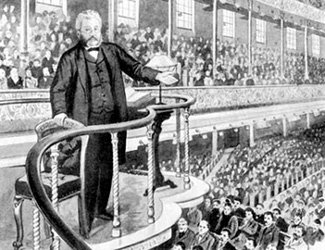
THERE are many occasions in our experience when we may very rightly, and with benefit, renew our covenant with God. After recovery from sickness when, like Hezekiah, we have had a new term of years added to our life, we may fitly do it. After any deliverance from trouble, when our joys bud forth anew, let us again visit the foot of the cross, and renew our consecration. Especially, let us do this after any sin which has grieved the Holy Spirit, or brought dishonour upon the cause of God; let us then look to that blood which can make us whiter than snow, and again offer ourselves unto the Lord. We should not only let our troubles confirm our dedication to God, but our prosperity should do the same. If we ever meet with occasions which deserve to be called “crowning mercies” then, surely, if He hath crowned us, we ought also to crown our God; let us bring forth anew all the jewels of the divine regalia which have been stored in the jewel-closet of our heart, and let our God sit upon the throne of our love, arrayed in royal apparel. If we would learn to profit by our prosperity, we should not need so much adversity. If we would gather from a kiss all the good it might confer upon us, we should not so often smart under the rod. Have we lately received some blessing which we little expected? Has the Lord put our feet in a large room? Can we sing of mercies multiplied? Then this is the day to put our hand upon the horns of the altar, and say, “Bind me here, my God; bind me here with cords, even for ever.” Inasmuch as we need the fulfillment of new promises from God, let us offer renewed prayers that our old vows may not be dishonoured. Let us this morning make with Him a sure covenant, because of the pains of Jesus which for the last month we have been considering with gratitude.
Israel’s Apostasy was for Your Salvation
Posted: April 23, 2010 Filed under: The Apostasy of Israel Leave a comment
Paul continues to unfold the mysteries of the issue of Israel’s apostasy, explaining why this falling away has occurred. He first poses a question: “So I ask, did they stumble in order that they might fall? As Paul so often does, he then answers with certainty, saying, “By no means!” then showing us his reasoning for saying so: “Rather through their trespass salvation has come to the Gentiles, so as to make Israel jealous.” It is clear through Paul’s words that it was the hand of God that planned the apostasy of His chosen nation – His chosen people – so that the Gentiles could come to know the gospel and find salvation in Christ. The apostasy of Israel is what caused the mission of God to go from a small group of people to spread among all of mankind, going forth among all the nations, making Himself known in a greater way than ever before. This enabled all to know the wonderful news which Israel rejected – that Jesus Christ saves! It should never be that anyone would think that God would blind His own nation for no purpose, because the truth is that God’s plan is far greater than anyone could imagine; nothing is done without a purpose. This is what Paul is saying: God gave the Romans the gospel, but in order to do so, He had to harden His people and make them jealous by offering the salvation that they wanted to partake in – namely, Jesus Christ their King – to the Gentiles. Paul is displaying trust in his words; trust that Israel’s apostasy is for a reason, and that the reason is the mission of God being brought forth to the Gentiles. The ESV Study Bible explains this in a simple manner, stating:
“Israel’s hardening is not the final word. God planned salvation history so that Israel’s trespass would open salvation for the Gentiles, and the Jews in turn would be provoked to jealousy when they see Gentiles being saved and enjoying a relationship with God.”[1]
Charles Hodge says,
“As the result and design of the rejection of the Jews was the salvation of the Gentiles, so the conversion of the latter was designed to bring about the restoration of the former. The Gentiles are saved in order to provoke the Jews to jealousy.”
Furthermore, Thomas Schreiner explains,
“The lapse of Israel is part of God’s all-encompassing purpose, for by means of their trespass salvation has been given to the Gentiles… God planned that the Jews would reject the gospel in large numbers and in response to their rejection the message was proclaimed to the Gentiles.”[2]
It is important to note here that Paul begins this section in parallel style with verses 1-10 of Romans 11; that is, he first asks a question, answers it, and then gives his reasoning. Paul makes it clear that the apostasy of Israel was not total, and therefore, it was not final. The mission which was sent to the Gentiles gave the promises and blessing of Christ, as was God’s purpose; however, there is even more to this. Paul makes it clear in his reasoning at the end of verse 11: “Salvation has come to the Gentiles, so as to make Israel jealous.” God’s mission is being laid out in Paul’s theology as follows:
- God’s mission to his covenant Nation (Genesis 12, 15, 17, 20 & 22)
- God’s mission revealed in Jesus Christ (The Gospels)
- God’s mission in hardening Israel because of their Apostasy (Romans 9-11 & 11:1-10)
- God’s mission sent forth to the Gentiles (Romans 11:12-24)
- God’s mission uses the Gentiles to make Israel Jealous (Romans 11:12-14)
- God’s mission sent to Israel (Romans 11:25-32)
Charles Hodge says it best like this:
“The stumbling of the Jews was not attended with the result of their utter and final ruin, but was the occasion of facilitating the progress of the Gospel among the Gentiles. It was, therefore, not designed to lead to the former but to the later result. From this very design it is probable that they shall be finally restored, because the natural effect of the conversion of the Gentiles is to provoke the emulation of the Jews. That the rejection of the gospel on the part of the Jews was the means of its wider and more rapid spread among the Gentiles seems to be clearly intimated in several passages of the New Testament.”[3]
This is the reason that Luke can say – as he does in Acts – that the message of salvation was first preached to Israel in order that they might reject it, fulfilling Isaiah’s prophecy:[4]
“But I said, ‘I have labored in vain; I have spent my strength for nothing and vanity; yet surely my right is with the LORD, and my recompense with my God.’ And now the LORD says, he who formed me from the womb to be his servant, to bring Jacob back to him; and that Israel might be gathered to him— for I am honored in the eyes of the LORD, and my God has become my strength—he says: ‘It is too light a thing that you should be my servant to raise up the tribes of Jacob and to bring back the preserved of Israel; I will make you as a light for the nations, that my salvation may reach to the end of the earth.’” (Isaiah 49:4-6)
Luke speaks of this in the following verses:
Acts 13:46 – “And Paul and Barnabas spoke out boldly, saying, ‘It was necessary that the word of God be spoken first to you. Since you thrust it aside and judge yourselves unworthy of eternal life, behold, we are turning to the Gentiles.’”
Acts 28:28 – “Therefore let it be known to you that this salvation of God has been sent to the Gentiles; they will listen.”
Some may have a hard time grasping that an all-loving God would claim Israel as His chosen nation and then harden them; it may seem hard to understand how this could be for good. But Paul, understanding that this would be so, says in verse 12, “Now if their trespass means riches for the world, and if their failure means riches for the Gentiles, how much more will their full inclusion mean!” The bad news of Israel’s apostasy was used by God to send forth His mission – the good news of His Son – to the Gentiles of the world. That is an all-loving God – a God who would use bad and good to carry out His mission to His people that are of Abraham (Israel) and, as Paul says, “Isaac” (Gentiles). Out of the apparent evil, the goodness of God’s mission is always done. The “Doctor” Martyn Lloyd-Jones preached it this way:
“As a result of Jewish unbelief two apparently impossible things follow, namely that the Gentiles should hear and believe the Gospel and, through that, the Jews might be made desirous of receiving it…. There is a very great purpose here. God knows what He is doing. He has a plan.” [5]
The plan is God’s mission being transferred from inside of one nation to being sent out to all the nations among the earth. Salvation to the Gentiles has now been placed in the mission of God, and is still today where the history of redemption is at. The stumbling of Israel was the salvation to the Gentiles, for it was the apostasy of Israel that brought the mission of God – the sending the gospel to the Gentiles.
[1] The ESV Study Bible. Crossway: Wheaton, 2008), p. 2176.
[2] Schreiner, ECNT: Romans, p. 594.
[4] It is also important to mention here the latter portion of Isaiah’s prophecy 49:8-26 is that of the later future of Israel that Paul speaks of in Romans 11:25-32.
[5] Lloyd-Jones, Romans: Chapter 11. p.72.
Did God Harden Israel into Apostasy?
Posted: April 22, 2010 Filed under: The Apostasy of Israel Leave a comment Paul explains as bluntly as one could exactly what the apostasy of Israel is for. Since Israel as a whole nation failed to seek God and apostatized from Him, only His remnant will obtain it; but far worse is that the rest “were hardened,” Paul says in Romans 11:7.
Israel of the flesh sought salvation in their own way – a way of Law-keeping only, salvation by their own works of righteousness – and they constantly made rules and regulations trying to seek salvation in that way, no matter how many times God continued to save them time after time. They tried to seek their Messiah and obtain salvation by their works of the Law, and never once came to the understanding that they could not become right with God by the Law only. Their own works of the Law could not bring them near – not even close! – to God, and seeking salvation this way was due to the lack of knowledge Israel had because of their unbelief. But then even worse, when they left God altogether they no longer had a chance of coming to the gospel at all anymore, for finally in God’s plan the time was too late – they were now hardened and cold to Christ. Here it is crucial to mention Paul’s thought from Romans 10:3, as when looking at Israel’s seeking of righteousness he states: “For, being ignorant of the righteousness of God, and seeking to establish their own, they did not submit to God’s righteousness.” Israel’s hope in obtaining salvation in the Law ended in the Lord Himself blinding them – because of their sin – from His blessing, because of His overall plan for the gospel. What that exactly is, is something we will deal with later in this chapter; but for now it is important to look at what Paul quotes in verses 8-10: “As it is written, God gave them a spirit of stupor, eyes that would not see, and ears that would not hear, down to this very day.” Here Paul is bringing together the text of Isaiah 29:10 and Deuteronomy 29:4, saying that God is the one that has hardened Israel so they would apostatize and not see nor hear of the truth in Christ – that is, the gospel. This is why Israel failed in what it was to seek; in their apostasy they were blinded because of God’s plan for not only His nation, but for all of His people.
Paul uses a prayer from King David (from Psalm 69:22-23) to show their apostasy, saying, “Let their table become a snare and a trap, a stumbling block and a retribution for them; let their eyes be darkened so that they cannot see, and bend their backs forever.” For what purpose does Paul have in quoting this from David to the Romans? It is to show the judgment which is to come upon God’s chosen people for their sin and unbelief of Christ. Thomas Schreiner makes this important point when he states: “Paul strengthens the emphasis on the activity of God by inserting the phrase “spirit of stupor.”[1] The significant meaning Paul is getting across to the Romans is that this is God’s doing, this is God’s plan, and this was always foreknown. Israel did not want to hear, see, nor do the Word of God, and because of their apostasy, judgment has now come upon them as a nation – now their eyes are literally blind to the gospel and they are bent from the truth of Christ. God turned the blessings He had given to Israel into the table of blindness and bitterness towards Christ because of their apostasy from His Word. What Israel had left was the very thing that God had given His people to follow – the Word of God; the actual words in which He spoke for His fame and His glory – and they turned their backs toward that, which is something God then used for their own damnation as He kept their ears and eyes closed to the coming Christ. Schreiner makes another key point here about Paul’s dealing of Psalm 69, saying the following:
“The very fact that Ps. 69 is quoted is significant since this Psalm is often used or alluded to in the NT in relationship to the life, ministry, and death of Jesus Christ (Matt. 27:34, 48; Mark 3:21; 15:23, 36; Luke 13:35; 23:36; John 2:17; 15:25; 19:29; Acts 1:20; Rom. 15:23; Heb. 11:26; cf. Also Phil. 4:3; Rev. 3:5, 16:1).”[2]
It is extremely thought provoking that David, when saying this in Psalm 69, would use it as a curse against his enemies, but then here in Romans 11 we see Paul using it against David’s own lineage – the nation of Israel. Even more interesting is that Paul is using these Old Testament Scriptures to tell the Romans of the fulfillment in them. But what fulfillment, and where? Paul seems to be using David’s quote to tell the Romans that the Jews had already not acknowledged that Jesus was the Christ and that their apostasy had already begun in the fullness as they as a whole nation have apostatized.[3] Paul’s prayer here is a prayer that was once used by David as a prayer for shelter form Israel’s enemies, and is now used as a fulfillment of Paul’s prayer of God’s judgment upon Israel’s apostasy as a nation. How fitting it would be for Paul to expound upon the prophecy of Isaiah 6:9-10:
“And he said, “Go, and say to this people: “‘Keep on hearing, but do not understand; keep on seeing, but do not perceive.’ Make the heart of this people dull, and their ears heavy, and blind their eyes; lest they see with their eyes, and hear with their ears, and understand with their hearts, and turn and be healed.”
The words of old now have come true, and Israel’s misunderstanding is being revealed by Paul to the Romans. Jesus Christ Himself spoke to His very own people saying in Matthew 13:13-16:
“This is why I speak to them in parables, because seeing they do not see, and hearing they do not hear, nor do they understand. Indeed, in their case the prophecy of Isaiah is fulfilled that says: ‘You will indeed hear but never understand, and you will indeed see but never perceive. For this people’s heart has grown dull, and with their ears they can barely hear, and their eyes they have closed, lest they should see with their eyes and hear with their ears and understand with their heart and turn, and I would heal them.’ But blessed are your eyes, for they see, and your ears, for they hear.”
Only Christ’s disciples seem to be part of the remnant that could see and could hear Christ, but the time had come for Israel’s apostasy to usher in something else far greater than what had taken place over the last 4,000 years among the nation of Israel.
But what great news could come from the apostasy – this falling away, blindness, and hardening – of the LORD’s chosen nation of people? What is the Lord doing with Israel? Paul makes it known that the Lord must do this because His mission includes more than physical Israel. His mission of the gospel is to go out to all the nations, bringing in all of His peoples among the earth. God assures us that the prophecies which were written in the Old Testament concerning Israel’s judgment are for real. No matter what, things are being fulfilled just as the prophet(s) said they would, and thus we see Israel’s apostasy as part of this. Paul makes it unquestionable that the Old Testament spoke of the nation of Israel as it was at the present time. With that regard, he also brings out the truth that there is harmony and agreement throughout all of Scripture; as King David’s words were true of the judgment that was to come upon Israel. We have here in the first ten verses of Romans 11 two main points which Paul makes about Israel, as he reveals the plan of redemption for God’s chosen elect:
1. Israel failed to obtain what it was seeking
2. Israel apostatized for the final time
The overall point brought to light in verse 10 is that the prophecy of David has been fulfilled, and that Israel has had their eyes darkened so that they cannot see, and burdens remain upon them as they bow down their back always because their apostasy has hardened them too far.
[1] Thomas Schreiner, ECNT: Romans. Baker: Grand Rapids, 1998), p. 587.
[2] Schreiner, ECNT: Romans. p.588.
[3] For an in-depth treatment in dealing with Paul’s use of Ps. 69 Cf. Douglas Moo, NICNT: The Epistle to the Romans. p. 679-83 and an understanding of Salvation in the Historical sense Cf. Der Brief an die Romer, teilband 3: Rom 12-16. Evangelisch-Katholischer Kommentar zum Neuen Testament 6/3. Zurich: Benziger/Neuirchen-Vluyn: Neukirchener Verlag.
God’s Election of a Remnant from Israel
Posted: April 21, 2010 Filed under: The Apostasy of Israel 1 Comment Psalm 94:14-15 states:
“For the LORD will not forsake his people; he will not abandon his heritage; for justice will return to the righteous, and all the upright in heart will follow it.”
Romans 11: 7-10 states:
“What then? Israel failed to obtain what it was seeking. The elect obtained it, but the rest were hardened, as it is written, God gave them a spirit of stupor, eyes that would not see and ears that would not hear, down to this very day. And David says, Let their table become a snare and a trap, a stumbling block and a retribution for them; let their eyes be darkened so that they cannot see, and bend their backs forever.”
When dealing with Romans 11, a question arises and stands out: How could God possibly allow the apostasy of His own physical nation, Israel, let alone do it Himself, when He had promised beforehand to never forsake His people? There seems to be quite a contradiction between Scriptures, because how can Paul say in Romans 11:7-10 that Israel was hardened into apostasy when David writes in Psalm 94:14-15 about how the LORD’s relationship with His people will never be forsaken? The answer to this is actually rather easy, in that God’s plan for the redemption of His people throughout history included more than physical Israel. Paul has given us the answer already in Romans 9:6-7:
“But it is not as though the word of God has failed. For not all who are descended from Israel belong to Israel, and not all are children of Abraham because they are his offspring, but through Isaac shall your offspring be named.”
Not all of “Israel” is from the actual physical nation of Israel. But how does that help answer our question? The answer lies in the fact that God’s people are not held to a specific ethnic group, but are all of mankind. This means that a Gentile can reap the benefits of the gospel by becoming a believer and obtain the same benefits that were promised to Abraham and given to Isaac. In God’s redemptive historical plan, He worked in such a way that the apostasy of the nation of Israel would bring forth the mission of the gospel to the Gentiles. To put it in the simplest way possible – to fulfill God’s plan for the gospel to go forth to all the nations in order to bring in all of His elect (both physical and spiritual Israel) He had to harden His chosen nation of people, so that they would be made jealous and watch the mission of God proclaim the gospel to all of His Israel – that is, His people.
Remember that here we are looking at Israel’s apostasy (Romans 9:20-10:21) and how that sent forth a mission to the Gentiles, and not the main thrust of Romans 11, which I believe to be about Israel’s future. When coming to the beginning of Romans 11 Paul, as he does many times throughout the book of Romans, begins chapter 11 with a question: “I ask, then, has God rejected his people?” He then answers by saying, “By no means!” The importance of this is that one can understand that although Israel as a nation has apostatized, they still have a future. Their rejection of God, the Son of God, and the gospel has not brought them to an end for all time, but has blinded them for the time being in order that the gospel can be sent forth to all of the nations.
Paul starts the chapter with God’s rejection/Israel’s apostasy for several reasons:
- There is a future for Israel
- Paul identifying himself as a Jew
- God does not chase away His people
These are each important, as Paul will continue throughout the rest of the chapter to talk about these subjects. He looks at the first issue, assuring that there is still a future for Israel after the Gentiles have come in. Secondly, Paul identifies himself as a Jew coming from the seed of Abraham, to explain to his audience that one who may still be a Jew today can come to the gospel and partake of the salvation in Christ Jesus. Thirdly, Paul wants it to be made known that even though Israel is hardened and jealous of what the Gentiles have in the gospel, God does not forget “His people whom He foreknew.” It is of utmost importance to understand here that Paul does not say this of Israel as a nation or a race, but it is Israel’s elect that are foreknown. This is important because Paul is not referring to the whole nation that had apostatized, saying that they will all be saved; rather, he speaks of a remnant of those who are God’s “people whom He foreknew” that will come back to Him for the Jewish race.[1] This is the same word ‘foreknew’ which Paul used earlier on, in Romans 8:26: “For those whom he foreknew he also predestined to be conformed to the image of his Son, in order that he might be the firstborn among many brothers.” We know that Paul is only referring to those that are the “foreknown” as the remnant because instead of talking about the nation as a whole he goes directly into giving the example of Elijah and the remnant of God’s people there.[2]
Paul chooses this unique example of Elijah to show both the apostasy of Israel as a whole, and also those whom were a part of a believing remnant at Elijah’s time. Paul quotes Elijah’s prayer as an example to the Romans – “Lord, they have killed your prophets, they have demolished your altars, and I alone am left, and they seek my life” – so that the Romans and today’s Gentile believers would understand that the apostasy of Israel was planned, just as all things had been before, by the hand of God. As God had saved a remnant of Israel during the time of Elijah, He has saved a select number of the nation of Israel today; however, they had to be hardened because of the plan God had for all of His people – not just the actual physical nation of Israel, but all of Israel, His children. Similar to Elijah’s time, Paul was writing during the worst of times, when Israel was covered in apostasy; the whole nation had basically fallen away, left God, disobeyed the Law, made their own legalistic laws, lost the blessing of God, and worshipped themselves more than God. They had forgotten what God had done for them, they had forgotten their heritage from Abraham, they had forgotten their merciful God that brought them out of Egypt, and the blessings God that gave them (their land, their King, etc.) as they so wanted. The people of Elijah’s time had apostatized, and it was no different now; therefore, Paul is showing that Israel’s apostasy as a nation happened for a reason – it was the plan of God, and it had to happen for the gospel to leave them as a nation and go forth in its’ mission to all the nations – that is, including the Gentiles.[3]
The subject of Israel’s apostasy here enables Paul to bring forth his thoughts and explain that the nation of Israel had been hardened by God for a purpose. Their apostasy shows that they had totally left what they had once professed; that those who had served the one and true God now – at this point in redemptive history – left the true God who had done so much for them and kept them time and time again. They had become this way due to repudiating the faith they had once professed as a nation.
We see in verses 4-5 that God had saved some from apostasy: “I have kept for myself seven thousand men who have not bowed the knee to Baal. So too at the present time there is a remnant, chosen by grace.” The point here is that in the same way that He had saved some from apostasy before, He is doing so again in order to remain gracious to His nation. Those who are a part of the remnant are of the elected grace in which God gives His people, as it says in verse 6, “But if it is by grace, it is no longer on the basis of works; otherwise grace would no longer be grace.” But for those that are not a part of the remnant of Israel, what happens? It is their apostasy which has blinded the nation as a whole and therefore they no longer see the gospel. It is this purpose that brings about the difference between the Old and New Covenant, as finally here the last apostasy of Israel happens, which brings total hardness upon the nation until “the fullness of the Gentiles has come in” (Romans 11:25).
[1] Douglas Moo, NICNT: The Epistles to the Romans. (Eerdmans: Grand Rapids, 1996), p. 674-5 for there he deals with the importance of why Paul refers to “the foreknew” instead of continuing to use “Israel.” Also see Charles Hodge, Romans. (The Banner of Truth Trust: Carlisle, 1972), p. 354 for his dealing with the different senses of the term “foreknew.”
[2] Leon Morris, The Epistle to the Romans. Eerdmans: Grand Rapids, 1987), p. 398-405 addresses the importance behind Paul’s use of Elijah and Israel for his example of a remnant of Israel that is left.
[3] Cf. For a proper view on God’s decree of the Gospel to the Gentiles, Robert Haldane, Geneva Series of Commentaries: Romans. (Carlisle: The Banner of Truth Trust, 1958), p. 523-5.
C. J. Mahaney’s Blurb for De Young is “Out of Control!”
Posted: April 20, 2010 Filed under: C. J. Mahaney, Just for Fun, Kevin DeYoung 14 Comments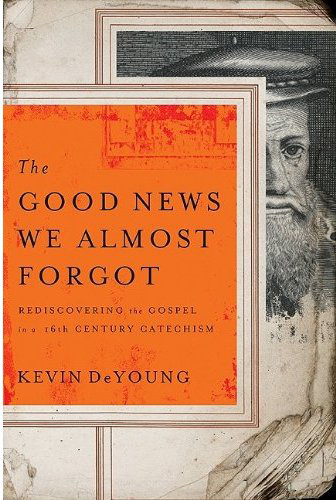 Last week at the Band of Bloggers Conference I received 12-titles from a number of different publishers. The book I was looking forward to getting the most was Kevin De Young’s newest title, The Good News We Almost Forgot: Rediscovering the Gospel in a 16th Century Catechism.
After getting back home to Grand Rapids, placing the other 11-titles on my shelf, I kept out De Young’s new title and starting reading (like I always do) the book blurbs and could not believe what I read. C. J. Mahaney’s blurb states, “I’m sure this will be the best book on the Heidelberg Catechism I’ve ever read. I know it will be the frist.”
“I’m sure this WILL be…” C. J. did you really write a blurb for a book that you did not even read yet? I am speechless, then again it seems today that book blurbs are just about who you have writing them, and not what they have to say.
“The best book on the Heidelberg Catechism I’ve ever read…” C. J. are you unaware of the massive amount of material that has been written over the past 400-years on The Heidelberg Catechism, and yet never reading any of them, you state that this will be the best?
No offense to Kevin De Young, (and I do love his writing & speaking) but I can name a number of different books and material that are above and beyond Kevin De Young’s 2-3 page commentary/exposition per Lord’s Day’s in The Heidelberg Catechism. Work like:
- Zecharias Ursinus, Commentary onThe Heidelberg Catechism
- Lyle D. Bierma with Paul W. Fields and Charles D. Gunnoe and Karin Y. Maag, An Introduction to the Heidelberg Catechism
- George W. Bethune, Lectures on the Heidelberg Catechism
- Henry Kersten’s 52-sermons on the Heidelberg Catechism
- Joel Beeke’s Heidelberg Catechism Sermons
- Herman Hoeksema’s 3-volumes on The Triple Knowledge: An Exposition of the Heidelberg Catechism
- William Ames’s A Sketch of the Christian’s Catechism.
“I know it will be the first.” Seriously? The first book you ever read on the Heidelberg Catechism and you are blurbing it? Does anyone else see this as ridiculous as I do? It seems that a pop-icon in evangelicalism can write blurbs for other author’s without even knowing what they am talking about? Can I start writing blurbs on books for the Sovereign Grace movement on how the charismata still exists today in the Church? That’d be fun!
Better yet than all of this, is that Moody Publishing, a Dispensational Publishing House (which I am sure now is not Classical Dispy) published Kevin DeYoung, a pastor from the Reformed Church of America on The Reformed Heidelberg Catechism. Who would have ever thought the day would come when a Dispensationalist started publishing material for Confessional Covenant Theology. However, I like it, keep it up Moody!
Romans 11 and Apostasy
Posted: April 19, 2010 Filed under: The Apostasy of Israel 3 CommentsWhen considering the Book of Romans, it is evident that it is filled with theology as it focuses on topics including Election, Perseverance, Justification, Predestination, and Calling. But when coming to Romans 11 in particular, theology becomes even more specific. This chapter looks at the following: Why Israel is broken off; Is there a difference between the Gentiles and Israel or are they the same?; What is the “root” in verse 16?; Why exactly did God harden the nation of Israel?; Why does Paul quote Elijah and David?; Is the church today making the Jews jealous or acting much like the same?; Is there another chance for the nation of Israel?; How does Israel’s disobedience lead to the Gentiles’ mercy? These are just some of the major questions brought out in the text. Even the “Doctor” – Martyn Lloyd-Jones – saw this hardship while dealing with this text, and as he starts his commentary on Romans 11 he says, “In many ways I would say that it is much more difficult than either chapter 9 and 10.”[1] However, what happens in these central chapters (Romans 9-11) sheds much light on the purpose behind Israel’s apostasy as a nation, and the mission of God going forth to the Gentiles. In all of the theology that that is packed into these very important chapters of Romans one question should come to thought, “Did God make it that His own nation (Israel) would apostatize from Him?” And if that answer is yes, then “Why would God harden His own nation, so that they would do this?”
When dealing with Romans 11 it is good to keep these questions in the back of your mind, especially while looking at the subject of Israel’s hardening bringing forth the gospel to the Gentiles. Dr. George Eldon Ladd brings the point of this chapter together when he states in his New Testament Theology:
“The rejection of Christ by Israel and its subsequent fall was not a mere accident of history but a factor in God’s redemptive purpose – an event in Heilsgeschichte. Even in the rejection of Israel, God had a purpose: that by Israel’s fall, salvation might come to the Gentiles (Rom.11:11). Then Paul makes a key statement: “Now if the fall of them be the riches of the world, and the diminishing of them the riches of the Gentiles, how much more their fullness?” (11:12).[2]
How does a Calvinist explain something like this? How can one minute person say that God does not wish for apostasy (His people to leave Him), and yet the next minute say that God Himself made His people apostatized from Him? Romans 11 helps to shed light on this theological issue.
[1] D. M. Lloyd-Jones, Romans: Chapter 11. (Banner of Truth Trust: Carlisle, 1998), p. 1. Cf. Pages 1-6 for D. M. Lloyd-Jones’s general introduction on the nation of Israel before dealing critically with Romans 11.
[2] George Eldon Ladd, A Theology of the New Testament. (Eerdmans: Grand Rapids, 1993), p. 607.
Apostasy in the Old Testament
Posted: April 16, 2010 Filed under: Apostasy in the Old Dispensation 1 CommentApostasy: claiming to know the one and only true God, yet not following His truth, His commands, and what He gives to His people. Cain offered a sacrifice to the one and true God, but had no faith. Ham saw with his very eyes the grace of God and was saved from the flood, yet left the covenant that was given to him and his family. Esau, the first born of Isaac, the first born who always receives the blessing, sold his blessing for a bowl of food because he was hungry. The people of the wilderness, saved from the hand of Egypt’s slavery, crossed the Red Sea and were in the very hand of God, yet fell into apostasy because they thought they knew better than the God that saved them. Then Jeroboam, a king over the people that God had protected and saved for nearly 4,000 years, thought that he knew better than the very covenant which God gave. Apostasy, like that of salvation, has its historical roots among the Lord’s people all throughout the Old and New Testaments.
Although at times in the Old Dispensation apostasy may seem like an individual act—such as with men like Cain, Ham, and Jeroboam—but in all of these cases, individual apostasy leads to corporate apostasy from the covenant which God has planned to save His elect people. Concluding thoughts upon apostasy in the Old Testament can only end with thinking of the LORD Himself. A person—a finite being—who has been brought into knowing the infinite God of creation, and who then walks away and breaks covenant in order to follow their own desires only deserves total damnation. And yet God uses both the salvation of His people and the apostasy of His people for His purpose, and His good.
Often, when dealing with themes of the Old Testament such as salvation, Israel, and redemption, one speaks of the history of redemption or the plan of salvation in which the God of the covenants has come into with mankind. This is most commonly called in reformed theology, “redemptive history.” However, as we can see, the Old Testament has an apostate history as well. How God uses both of these themes for His good is hard for the human mind to comprehend; but for one who is in the covenant that God has given, the history of redemption for His people is much greater. When understanding the sovereign control of God in allowing apostasy through history, the one in the covenant can even enjoy the plan which God has made, and allowed, because of the fall of Adam/mankind. In this, the God of the covenants is that much more beautiful, and the coming Christ is that much more special.
Jeroboam’s Apostasy and the Davidic Covenant
Posted: April 14, 2010 Filed under: Apostasy in the Old Dispensation Leave a commentLastly, the Davidic covenant which was given to David, for the people, with the promise of the Messiah kingship, ends the covenants in the Old Testament. Like that of any other covenant in the Old testament, the Davidic covenant was no different in the sense that apostasy ruled more than ever, to the point that all of that of Israel would fall until the coming of Christ. Aaron’s account of the people leaving the covenant in Exodus 32 has many similarities to Jeroboam’s account in 1 Kings 12 with the calves. Although, where Moses mediated for the sins of Aaron, the sins of Jeroboam go unrequited, to the point of leading to the destruction of Israel in total apostasy. Here Jeroboam’s symbols of the calves continue on throughout the history of the 10 tribes; even the purge of Jehu does not eradicate them in 2 Kings10:29.
Although the people of Aaron and the followers of Jeroboam “find blessing only through Zion,” the Davidic covenant ends with an awful ending. Some liberal scholars see Jeroboam’s act with the calves as just an act in a nation that differed, and not as an act of apostasy. As earlier mentioned, Dr. Gary Knoppers says, “That history, as Deuteronomistic commentary on the relationship between Israel and its deity, is unkind to the northern kingdom is therefore hardly surprising. Its course testifies to the enduring value of the Jerusalem temple.”[1] The problem with this view is that Dr. Knoppers’ understanding of the Word is warped as it does not see the Divine, but only sees a book of history written by people no better than himself. However, Jeroboam’s decision to worship the calves instead of the God of Israel that had come into covenant with them, would lead not only him, but also his followers—10 of the 12 tribes—into total apostasy. There is no better example of corporate apostasy than this in the history of mankind, with one man leading a nation of people into total disbelief. Some who carry the same view as Dr. Knoppers believe that Jeroboam’s intent was to differ from the others and head in his own direction as a nation. However, those who left and decided that their thoughts and beliefs were better than obeying God, were broken off from the God that came into covenant with them.
What makes matters worse for Jeroboam is that he was warned about what he was doing in breaking covenant with God. In 1 Kings 13:1-6 a man of God made the covenant clear:
“And behold, a man of God came out of Judah by the word of the LORD to Bethel. Jeroboam was standing by the altar to make offerings. And the man cried against the altar by the word of the LORD and said, “O altar, altar, thus says the LORD: ‘Behold, a son shall be born to the house of David, Josiah by name, and he shall sacrifice on you the priests of the high places who make offerings on you, and human bones shall be burned on you.’” And he gave a sign the same day, saying, “This is the sign that the LORD has spoken: ‘Behold, the altar shall be torn down, and the ashes that are on it shall be poured out.’” And when the king heard the saying of the man of God, which he cried against the altar at Bethel, Jeroboam stretched out his hand from the altar, saying, “Seize him.” And his hand, which he stretched out against him, dried up, so that he could not draw it back to himself. The altar also was torn down, and the ashes poured out from the altar, according to the sign that the man of God had given by the word of the LORD. And the king said to the man of God, “Entreat now the favor of the LORD your God, and pray for me, that my hand may be restored to me.” And the man of God entreated the LORD, and the king’s hand was restored to him and became as it was before.”
Jeroboam knew exactly what he was doing against the God of the covenant. Yet for Jeroboam that meant nothing; his desires and his flesh were more important and would only lead him into apostasy, leaving the covenant of the coming Christ to save His people. By the time that Jeroboam’s arrest came, his heart was completely hardened and he was far from God. His fall came spiritually, through his individual apostatizing from the covenant—which would also lead to the corporate apostasy of 10 tribes of Israel. What Jeroboam thought was war against Judah, was only war against the God that had came into covenant with Adam, and with Jeroboam’s people—the nation of God—Israel. Jeroboam would go on to reign physically as king of Israel; however, he would never be spiritually part of the covenant which God had made with his fathers of Israel.
[1] Gary N. Knoppers “Aaron’s Calf and Jeroboam’s Calves,” pp. 104.
Apostasy in the Mosaic Covenant
Posted: April 13, 2010 Filed under: Apostasy in the Old Dispensation Leave a commentWhat happened to Esau in his desire to satisfy his hunger also happened to Israel is Exodus 32, as they sought to satisfy their desire for another mediator while Moses was on Mount Sinai. Israel had come out of captivity and knew that they were the LORD’s elect, being kept for God’s covenant. Yet in Exodus 32 they chose to come into corporate apostasy, making the golden calf, in which Aaron led them. Though Israel corporately apostatized many times throughout history, it was this act in the wilderness right after being brought out of Egypt that was the beginning of their continual falling from God.
In Exodus 32, Aaron leads an act of apostasy from God—the same God who had made a covenant with them just previously in Exodus 20. However, it is not that Aaron himself became an apostate as Cain, Ham, or Esau did, but it was his sinful act that would lead the people of the wilderness into apostasy at the given time, and for their future in the Mosaic covenant. Dr. Gary Knoppers (mentioned before) makes light of Aaron’s act of apostasy since his event was cut short and ended quickly, therefore not affecting the people of Israel. However, this is not true; for the people in the wilderness would wander for the next 40 years in the wilderness until those that were apostates died off. After the people made themselves a calf to bow to, Moses pleads on the people’s behalf. Here the intent of Aaron was deliberate, which can be seen by the way Moses treats the calf as a cult symbol. Here one sees a swift resolution as Moses’ plea for Aaron and the act of Aaron’s sin is dealt with right away. But for the people of the wilderness in Exodus 32:21-35, they never asked forgiveness for their sins—never repented—and as a result, fell away from the covenant that their LORD made with them.
“And Moses said to Aaron, “What did this people do to you that you have brought such a great sin upon them?”And Aaron said, “Let not the anger of my lord burn hot. You know the people, that they are set on evil. For they said to me, ‘Make us gods who shall go before us. As for this Moses, the man who brought us up out of the land of Egypt, we do not know what has become of him.’ So I said to them, ‘Let any who have gold take it off.’ So they gave it to me, and I threw it into the fire, and out came this calf.” And when Moses saw that the people had broken loose (for Aaron had let them break loose, to the derision of their enemies), then Moses stood in the gate of the camp and said, “Who is on the LORD’s side? Come to me.” And all the sons of Levi gathered around him. And he said to them, “Thus says the LORD God of Israel, ‘Put your sword on your side each of you, and go to and fro from gate to gate throughout the camp, and each of you kill his brother and his companion and his neighbor.’” And the sons of Levi did according to the word of Moses. And that day about three thousand men of the people fell. And Moses said, “Today you have been ordained for the service of the LORD, each one at the cost of his son and of his brother, so that he might bestow a blessing upon you this day.” The next day Moses said to the people, “You have sinned a great sin. And now I will go up to the LORD; perhaps I can make atonement for your sin.” So Moses returned to the LORD and said, “Alas, this people has sinned a great sin. They have made for themselves gods of gold. But now, if you will forgive their sin—but if not, please blot me out of your book that you have written.” But the LORD said to Moses, “Whoever has sinned against me, I will blot out of my book. But now go, lead the people to the place about which I have spoken to you; behold, my angel shall go before you. Nevertheless, in the day when I visit, I will visit their sin upon them.” Then the LORD sent a plague on the people, because they made the calf, the one that Aaron made.”
Like the people that made the calf and did not repent, it was only the beginning of the constant corporate apostasy of Israel against their LORD throughout the Old Testament.
When speaking of the people in the wilderness, not many remember that the Epistle of Jude made a short, yet important, mention of them, which brings even more light to the corporate apostasy that Israel made in the wilderness. Jude states in the verses of 4-5:
“For certain people have crept in unnoticed who long ago were designated for this condemnation, ungodly people, who pervert the grace of our God into sensuality and deny our only Master and Lord, Jesus Christ. Now I want to remind you, although you once fully knew it, that Jesus, who saved a people out of the land of Egypt, afterward destroyed those who did not believe.”
I make mention of the previous verse before Jude mentions the people in the wilderness because of Jude’s focus and warning against false teachers. Jude’s whole letter refers to the false teachers during the New Testament church, and here he immediately makes mention of those in the wilderness that were apostates. In verse four he speaks of false teachers and how their teachings come about, then moves into the reminder of those in the wilderness during the time of the Mosaic covenant who had fallen into apostasy. Jude brings the New Testament back to remember Israel—who knew the God of the covenant and knew that it was God that brought them out of Egypt, yet did not live accordingly. Israel had been brought into the covenant promised to Abraham, Isaac, and Jacob, yet fell into apostasy. Jude reminds his readers of the dangers of this; making mention that Israel’s apostasy had placed upon them a judgment, which kept them from reaching the Promised Land because of their disbelief and their apostasy.

 Gospel-Centered Musings