The Joy of the Spirit
Posted: June 12, 2010 Filed under: Holy Spirit Leave a commentRomans 14:17 For the kingdom of God is not a matter of eating and drinking but of righteousness and peace and joy in the Holy Spirit.
1Thessalonians 1:6-7 And you became imitators of us and of the Lord, for you received the word in much affliction, with the joy of the Holy Spirit, so that you became an example to all the believers in Macedonia and in Achaia.
Out of all of the truths that lie in the gospel, nothing should bring a smile to the face of a believer more than enjoying the gospel. The Spirit allows the believer to enjoy the gospel at salvation and forever after; and he is able to boast in this gospel, which is the greatest news that exists.
The joy of the Spirit is marveling at the fact that the gospel of Christ allows believers to have enjoyment both on earth and eternally. This joy lasts forever, and is indeed unfathomable. It is an eternal joy that will – and should also now – bring delight to men’s souls when they find that all happiness and delight and pleasures meet in the gospel alone. The Spirit causes affections to be revealed in – and through – the believer. These affections should be seen flowing out of the believer in all their movements, actions, words and thoughts. The believer should always see, find, and enjoy the gospel given to them by the Spirit at salvation.
From the moment of salvation, the Spirit was given to the believer to aid them in pursuing perfection: living every day for the glory of God, by the example of Christ’s life on earth, through the enablement of the Holy Spirit. From that moment, the believer begins on the path of advancement towards perfection, which will culminate in glory. It is the joy of the Spirit that makes this process so great and so enjoyable; being able to live every day in the Christian faith, living the Christian walk, boasting in the gospel. There is no greater joy in life than living out something so great and being able to enjoy it always, no matter if the days are hard or easy. The Christian life is enjoyable because the believer has been given the Spirit. This living for the gospel and enjoying the gospel boasts in Christ, boasts in God, and boasts in the Spirit. When the believer lives for the gospel and enjoys the gospel every day – seeing that it is their very life – they then enjoy boasting every day for the gospel, in the gospel. Living a gospel-centered life for the glory of God boasts in the Spirit because without Him, the believer could never enjoy the gospel.
It is sad how often believers either forget or neglect to look at any of the above. In the post-modern world people tend to look everywhere for their own enjoyment. Sex, booze, drugs, filthy reading, eating – what they want, when they want, and of as much as they want. People today (and yes, even believers) look for enjoyment in friends, in popularity, in community; or even in getting a spiritual high off studying theology and doctrines for their own mind and not to boast in the gospel. Man looks for enjoyments in politics for fame, power, wealth, possessions, etc. These are all part of how the world enjoys life, and enjoys it for themselves. I simply say what Paul told Thessalonica in 1 Thessalonians 1:6-7: “And you became imitators of us and of the Lord, for you received the word in much affliction, with the joy of the Holy Spirit, so that you became an example to all the believers in Macedonia and in Achaia.” Believers delight in the duties related to that which saved them, and what is given them and named as theirs: the Father, for His glory, Christ, because of His cross, and the Spirit, given so that the believer can enjoy the good news. For it is the joy of the Spirit that allows mankind to pursue a life of holiness like Christ and be like Christ – for Christ – so that others may see the believer boast in the gospel. This joy is what gives the believer a deeper, more intimate relationship with God, as he gains the intellectual knowledge of the gospel. This Spirit of the gospel gives the believer a brighter, more desirable sight of the enjoyment that lies in the gospel; it gives a more vigorous faith to the gospel, it gives a delight to the gospel, and a will that enjoys the gospel. It gives the believer joy in that they can know the delight of giving up the flesh and finding joys not in this world, but in what saved them – the gospel. And this joy of the Spirit is what gives the believer a willingness to suffer for the sake of the gospel and make themselves servants of the Master. Having the Spirit of joy is simply enjoying the gospel forever. How great it is for sinners to be able to enjoy anything for eternity, let alone knowing and enjoying God – Father, Son, and Holy Spirit.
The Comfort of the Spirit
Posted: June 11, 2010 Filed under: Holy Spirit Leave a commentJohn 14:16-17 And I will ask the Father, and he will give you another Helper, to be with you forever,even the Spirit of truth, whom the world cannot receive, because it neither sees him nor knows him. You know him, for he dwells with you and will be in you.
John 14:26 But the Helper, the Holy Spirit, whom the Father will send in my name, he will teach you all things and bring to your remembrance all that I have said to you.
John 15:26 But when the Helper comes, whom I will send to you from the Father, the Spirit of truth, who proceeds from the Father, he will bear witness about me.
John 16:7 Nevertheless, I tell you the truth: it is to your advantage that I go away, for if I do not go away, the Helper will not come to you. But if I go, I will send him to you.
Acts 9:31 So the church throughout all Judea and Galilee and Samaria had peace and was being built up. And walking in the fear of the Lord and in the comfort of the Holy Spirit, it multiplied.
There is no greater comfort to the heart of man than the Holy Spirit. For the believer to boast in knowing that the Comforter dwells inside him, places God where He should be – glorified above all things.
The comfort of the Spirit could be talked about in many ways. However, there is nothing more satisfying to the soul of man than knowing and seeing the Spirit engaged in this particular work in their life. This Comforter is like none other, as He is one with the Son and Father, being always faithful to the believer. There are no days off, vacations, or breaks. The Holy Spirit is faithful to those who are the Father’s at all times. The same love of God read about earlier in the book is the love of the Spirit, and in the Spirit’s comfort He displays not only His love, but also His love for God’s people. The Spirit is both loving and comforting in His work in the heart of the believer. The Spirit acts as the greatest Comforter in that He is what restores the soul to God when in conviction and in doubt. For there is nothing that can bring about rightful living in the believer’s life other than the Holy Spirit. The Spirit is always alive, in that He – even now – molds the believer and beings to show them how to live for the gospel by making it known above all things. Through enjoying its truths, the believer is given a sense of comfort in whom they are rooted in, and what they are rooted in – namely, the gospel.
When the believer is stressed or in a time of need and cannot find aid in human hands, the Spirit of comfort is always there to aid in bringing the soul of man back to Christ. When man is in sorrow because of a situation or because of his own sin, the Spirit is there to comfort the soul. The believer often becomes so stressed at life in general that they tend to forget what the gospel gave them: the Holy Spirit as their Comforter. Nothing makes the gospel known more than when the believer runs into the arms of the Spirit, depending upon Him, and not his own self in time of need. Depending on a comforter that never falters, never fails, but is altogether wise brings comfort to the soul of man, so that he can boast in the gospel truth of always having a Savior, a Father and a Comforter in the time of need. It is this Spirit in which the believer can boast: the Spirit who brought them to God, out of sin to righteousness, and keeps them from eternal judgment (and these are only part of the ways in which the Spirit comforts the soul!). For the believer to wake every morning and know with certainty that no matter what they face their hearts have been cleansed from all sin and they will be forever redeemed by the cleansing of sin, is something that should bring about such joy in the Father’s plan of redemption set forth in Christ.
The Spirit of God came not just to cleanse men from sin, but to dwell in them until the day of the renewing of their bodies to the state of glorification forevermore. Here on earth, in the flesh, conflicts often arise, troubles occur, and hardships set in. The death of children, parents and grandparents happen every hour, and diseases that take over the earthly body seem to worsen every day. Day after day men die because of the curse of sin. Even for believers it is often hard to deal with such areas of life. Cancer, AIDS, MS, and numerous other worse, or lesser-known diseases, take over and set in to destroy not only the flesh, but the heart of man as well. Hardships in friendships and relationships, ruined marriages, the loss of a child running down the wrong path, are all areas that crush and break down the soul of a believer, that can sometimes black out the gospel from the believer’s sight. Broken cars, broken hearts, run-down houses, bodies worn out from work, financial struggles, etc – all will never compare to the lost state and debt that the believer was in before the Spirit of comfort brought them to God. The great truth of this comforting Spirit is the knowing the truth that in all times there is one in whom the believer can run to for comfort. The world does not know sin the way that a believer does, and has no clue that they are in sin – bringing forth their own death. Of all of the comforts the Spirit gives, none compares to the comfort He gives in the gospel. The Spirit bringing man out of sin and into the hand of God is THE greatest comfort He can – and will – give to the believer’s life every single day. The believer boasts in this, remembering that the Spirit comforted them once so much that that act alone was – and is – enough for the believer to enjoy the gospel for the rest of their earthly lives, until they enjoy the gospel eternally with God – the very gospel Himself. The believer, in enjoying the comforts of the Spirit that are given to him at the moment of salvation, also boasts in the truth of the Spirit – bringing all the glory to God by the work of Christ for the satisfaction of the soul of man. That, and that alone, is boasting properly in the gospel which the Spirit comforted the lost soul with, and it should be boasted of every day!
The Fellowship of the Spirit
Posted: June 10, 2010 Filed under: Holy Spirit Leave a commentPhilippians 2:1-2 So if there is any encouragement in Christ, any comfort from love, any participation in the Spirit, any affection and sympathy, complete my joy by being of the same mind, having the same love, being in full accord and of one mind.
2 Corinthians 13:14 The grace of the Lord Jesus Christ and the love of God and the fellowship of the Holy Spirit be with you all.
The fellowship that the Spirit gives the believer is the communion that exists between the Father and the Son, and is like nothing else that man could ever imagine. Boasting in the fellowship given by the Spirit gives God the glory He deserves, as it provides a way for sinners to come and enjoy the fellowship of the Triune God.
Paul’s benediction in his second letter to the Corinthians ends with the best way of showing exactly what this fellowship of the Sprit means to the believer. There is no better way to end any letter than giving the over-arching plan of redemption contained in one sentence. As Charles Hodge puts it, this single verse gives “first, the grace, or favor, of our Lord Jesus Christ, secondly, the love of God, and thirdly the communion of the Holy Ghost.”22 For it is by Christ’s great grace and God’s love that the believer can enjoy the fellowship of the Spirit. The reason that the believer can enjoy the fellowship of the Spirit is because of the death of Christ. It is the cross of Christ that has given the Spirit the ability to now allow sinners to enter fellowship with God, and even boast in God in great measure. That is why Paul could say in Galatians 3:13-14, “Christ redeemed us from the curse of the law by becoming a curse for us—for it is written, ‘Cursed is everyone who is hanged on a tree—’ so that in Christ Jesus the blessing of Abraham might come to the Gentiles, so that we might receive the promised Spirit through faith.” It is this Spirit that the believer is fully secured in – in the covenant of redemption – and brought into fellowship with God, because of the death of Christ. The believer enjoys the gospel as he sees the Trinity at work not only in this verse, but in his life; and as he sees that the gospel works itself out for the glory of God. The believer, when coming into the fellowship of the Spirit, then enjoys the grace of Christ and love of God, and he is able to boast in the Triune God at work in giving the gospel to sinners.
One of the many aspects that this fellowship is lived out through boasting is by the way we approach God. Doing so in fellowship with Him brings light to the gospel, and gives the believer the means of communion with God. All of the teachings and all of the learning that the believer sees and hears from the Word of God, comes from the Spirit. It is through the fellowship of the Spirit that the believer is able to learn, see, and enjoy the gospel. From the moment of justification everything that the believer has learned and will learn, is through the fellowship of the Spirit. All of the growth in the believer’s life comes from the fellowship of the Spirit of God that moulds and shapes the believer to be more like Christ. Possessing the Spirit who has fellowship with believers, and bringing about communion with the Father and Son, is what fills the heart of the believer with warmth and the joy to boast in the gospel. This is done by examining the countless blessings that the gospel has given the believer by the indwelling of the Spirit. This is not done by grieving, resisting, blaspheming, insulting, or quenching the Spirit, but only by boasting in the Spirit to bring glory to God. All power and authority in this fellowship has been given to the sinner by the Spirit so that they can increasingly live for the gospel rather than themselves.
While this is a simple truth of the gospel to boast in, the believer often needs to be reminded of it. The fellowship of the Spirit brings the believer into communion with God the Father and Christ the Son, it lets the believer learn, see, know, and understand theology, it lets the believer understand who God is and what Christ did, and most of all, it lets them see the gospel! Everything that the believer has ever come to know from God’s Word about Him is because the Spirit gave them fellowship to learn and know about God. Without the Spirit of fellowship, no man and no believer today could have ever come into a right relationship with God, nor could the church know as much about God as it does. The Spirit fellowshipping with the believer is what allows for boasting, and brings glory to Christ. Bruce Ware says, “so long as we make clear that the Spirit seeks always and only to point away from himself to the Son and, through him, to the Father, we can honor the Spirit in a way that also honors the focus of his own Person and work.”23 When the believer boasts in the fellowship that the Spirit brings to him, they are boasting in the gospel, glorifying Christ and God above all things. The believer is to boast in the fellowship, simply because there is no greater fellowship than that of the Father and Son – the God and the Christ. That truth alone will call the believer to find all enjoyment in itself about the gospel.
The Guarantee of the Spirit
Posted: June 9, 2010 Filed under: Holy Spirit Leave a comment2 Corinthians 1:21-22 And it is God who establishes us with you in Christ, and has anointed us, and who has also put his seal on us and given us his Spirit in our hearts as a guarantee.
2 Corinthians 5:5 He who has prepared us for this very thing is God, who has given us the Spirit as a guarantee.
Ephesians 1:13-14 In him you also, when you heard the word of truth, the gospel of your salvation, and believed in him, were sealed with the promised Holy Spirit, who is the guarantee of our inheritance until we acquire possession of it, to the praise of his glory.
The Spirit that Christ promised to His people has come. The believer can boast in knowing that they are forever Christ’s. Along with boasting, they ought to give their life to the gospel.
The Holy Spirit is holy in Himself. It is because He is holy that the believer is made holy as well. The Holy Spirit, being the Spirit of promise, is what gives the believer hope to look to the day of eternal holiness and joy when they can stand before God, sealed by Him. This seal that the Holy Spirit gives to the believer is an eternal inheritance. Forever sealed until the end of time on earth, the believer can enjoy knowing that his pursuit of holiness will not end in failure, but that he will be made holy like God for eternity. When the Spirit enters a man’s heart, He is sealing it forever, making the soul God’s. In this, the believer has the guarantee of the Spirit. This guarantee gives the believer the enjoyment of the gospel in looking towards Christ’s life as an example of how he should live for Christ while on earth. But even more, he is given the enjoyment in the gospel knowing that one day he will worship God in all holiness, forever! This “mark” of the Spirit is a distinguishing mark that belongs only to those whom the Spirit indwells.
The believer can enjoy the fact that this guarantee which the Spirit gives them will not only reap blessing here on earth, but is the very seal that allows them to stand in Christ’s righteousness before God. This earnest part of the Spirit’s work is a gift that the believer is to enjoy, given because of what Christ had done previously on the cross. Out of this, the believer is privileged to enjoy the gospel through many areas that the Spirit gives throughout his life. All of the things that the Spirit does – all that He influences, all that He leads, all that He teaches, and all of His comforts – are only but a hint of the eternal joy that the believer will enjoy even more, in all fullness, in eternity. The believer enjoys this every morning as he awakes from his sleep, being able to live another day for Christ – glorifying God in the way He designed all things, worshipping Him in all things, and proclaiming the gospel, showing others this good news which saves and gave the believer a way of life, and living by the work of the Spirit in their life. The Spirit who gives the guarantee of promise is the same Sprit who enjoys the gospel Himself. The Spirit enjoys being the One who seals; He enjoys convicting, He enjoys molding the heart, and He enjoys keeping those that are the Father’s until the day their souls leave earth. This promise is what makes the believer heirs with Christ, and is what makes the believer a brother with Christ, and it is what leads the believer to the process of sanctification. This promise is what shapes the believer more every day into the image that Christ has set before His people as a living example here on earth. This inheritance is not partial or in any way deficient, leaving the believer to complete it. No! It is complete because of the work of Jesus Christ, and will lead the believer to live out the gospel until the day of redemption. As the Apostle Paul said in Ephesians 1:13-14,
“In him you also, when you heard the word of truth, the gospel of your salvation, and believed in him, were sealed with the promised Holy Spirit, who is the guarantee of our inheritance until we acquire possession of it, to the praise of his glory.”
For the believer to boast properly in the gospel truths which the Spirit gives them, they must realize every morning they awake, that they awake as God’s own. From the moment of the promise of the Spirit, they are Christ’s bought souls, and that in itself deserves nothing less than a pursuit of holiness to glorify God always and before all else. The believer must allow the Spirit to shape their lives from the Scriptures, they must allow the Spirit to mould their hearts to care like Christ, and they must allow the Spirit to groan for them when they go in prayer. This is why the believer listens to the Word preached, and why the believer prays and sings songs of worship and praise to God – to live out the gospel truth that the Spirit dwells in them, making the glory of God further known among all the inhabits upon the earth. It is the power of the gospel that gives the believer the enjoyment of what the Sprit does for them – things that the believer doesn’t even know and cannot comprehend, and what the believer cannot and would never be able to do on their own. That is why the believer boasts in the guarantee of the Spirit – because it does all that man could never do.
The Cry of the Spirit
Posted: June 8, 2010 Filed under: Holy Spirit Leave a commentRomans 8:15-17 For ye have not received the spirit of bondage again to fear; but ye have received the Spirit of adoption, whereby we cry, Abba, Father. The Spirit itself beareth witness with our spirit, that we are the children of God: And if children, then heirs; heirs of God, and joint-heirs with Christ; if so be that we suffer with him, that we may be also glorified together.
The cry of the Spirit is given so that believers can call upon their heavenly Father, enjoying relationship with Him. Knowing that they can call upon their Father anytime, they should boast in this by lifting high what the Spirit does for them.
The believer, immediately following the act of salvation (justification), is adopted into the family of God. Having been adopted into God’s family they now have the Spirit who calls upon God. It is as if the believer is given a tuning device enabling them to communicate with God the Father. The believer can now call upon the Lord. This cry of the Spirit brings many blessings upon the believer. It is what gives the believer the right to the eternal inheritance of membership in the family of God. And it is also the cry that makes the believer a brother of their Savior, Jesus Christ.
This cry of the Spirit gives the believer several blessings to boast in. The believer can boast in the fact that they have intimate fellowship with Christ and God because of the Spirit who cries, “Abba, Father.” Galatians 4:7 says, “Wherefore thou art no more a servant, but a son; and if a son, then an heir of God through Christ.” This Spirit not only gives intimate fellowship, but also guidance. This is how one knows they are a part of the family of God. This is seen in Romans 8:14: “For as many as are led by the Spirit of God, they are the sons of God.” The believer can boast in knowing that he – when receiving this Spirit – can always call upon his Father, being a true son of God. The believer can boast in the knowledge that he is a believer. Once receiving the Spirit, he will forever have the Spirit. Romans 8:16 says, “The Spirit itself beareth witness with our spirit, that we are the children of God.” Once a believer of the Gospel; always and forever – with the Spirit as their witness – a believer of the gospel. The believer can boast in the gospel because they bear the Spirit in their hearts in perfect communion, making them a son of God in an intimate relationship with the Father. Romans 8:14 says, “For as many as are led by the Spirit of God, they are the sons of God.”
Another way the believer can boast in the Triune God is in seeing that this truth of the Spirit is what makes the believer an heir of God, and joint heirs with Jesus Christ. What is sweeter to know, and what is more beautiful to dwell upon, than knowing that upon receiving this Spirit they have become part of a family that is not physical, but of the spiritual realm that will never end. When joining this family it is great to often look towards the future of glorification when one day the believer will bear the likeness of the glorified body – of Christ. Then the believer will boast always and forever in the gospel, glorified like Christ, so that they can worship Him and boast in Him perfectly, for eternity. In 1 John 3:2, this is stated perfectly: “Beloved, we are God’s children now, and what we will be has not yet appeared; but we know that when he appears we shall be like him, because we shall see him as he is.” Oh, how greatly will the believer rejoice then! The cry of the Spirit is what gives the believer the inheritance of all things, adopted in the Son of God. In 1 Corinthians 3:21-23, Paul says, “So let no one boast in men. For all things are yours, whether Paul or Apollos or Cephas or the world or life or death or the present or the future–all are yours, and you are Christ’s, and Christ is God’s.”
There are a number of areas of this “cry” that may be boasted in. The experiences that it allows (the enjoyment of membership in the family of God) and the ways in which it makes the believer today boast in the gospel, are sweeter to the soul of mankind than all else. For this is the very highest blessing of the gospel itself. There is no aspect of the gospel more beautiful than God’s adopting His children. These blessings that the believer can enjoy – in praising God in thanks – are not only enjoyed on earth but will be enjoyed forever in heaven with their Father; worshiping their Father, crying no longer in need, but in worship alone, “Holy, Holy, Holy is the Lamb.”
Redeemer Presbyterian Church
Posted: June 7, 2010 Filed under: Emily and I Leave a commentThis weekend (while on vacation) in Overland Park Kansas, Emily and I looked up a church to attend this Lord’s Day. After looking at a number of “Bible” Churches and Independent Baptist Churches we decided to go with a PCA Church where we both new we would be feed and the service would be centered upon Christ. So we decided to attend Redeemer Presbyterian Church. The service was great – fixed upon the Word of God all throughout its service, friendly people, a great sermon on John 5 and the church was beautiful. If ever in Overland Park, Kansas, I strongly recommend Redeemer Presbyterian Church.


About Redeemer and the PCA:
The Presbyterian Church in America or “The PCA” is a distinctly evangelical denomination in the Reformed tradition. The PCA has made a firm commitment on the doctrinal standards which had been significant in Presbyterianism (churches governed by elders or “presbyters”) since 1645, namely the Westminster Confession of Faith and Catechisms. These doctrinal standards express the distinctives of the Reformed tradition. Among the distinctive doctrines of the Westminster Standards and of Reformed tradition is the unique authority of the Bible. The reformers based all of their claims on “sola scriptura,” the Scriptures alone. This included the doctrine of their inspiration which is a special act of the Holy Spirit by which He guided the writers of the books of Scriptures (in their original autographs) so that their words should convey the thoughts He wished conveyed, bear a proper relation to the thoughts of other inspired books, and be kept free from error of fact, of doctrine, and of judgment — all of which were to be an infallible rule of faith and life. Historically, the concept of infallibility has included the idea of inerrancy.
The Lord’s Day
Posted: June 6, 2010 Filed under: Sundays with Spurgeon Leave a comment“God has, in great mercy, given us a day, one day in seven, wherein to rest, and to think of holy things. There were seven days that God had in the week. He said, “Take six, and use them in your business.” No, we must have the seventh as well. It is as if one, upon the road, saw a poor man in distress, and having but seven shillings, the generous person gave the poor man six; but when the wretch had scrambled on his feet, he followed his benefactor to knock him down, and steal the seventh shilling from him. How many do this! The Sabbath is their day for sport, for amusement, for anything but the service of God. They rob God of his day, though it be but one in seven. This is base unthankfulness.” – Charles Spurgeon
1 Long Day
Posted: June 5, 2010 Filed under: Emily and I Leave a commentWhat does 1 broken transmission line, 4 hours at a garage to fix it, 11 hours driving and 1 hour watching a tornado cross in front of me equal? 1 Long Day! Here is just one of the videos that my wife took yesterday in Mizzou. You can check out YouTube account for some others.
Let the Vacation Begin!
Posted: June 3, 2010 Filed under: Country Music Leave a commentTonight kicks off my summer vacation hanging out with Donnie, James, Chris, and Ross as we are headed to watch Easton Corbin on of my new favorites in country music. Speaking of new, he may be the only one “new” I enjoy listening to – due to the overwhelming amount of awful country music I have heard in the last 6-months. At any rate, this guy can flat out sing some good country music. Have a listen, and next time I write, I’ll be in Kansas, where in Kansas I have no idea, but I’ll be in it, and I am sure my wife will be directing me.
Are You Baptist, If so what kind?
Posted: June 3, 2010 Filed under: Baptist Leave a comment If your a baptist you have a confessional heritage like any other denomination. However at times in America it can easily seem that Baptist over look their historical roots. What is your favorite Baptist Confession and why?
1644 London Baptist Confession of Faith
1698 LondonBaptist Confession of Faith
1742 Philadelphia Confession of Faith
1833 New Hampshire Baptist Confession of Faith
If you are baptist, which one do you hold to? any? and why?
If you don’t, then why do you not?
4 Books for Only $10
Posted: June 2, 2010 Filed under: RHB's Deal of the Week Leave a comment LIMITED TIME ONLY
Reformation Heritage Books would like to offer the following four books for the low cost of $10!
Family Worship
Dr. Beeke offers a heartfelt and solemn plea for families to return to Biblical, consistent and passionate family worship. With pastoral insight and care the author provides practical and valuable answers to the practice of family worship and at the same time addresses objections raised against it. In a world of impossible standards and idealism, this book is a helpful and motivating guide to implement or increase the depth of your family devotions.
Contagious Christian Living
When some people smile, they ignite smiles in people around them. They have contagious smiles. If that’s what a contagious smile is, what is contagious Christian living? It is living that is so godly and so consistent that people around them cannot help but be impacted and inspired. In Contagious Christian Living, Joel R. Beeke looks at four people in the Bible to find out how people today can live an influential life in dependence on the Holy Spirit. Here is your invitation to read about, and pray for, the sacrificial submission of Jephthah’s daughter, the Christ-centeredness of Bartimaeus, the contagious blessings of Jacob, and the consistent integrity of Daniel.
The Happiness of Heaven
While belief in heaven is essential to the Christian faith, the fact that pilgrim believers have not yet experienced heaven leaves us with many questions about what it will be like. In The Happiness of Heaven, Maurice Roberts surveys Holy Scripture to tell us what heaven is all about. In his characteristic style, Roberts discusses the biblical data clearly and relevantly, making soul-searching application at every turn. This is not just a book of interesting facts about what heaven is like; it is an appeal to men and women to find their happiness in the eternal comfort of God in Christ.
Walking as He Walked
Every Christian yearns to be more Christlike. This book addresses how we can be more conformed to the image of Christ (Rom. 8:29) in four of the most difficult areas of the Christian life: cross-bearing, office-bearing, sorrow, and endurance.
Disagreements with the WCF
Posted: June 1, 2010 Filed under: London Baptist Confession, Westminster Confession of Faith Leave a comment Recently I had to sit down and write the differences I saw between The London Baptist Confession and The Westminster Confession of Faith. I figured that I would go ahead and post it as well for others to read as well.
Disagreements with The Westminster Confession of Faith
My wife and I am Confessional Baptist, like that of Confessional Presbyterians (The Westminster Confession of Faith and Larger & Shorter Catechisms) or Confessional Dutch-Reformed (The Three-Forms of Unity). There are not many differences between us at all, besides three areas: Church Sacraments, Church Magistrate, and Church Polity (which is not an confessional issue). The five Baptist confessions we adhere to are the following:
- 1644 London Baptist Confession of Faith
- 1698 London Baptist Confession of Faith
- 1742 Philadelphia Confession of Faith
- 1833 New Hampshire Baptist Confession of Faith
- 1858 Abstract of Principles
There are a few differences within these confessions, like that from The Westminster Confession of Faith to the Three-Forms of Unity, they are both reformed, but yet have small differences within them. My wife and I agree mostly with that of the 1644 London Baptist Confession, 1833 New Hampshire Baptist Confession of Faith, and the 1858 Southern Baptist Abstract of Principles. I feel the need at this time to make it known that all three of these (nor any of the Baptist Confessions) is not Dispensational in any means. Due to American Baptist history within the last 150-years, not one of these have Dispensational roots, nor leanings.
Sacraments
Baptism – It is most obvious that we disagree upon the Westminster Confession of Faith chapters 28 and 29, from that of the London Baptist Confession chapters 29, and 30. The London Baptist Confession although short in explanation compared to the Westminster, is what I believe and hold to be true.
Lord’s Supper – The Westminster Confession of Faith chapter 29 and the London Baptist Confession chapters 30 and 32, I see that they agree and I have no difference here. I do believe that the Westminster Confession of Faith has done a better job and see that it is more in-depth in explaining.
Church Magistrate – I do not agree with the original Westminster Confession of Faith, I do agree with the American Version of the WCF chapter 23 and the London Baptist Confession Chapter 24.
Church Polity – Unlike the Westminster Confession of Faith chapters 30 and 31, The London Baptist Confession of Faith has left it open to individual congregational church to determine the censures, synods, and councils to the churches belief of the Scriptures. Thus however is much debated in the American modifications that are made to the Reformed Confessions today, namely the American Presbyterian churches (PCUSA, PCA, OPC, ARP) and American-Dutch-Reformed churches (RCA, CRC, URC, FRCNA, HNRC, NHRC, PRC). I give examples below.
- American Presbyterian – Scotland Presbyterian State Free Church
- American Dutch-Reformed – Netherlands State Church
There may be some minor differences between Presbyterian and Congregational Church polity, however I do not see that major, or an issue that would be brought up in teaching Bible at Chamberlain-Hunt. The differences here lie in how the church is govern, mainly in church discipline, meaning that I believe the church denomination/association does not exercise control over the member but the individual church in which one is a member of, better known as an Congregationalist, (like that of Robert Brown, Jeremiah Burroughs, John Owen, John Bunyan, and the Puritans of Massachusetts Bay Colony). The main difference is that Congregationalist churches are to remain completely independent in principle, but yet I do believe it is best for Congregational churches to invite members of the associative churches to ordain their called pastor.
I do not see this being an issue being that I have been a member of an Orthodox Presbyterian Church for over a year. I have submitted to their church order and never once publically, nor in secret went against their church order and law. I have taught in the OPC for the past year in theology classes and in Sunday-school classes and would never once go against the Westminster Confession of Faith. The reason why, is that I would never for the sake of the Gospel and being Christ-centered make this minor issue an importance. The gospel and the center of it are far superior to that of minor issues like that of church polity and the magistrate.
Differences in Confessions
The application asks that I make mention/list of the differences in areas that I disagree upon and to explain why on a separate sheet of paper. Below are the minor exceptions that I disagree or issues on which I have not yet formed an opinion or conviction upon dealing with The Westminster Confession of Faith. I have taken the time over the past week to sit down and read through the Westminster Confession and Baptist Confessions, so that I can properly explain the minor differences. The differences that a confessional Baptist, like myself has from that of the Westminster Confession of Faith are the following.
Chapter 6: Of the Fall of Man, of Sin, and of the Punishment thereof: The London Baptist Confession has added wordage to this section, not to disagree, but yet better explain the fall of mankind and the punishment to come. Although the London Baptist does not include the Westminster 6.6, I do however fully agree when it states,
“Every sin, both original and actual, being a transgression of the righteous law of God, and contrary thereunto, doth in its own nature bring guilt upon the sinner, whereby he is bound over to the wrath of God, and curse of the law, and so made subject to death, with all miseries, spiritual, temporal and eternal.”
Chapter 7 Of God’s Covenant (with man): The London Baptist has lessen in confession the “covenant of works” and how the covenant of grace is set forth in Scripture. I am in fully agreement in how the Westminster Confession of Faith has described the covenant with mankind through its history in particular with 7.2-7.6.
Chapter 8 Of Christ the Mediator: The Westminster’s most beautiful chapter by far. Yet I believe the London Baptist Confession has done an addition in adding 8:9 and 8:10, that it brings addition in saying how the office of Jesus Christ may not be given to any other (8.9) and in how man’s ignorance, mankind stands in need of a mediator (8.10).
Chapter 17 Of the Perseverance of the Saints: I believe that the London Baptist Confession has done a great addition to explain in how the believer is brought through and from this world, being kept by God, where they will keep their inheritance and being engrave upon the palm of His hands (LBC 17:1).
Chapter 20 Of the Gospel and the Extent of Grace Thereof: An addition that was not in the Westminster Confession of Faith, exampling the broken covenant of works, the promise of Christ, and the revelation of Jesus Christ through the work of the Holy Spirit that will effect their conversion to God.
Chapter 21 Of Christian Liberty and Liberty of Conscience: The Westminster adds a section (21:4) dealing with the Christian liberty that I agree.
Chapter 22 Of Religious Worship and the Sabbath Day: There are some differences here from the Westminster Confession of Faith from that of the 1644 & 1689 London, Philadelphia, and New Hampshire. However I am in full agreement the Westminster.
Chapter 23 On Singing Praise: The Philadelphia Confession adds a section that sees the importance of singing to worship God as an ordinance of the church. Further more in chapter 23 of The Westminster Confession of Faith dealing with the Civil Magistrate, there is much debate between the original confession, American and London Baptist Confession (20:2-4). I discussed this earlier.
Chapter 24 Of Marriage and Divorce: The London Baptist Confession does not take a stance upon the covenant of marriage being broken. Unlike that of the Westminster Confession of Faith, it does upon the issues of adultery and desertion.[1]
Chapters 26 & 27 Of the Church: I believe the London Baptist has done a great job (addition to the Westminster) in describing the role of the church, in particular with the role of the pastor (28:4-15).
Chapters 28-30 Baptism and the Lord’s Supper: I have discussed this earlier.
Chapter 31 On the Laying on of Hands: The Philadelphia Confession makes additions in addition to explain the ordinance of the laying on of hands to believers in the church. This I am in agreement with, which is not made mention in the Westminster.
Chapters 30 and 31 Of Church Censures and of Synods and Councils: (of the Westminster confession of Faith) I have discussed this earlier.
[1] I did a study during my Th.M. under Dr. James Grier on a biblical theology of Divorce. During that study I came to the conclusion that the covenant of marriage is unbreakable, no matter what the issue may be. I am not set in stone upon this issue, but at this point I do not agree with the Westminster in that a marriage can be broken because of their two reasons, adultery and desertion. This is not a major issue of the gospel.
Who To Commemorate?
Posted: May 31, 2010 Filed under: Two Kingdom Theology 1 Comment Memorial Day is a United States federal holiday observed on the last Monday of May (May 31 in 2010). Formerly known as Decoration Day, it commemorates U.S. soldiers who died while in the military service.[1] First enacted to honor Union soldiers of the American Civil War (it is celebrated near the day of reunification after the Civil War), it was expanded after World War I.
But what about the Second-Kingdom? Why do not believers take something like Memorial Day to remember the fallen heros who in service lost their lives for the sake of the Lord’s Kingdom. It often makes myself wonder from time to time in Evangelicalism, if those who claim Christianity ever think about the history of the fallen church fathers that died in service of the gospel ministry. Let alone take the time once a year!
Maybe you (the Christian) can take the time today to thank your fellow Christian soldiers who died in service. Like: Stephen, James of Zebedee, Polycarp, Cyprian, bishops in Smyrna and Carthage and thanks to the many more that have died standing for the Gospel throughout the last 2,000 years and thanks to even those today that lose their lives, that continue to work for the Lord’s Kingdom, spreading the gospel among the nations for the sake of God’s fame being known throughout this world.
Demas a Apostate in the NT
Posted: May 31, 2010 Filed under: Apostasy Leave a comment
 Paul writes in Philemon 1:23-24: “Epaphras, my fellow prisoner in Christ Jesus, sends greetings to you, and so do Mark, Aristarchus, Demas, and Luke, my fellow workers.” He again writes in Colossians 4:14: “Luke the beloved physician greets you, as does Demas.” Demas, according to Paul’s writings, worked alongside Paul for a time. However, we find Demas mentioned again in Paul’s later writings to Timothy, but not in the same way as before. In 2 Timothy 4:10 Paul writes, “For Demas, in love with this present world, has deserted me and gone to Thessalonica. Crescens has gone to Galatia, Titus to Dalmatia.”
How did Demas apostatize from the Church? Paul gives the reason as he said Demas was “ in love with this present world.” Demas is the perfect example of how many today fall into apostasy and never return to what they had once tasted and seen. Demas, letting his guard down, allowed the world to fulfill his desires. Through this we see that he was never truly a co-worker with Paul for the gospel, but was merely one who had personally tasted the gospel, yet never fully eaten from it. This was an act of one who saw the gospel ministry first hand beside Paul—watching sinners come to the gospel, spiritual gifts take place, healings, and churches filling—yet fell into the ways of the world, just as easily as anyone today. The feeding of the flesh is extremely easy to fulfill, and is likewise just as hard to quench. Demas, after all that he saw and did alongside Paul, broke away, falling into apostasy in the ways of the world. One can be sure that this must have broken Paul’s heart; but even more so, Paul saw this as an important example to relay to Timothy—that apostasy can happen to anyone, no matter who you are or what you have done; even those that have worked for the gospel can still apostatize from it.
New Covenant apostasy is no different than that of the Old: one may see the work of God first hand, or walk with Jesus here on earth like Judas, see the gospel at work like Hymenaeus and Alexander, or work alongside Paul like Demas, but no man is safe from his own wicked flesh or from the temptation of leaving that which they know is better. It is only God’s children that can remain from falling away, as it is the eternal security the believer has in which they can rest assured of their salvation in the gospel.
Like that of the Old Dispensation and Covenants, there are covenant breakers that the Lord has allowed to fall away and apostatize from the gospel throughout all of history, including in the New Covenant. For the Church today, apostasy still lives like it always has, but even more in number than ever before. Today, these essential beliefs which constitute the power of Christianity, are being subjected to an unparalleled assault from within the Church itself. The Bible says that in the end times people will mock the promise of the Lord’s return; 2 Peter 3:3-4 states: “knowing this first of all, that scoffers will come in the last days with scoffing, following their own sinful desires. They will say, “Where is the promise of his coming? For ever since the fathers fell asleep, all things are continuing as they were from the beginning of creation.” What is more shocking is that this is done by those that call themselves a part of the true Church. Jesus, Paul, Peter and Jude’s theology constantly teaches, both in warning and render, that apostasy will bite away time and time again at the Church, trying to destroy the true gospel. Today a church may appear godly, but is not truly of God. It believes not the true gospel of the Lord; or it pretends to believe, but will not obey. It is a church that produces no real good fruit, as it may look good on the outside and sound good on the inside, but its members produce no fruit on an individual basis; the members are not taught to proclaim the gospel. Overall, it is a fine religion that does little but serve itself. This kind of church has a form of godliness, but denies the power of God, as it merely tickles the ears of its members with good tidings and refrains from inflicting hell-fire sermons which might offend the sheep; repentance, holiness, and good works are frowned upon. The fact is that just because countless churches are doing the same things, does not mean they are following God’s Word or His commands. The apostate church creates the great falling away and will certainly disobey God’s commands, and yet appear as an angel of light.
A main focus in Paul’s letters to Titus and Timothy is that of warning—that is, a warning of apostates and the false teaching done by them. Paul very clearly understood this and saw it as a crucial warning, which was much needed in that time, and is still needed today. Paul’s prophetic charge to the church of Thessalonica is still what the Church deals with every day until the second coming of Jesus Christ. It is a warning and yet a comfort to the Church that deals with apostasy at large today in the New Covenant. 2 Thessalonians 2 reads:
“Now concerning the coming of our Lord Jesus Christ and our being gathered together to him, we ask you, brothers, not to be quickly shaken in mind or alarmed, either by a spirit or a spoken word, or a letter seeming to be from us, to the effect that the day of the Lord has come. Let no one deceive you in any way. For that day will not come, unless the rebellion comes first, and the man of lawlessness is revealed, the son of destruction, who opposes and exalts himself against every so-called god or object of worship, so that he takes his seat in the temple of God, proclaiming himself to be God. Do you not remember that when I was still with you I told you these things? And you know what is restraining him now so that he may be revealed in his time. For the mystery of lawlessness is already at work. Only he who now restrains it will do so until he is out of the way. And then the lawless one will be revealed, whom the Lord Jesus will kill with the breath of his mouth and bring to nothing by the appearance of his coming. The coming of the lawless one is by the activity of Satan with all power and false signs and wonders, and with all wicked deception for those who are perishing, because they refused to love the truth and so be saved. Therefore God sends them a strong delusion, so that they may believe what is false, in order that all may be condemned who did not believe the truth but had pleasure in unrighteousness. But we ought always to give thanks to God for you, brothers beloved by the Lord, because God chose you as the first fruits to be saved, through sanctification by the Spirit and belief in the truth. To this he called you through our gospel, so that you may obtain the glory of our Lord Jesus Christ. So then, brothers, stand firm and hold to the traditions that you were taught by us, either by our spoken word or by our letter. Now may our Lord Jesus Christ himself, and God our Father, who loved us and gave us eternal comfort and good hope through grace, comfort your hearts and establish them in every good work and word.”
Hymenaeus & Alexander
Posted: May 27, 2010 Filed under: Apostasy Leave a comment Hymenaeus was an opponent of the Apostle Paul, and was associated with Alexander in 1 Timothy 1:18-20. Alexander was a Jewish coppersmith who, with Hymenaeus and others, promulgated certain heresies regarding the resurrection (1 Timothy 1:19; 2 Timothy 4:14), and made shipwreck of faith and of a good conscience. Paul excommunicated him, as is seen in 1 Timothy 1:20.[1]
Paul J. Achtemeier makes mention on Hymenaeus’ heretical beliefs which made him an apostate: “With Philetus, Hymenaeus held that the general resurrection was already past (cf. 2 Thess. 2:1-2). Gnostic dualistic assumptions probably supported an anti-Pauline spiritualizing of the Christian hope and a denial of bodily resurrection.”[2] A. F. Walls adds to Achtemeier’s comments above saying,
“It had not, however, evoked repentance when 2 Tim. 2:17 was written. The error of Hymenaeus and others, described in clinical terms as ‘feeding like gangrene’, was still much in Paul’s mind. It involved a ‘spiritualization’ of the resurrection (including, doubtless, the judgment), doctrine always repugnant to the Greek mind: there were similar misunderstandings at Corinth earlier (1 Cor. 15:12). Such ideas took various forms in Gnostic religion: cf. the claim of the false teachers in the Acts of Paul and Thecla 14 (combining two ideas): ‘We will teach thee of that resurrection which he asserteth, that it is already come to pass in the children which we have, and we rise again when we have come to the knowledge of the true God’ (tr. M. R. James, Apocryphal New Testament, p. 275).”[3]
Hymenaeus and Alexander worked together to mislead and falsely teach others into apostasy, claiming to be true believers of God, yet they did not follow the true teachings of the New Covenant Church about Jesus Christ, and for this they were handed to Satan for his workmanship and not that of the One whom they thought they knew. While writing to Timothy, Paul saw fit that he be well aware of those that were claiming to be believers of God, yet proclaiming another gospel—these being apostates that falsely teach, misleading others under their apostate teaching. Like that of Judas, Paul makes specific mention of those that are under Satan’s work; in 1 Timothy: 1:18-20 he says,
“This charge I entrust to you, Timothy, my child, in accordance with the prophecies previously made about you, that by them you may wage the good warfare, holding faith and a good conscience. By rejecting this, some have made shipwreck of their faith, among whom are Hymenaeus and Alexander, whom I have handed over to Satan that they may learn not to blaspheme.”
Matthew Henry, in his commentary on 1 Timothy, says,
“As for those who had made shipwreck of the faith, he specifies two, Hymeneus and Alexander, who had made a profession of the Christian religion, but had quitted that profession; and Paul had delivered them to Satan, had declared them to belong to the kingdom of Satan, and, as some think, had, by an extraordinary power, delivered them to be terrified or tormented by Satan, that they might learn not to blaspheme not to contradict or revile the doctrine of Christ and the good ways of the Lord.”[4]
For the Church dealing with apostates today, it is crucial to understand the relationship that occurs between those that are in the Church and those that merely claim to be in the Church. If a believer knows an apostate, it is natural to want to fight to bring them back to the gospel that was left. However, Paul sees that it is perfectly acceptable that there is a time, after much has been done, to let the apostate leave to go to their master whom they serve—Satan—and let them be, yet remaining aware of them and their false teaching. Simon Robinson gives a pastoral approach of looking at this, saying, “This may seem hard but it is the loving thing to do because it enables the people concerned to realize the seriousness of their rebellion against God and it will also serve as a warning to the rest of the church not to follow such examples.”[5] Matthew Henry also brings to light the primary purpose of the New Testament Church, and her dealing with false teachers/apostates:
“Observe, The primary design of the highest censure in the primitive church was to prevent further sin and to reclaim the sinner. In this case it was for the destruction of the flesh, that the spirit might be saved in the day of the Lord Jesus.”[6]
Today in the New Covenant, the Church deals with those that claim to preach and teach the Word of God, proclaiming they are saved by Jesus Christ, but are misleading thousands of men and women with their false teaching of the gospel. However, it is the true Church’s job to understand that these people are a work of Satan, like that of Hymenaeus and Alexander who worked together against the gospel. As Paul helped equip Timothy to be prepared for these men, the same must be seen in the Church today, in that pastors and elders must continue to prepare the Church for those that falsely teach and lead others astray from the truth of Jesus Christ.
[1] M.G. Easton, Easton’s Bible Dictionary (Oak Harbor, WA: Logos Research Systems, Inc., 1996).
[2] Paul J. Achtemeier, Publishers Harper & Row and Society of Biblical Literature, Harper’s Bible Dictionary, 1st ed. (San Francisco: Harper & Row, 1985), pp. 413.
[3] D. R. W. Wood and I. Howard Marshall, New Bible Dictionary, 3rd ed. (Leicester, England; Downers Grove, Ill.: InterVarsity Press, 1996), pp. 492.
[4] Matthew Henry, Matthew Henry’s Commentary on the Whole Bible : Complete and Unabridged in One Volume (Peabody: Hendrickson, 1996), 1 Ti 1:18–20.
[5] Simon J. Robinson, Opening Up 1 Timothy (Leominster: Day One Publications, 2004), pp. 31.
[6] Matthew Henry, Matthew Henry’s Commentary on the Whole Bible : Complete and Unabridged in One Volume (Peabody: Hendrickson, 1996), 1 Ti 1:18–20.
Judas Iscariot the Apostate
Posted: May 26, 2010 Filed under: Apostasy 2 Comments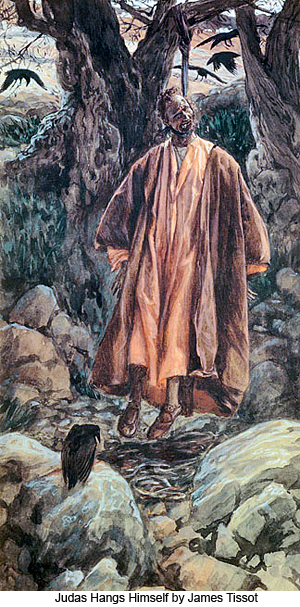 Judas Iscariot[1] is the most well known apostate of the New Dispensation. There is one particular branding which the New Testament Gospel writers all make mention of when mentioning Judas Iscariot—that is, “The Betrayer.”
- Matthew 10:4 – “Simon the Canaanean, and Judas Iscariot, who betrayed him.”
- Mark 3:9 – “and Judas Iscariot, who betrayed him.”
- Luke 16:6 – “and Judas the son of James, and Judas Iscariot, who became a traitor.”
- John 18:5 – “They answered him, “Jesus of Nazareth.” Jesus said to them, “I am he.” Judas, who betrayed him, was standing with them.”
In every Gospel account, Judas is remembered and mentioned as the betrayer; an apostate. He was one who followed Jesus, worshipped Him, learned from Him, and yet at the end of Christ’s ministry was still controlled by Satan. R. P. Martin compares Judas and Jeroboam’s apostasy, saying, “We may compare the case of Jeroboam I, in the OT, who is mentioned with horror as the one ‘who made Israel to sin’.”[2] What is comparable is that both were a part of the covenant—tasting it and seeing it first hand—yet they made a covenant with themselves which they would rather follow. Jeroboam, under Solomon (a type of Christ), broke away from the Davidic Covenant and lead Israel into sin. Judas, under the teaching of Jesus Christ, broke away from the New Covenant, continuing to lead mankind into sin.
One may ask how anyone could possibly apostatize directly from faith in Jesus Christ after spending three and a half years living and learning with Him. The answer is found in Luke 20:1-6, which tells us exactly how such apostasy takes place:
“Now the Feast of Unleavened Bread drew near, which is called the Passover. And the chief priests and the scribes were seeking how to put him to death, for they feared the people. Then Satan entered into Judas called Iscariot, who was of the number of the twelve. He went away and conferred with the chief priests and officers how he might betray him to them. And they were glad, and agreed to give him money. So he consented and sought an opportunity to betray him to them in the absence of a crowd.”
Matthew Henry comments on these verses saying,
“It was the devil’s work, who thought hereby to ruin Christ’s undertaking, to have broken his head; but it proved only the bruising of his heel. Whoever betrays Christ, or his truths or ways, it is Satan that puts them upon it. Judas knew how desirous the chief priests were to get Christ into their hands, and that they could not do it safely without the assistance of some that knew his retirements, as he did. He therefore went himself, and made the motion to them, v. 4. Note, It is hard to say whether more mischief is done to Christ’s kingdom by the power and policy of its open enemies, or by the treachery and self-seeking of its pretended friends: nay, without the latter its enemies could not gain their point as they do. When you see Judas communing with the chief priests, be sure some mischief is hatching; it is for no good that they are laying their heads together.”[3]
It is the same today in the New Covenant: apostasy is the work of Satan, drawing away those who have seen the gospel first hand and capturing them into his darkness. It was Judas’ long history of habitual sins—namely stealing and thievery—which John makes mention of in his Gospel in 12:6 saying, “He said this, not because he cared about the poor, but because he was a thief, and having charge of the moneybag he used to help himself to what was put into it.” Andrew Knowles also makes mention of Judas’ problems with money as he says, “There are many possible reasons why Judas betrays Jesus. He loves money. John tells us that Judas is an eager but dishonest treasurer (John 12:6). Is he so desperate for money that he will sell his master?”[4] Habitual sins can sear the heart to the point that it no longer feels repentance; instead becoming a lifestyle that leads one who has tasted to gospel to live apart from the gospel and leading away from Christ into apostasy.
At one of the most intimate times in the history of mankind—Jesus eating with His disciples at Passover, transitioning the Old into the New Covenant—it is made clear that there was one amongst them who had already betrayed Jesus. Luke 22:20-23 states:
“And likewise the cup after they had eaten, saying, “This cup that is poured out for you is the new covenant in my blood. But behold, the hand of him who betrays me is with me on the table. For the Son of Man goes as it has been determined, but woe to that man by whom he is betrayed!” And they began to question one another, which of them it could be who was going to do this.”
Just as stunning today as it was at the time, Jesus was in the middle of telling His disciples of His coming death and let it be known that there was one in their circle who would apostatize. As Jesus spoke of these events that were to come—His betrayal by Judas and His death—they were of no surprise to Him, as He both knew and planned how every last detail would play out.
One of the most critical questions about Judas’ apostasy is “why?” Why would he apostatize from Jesus after being a disciple of His? One way of perceiving Judas’ apostasy is by understanding the redemptive historical approach of looking at the history of the Bible. In this we see that in God’s will He had made plans that His Son, Jesus Christ, would be betrayed by one of His disciples, and that it would be Judas whom Satan would take hold of and blind from the gospel. In fact, Judas’ betrayal of Jesus was prophesied in the Old Testament:
- Psalm 41:9 – “Even my close friend in whom I trusted, who ate my bread, has lifted his heel against me.”
With this in mind it is common to question whether it was Judas that apostatized from Christ, or was it God that had planned his future to apostatize? Considering this, one must not be lead to a misunderstanding of God’s sovereignty and man’s accountability. What takes place from the hands of evil men is not done by God, but is allowed by Him. Man is still accountable for his actions even though God knows and allows man to continue in sin. So are those in the New Covenant any different from Judas, since God does not prophesy one’s future today? Of course the answer is an astounding “no,” because mankind himself prophesied his own future when Adam took part of the fruit in Genesis 2. This is better said by Paul in Romans 5:12-13, as he explains, “Therefore, just as sin came into the world through one man, and death through sin, and so death spread to all men because all sinned—for sin indeed was in the world before the law was given, but sin is not counted where there is no law.” Like Adam in the garden walking in perfect communion with God, and like Judas learning from Jesus’ teaching, all of mankind can easily fall into sin; but with Judas, it was his habitual sin that lead him into a life that would allow Satan to overtake not only his body, but also his soul, leading him into apostasy until his death. It is very important to see that no man, including even the disciples of Christ, is safe from the work of Satan. Once one has committed into apostasy—hardening their heart—it is impossible for them to return. As in Judas’ example, upon realizing what he had done he could not repent for his actions and decisions. Matthew 27:3-5 says,
“Then when Judas, his betrayer, saw that Jesus was condemned, he changed his mind and brought back the thirty pieces of silver to the chief priests and the elders, saying, “I have sinned by betraying innocent blood.” They said, “What is that to us? See to it yourself.” And throwing down the pieces of silver into the temple, he departed, and he went and hanged himself.”
Reflecting on this, Acts 1:15-20 helps the Church today to look back at the act of Judas’ apostasy to show how God uses the evil of mankind for the good of His people and His plan of redemption for His elect. Acts 1:15-20 states:
“In those days Peter stood up among the brothers (the company of persons was in all about 120) and said, “Brothers, the Scripture had to be fulfilled, which the Holy Spirit spoke beforehand by the mouth of David concerning Judas, who became a guide to those who arrested Jesus. For he was numbered among us and was allotted his share in this ministry.” (Now this man acquired a field with the reward of his wickedness, and falling headlong he burst open in the middle and all his bowels gushed out. And it became known to all the inhabitants of Jerusalem, so that the field was called in their own language Akeldama, that is, Field of Blood.) “For it is written in the Book of Psalms, “‘May his camp become desolate, and let there be no one to dwell in it’”
[1] Cf. for a study of Judas’ life and apostasy: The difficulties associated with the variant details of the death of Judas are discussed in BC, 1.5, pp. 22–30; cf., too, Arndt, loc. cit. and s.v. ‘Ioudas’, 6; K. L¸thi, Judas Iskarioth, 1955; D. Haugg, Judas Iskarioth in den neutestamentlichen Berichten, 1930; J. S. Stewart, The Life and Teaching of Jesus Christ, 1933, pp. 166–170; P. Benoit, art. ‘La mort de Judas’ in collected works, ExigËse et Thiologie, 1961; B. G‰rtner, Iscariot, E.T. 1971.
[2] D. R. W. Wood and I. Howard Marshall, New Bible Dictionary, 3rd ed. (Leicester, England; Downers Grove, Ill.: InterVarsity Press, 1996), pp. 624.
[3] Matthew Henry, Matthew Henry’s Commentary on the Whole Bible : Complete and Unabridged in One Volume (Peabody: Hendrickson, 1996), Lk 22:1–6.
[4] Andrew Knowles, The Bible Guide, 1st Augsburg books ed. (Minneapolis, MN: Augsburg, 2001), pp. 495-96.
NT Warnings of Apostasy
Posted: May 25, 2010 Filed under: Apostasy, New Testament Theology Leave a comment Although the theme of apostasy can be traced throughout all of human history, its theology and the fullness of it is found in the New Dispensation—namely in the theology of Paul as he delivers warnings of false teachers,[1] and also in the theology of other New Testament writers Peter, Jude, and John. In Paul’s writings there are a few warnings that stand out among the rest, such as in Acts 20:28-31 where he sends a warning to the elders at Ephesus saying,
“Pay careful attention to yourselves and to all the flock, in which the Holy Spirit has made you overseers, to care for the church of God, which he obtained with his own blood. I know that after my departure fierce wolves will come in among you, not sparing the flock; and from among your own selves will arise men speaking twisted things, to draw away the disciples after them. Therefore be alert, remembering that for three years I did not cease night or day to admonish everyone with tears.”
Paul once again warns the church of the “great falling away” and the “man of sin” at Thessalonica in 2 Thessalonians 2:1-4 as he says,
“Now concerning the coming of our Lord Jesus Christ and our being gathered together to him, we ask you, brothers, not to be quickly shaken in mind or alarmed, either by a spirit or a spoken word, or ea letter seeming to be from us, to the effect that the day of the Lord has come. Let no one deceive you in any way. For that day will not come, unless the rebellion comes first, and the man of lawlessness* is revealed, the son of destruction, who opposes and exalts himself against every so-called god or object of worship, so that he takes his seat in the temple of God, proclaiming himself to be God.”
In the Pastoral Epistles, Paul describes to Timothy both how a man will depart from the faith and how some will not endure sound doctrine in 1 Timothy 4:1-3:
“Now the Spirit expressly says that in later times some will depart from the faith by devoting themselves to deceitful spirits and teachings of demons, through the insincerity of liars whose consciences are seared, who forbid marriage and require abstinence from foods that God created to be received with thanksgiving by those who believe and know the truth.”
and 2 Timothy 4:1-4:
“I charge you in the presence of God and of Christ Jesus, who is to judge the living and the dead, and by his appearing and his kingdom: preach the word; be ready in season and out of season; reprove, rebuke, and exhort, with complete patience and teaching. For the time is coming when people will not endure sound teaching, but having itching ears they will accumulate for themselves teachers to suit their own passions, and will turn away from listening to the truth and wander off into myths.”
As mentioned, there are more than just Paul’s warnings about those that will fall from the truth and teach a false gospel. Peter—in 2 Peter 2:1-2—warned his readers of the false teachers to come who will bring destructive heresies and whom many will end up following:
“But false prophets also arose among the people, just as there will be false teachers among you, who will secretly bring in destructive heresies, even denying the Master who bought them, bringing upon themselves swift destruction. And many will follow their sensuality, and because of them the way of truth will be blasphemed.”
In Jude’s theology of apostasy he warns his readers of the false teachers who were even present during that time in the church, who crept their way in, turning the grace of God into lewdness and denying the Lord God and Jesus Christ. Jude 3-4 states:
“Beloved, although I was very eager to write to you about our common salvation, I found it necessary to write appealing to you to contend for the faith that was once for all delivered to the saints. For certain people have crept in unnoticed who long ago were designated for this condemnation, ungodly people, who pervert the grace of our God into sensuality and deny our only Master and Lord, Jesus Christ.”
Lastly, John’s theology matches the New Testament theme of apostasy as he also warns the church of it, specifically as he mentions the “antichrists” who had come—in fact, had already come during that time—and as such, John saw that the Church was living in the last hour before Jesus Christ’s second-coming. 1 John 2:18-19 reads:
“Children, it is the last hour, and as you have heard that antichrist is coming, so now many antichrists have come. Therefore we know that it is the last hour. They went out from us, but they were not of us; for if they had been of us, they would have continued with us. But they went out, that it might become plain that they all are not of us.”
These warnings of apostasy through the New Testament writers also brings to light Jesus’ teaching to His disciples that apostasy was already underway during His ministry here on earth, when He stated in Matthew 7:15, “Beware of false prophets, who come to you in sheep’s clothing but inwardly are ravenous wolves.” Another one of Jesus’ great predictions of what will take place before the end is characterized by tribulation which will occur in such a way that many will apostatize from the faith, as Matthew 24:10 says, “then many will fall away and betray one another and hate one another.” Here in Christ’s teaching one can see that until His second coming, apostasy will continue to take place within the Church. With this teaching, it is very evident in the letter to the Hebrews—from the very opening of the letter—that Jesus Christ occupies the ultimate position in the redemptive purpose of God, as Hebrews 1:1-4 reads,
“Long ago, at many times and in many ways, God spoke to our fathers by the prophets, but in these last days he has spoken to us by his Son, whom he appointed the heir of all things, through whom also he created the world. He is the radiance of the glory of God and the exact imprint of his nature, and he upholds the universe by the word of his power. After making purification for sins, he sat down at the right hand of the Majesty on high, having become as much superior to angels as the name he has inherited is more excellent than theirs.”
This is what the Old Testament looked toward, and is that which the New Testament believers apostatized from—that is, the Messiah, Jesus Christ. Because of the nature of this, the letter to the Hebrews insists that one cannot reverse apostasy; a teaching found in Hebrews 6:4-6[2] and 12:16-17. This, which those in the Old Dispensation broke away from and lost covenant, is that the same in which those in the New Covenant, during the New Dispensation, break or fall away from as well. Paul deals with this in his teachings in both Galatians 1:7-9 and in 1 Timothy 1:1-5. Paul explains to the New Testament Church that they would have among them those that claimed to live and teach the gospel, but in actuality preach a hypocritical gospel. Passages like 2 Timothy 4:3-4 and Acts 20:29-30 (as Paul deals with the elders at Ephesus) show that there were those that mislead the church from the truth of the gospel. It is important here to look at who the major New Dispensation apostates are, just as we did with the Old Dispensation in chapter three.
[1] For an in-depth study dealing with New Testament warning passages Cf. Robert Peterson, Our Secure Salvation: Perseverance and Apostasy, P&R Publishing: Philisberg, 2009), pp. 101-94.
[2] Hebrews 6:1-4 will be dealt with deeper in chapter 8. Cf. for a study of the Hebrews “warning passages”: Robert Peterson, Our Secure Salvation: Perseverance and Apostasy, P&R Publishing: Phillipsburg, 2009), pp. 157-77.
The Dewalts Blog
Posted: May 24, 2010 Filed under: Just for Fun Leave a comment Really looking forward to blogging along side my wife over at another online home called TheDewalts. The blog is going to set out to a be a daily place were Emily and I place….
- our thoughts
- our stories
- a text
- quotes we like
- videos we enjoyed watching
- vlogs we make
- favorite pictures
The blog is made mainly for the purpose for our families to read. However if you care to get a laugh from time to time and wanna check in on our online house, please do!
Follow us on Twitter or RSS the blog.
The Lord will Perfect Me
Posted: May 23, 2010 Filed under: Sundays with Spurgeon Leave a comment“The Lord will perfect that which concerneth me.” — Psalm 138:8
 Most manifestly the confidence which the Psalmist here expressed was a divine confidence. He did not say, “I have grace enough to perfect that which concerneth me—my faith is so steady that it will not stagger—my love is so warm that it will never grow cold—my resolution is so firm that nothing can move it; no, his dependence was on the Lord alone. If we indulge in any confidence which is not grounded on the Rock of ages, our confidence is worse than a dream, it will fall upon us, and cover us with its ruins, to our sorrow and confusion. All that Nature spins time will unravel, to the eternal confusion of all who are clothed therein. The Psalmist was wise, he rested upon nothing short of the Lord’s work. It is the Lord who has begun the good work within us; it is he who has carried it on; and if he does not finish it, it never will be complete. If there be one stitch in the celestial garment of our righteousness which we are to insert ourselves, then we are lost; but this is our confidence, the Lord who began will perfect. He has done it all, must do it all, and will do it all. Our confidence must not be in what we have done, nor in what we have resolved to do, but entirely in what the Lord will do. Unbelief insinuates— “You will never be able to stand. Look at the evil of your heart, you can never conquer sin; remember the sinful pleasures and temptations of the world that beset you, you will be certainly allured by them and led astray.” Ah! yes, we should indeed perish if left to our own strength. If we had alone to navigate our frail vessels over so rough a sea, we might well give up the voyage in despair; but, thanks be to God, he will perfect that which concerneth us, and bring us to the desired haven. We can never be too confident when we confide in him alone, and never too much concerned to have such a trust.
What Caused the Fall of Adam?
Posted: May 21, 2010 Filed under: Just for Fun Leave a comment Every evangelical knows of the fall of mankind, but what did that have to do with you or me? Why would have Adam’s fall, better yet how could have one single piece of fruit have such infliction and such vengeance on the whole of human race. John Calvin helps explain exactly what happen at the fall and its implications to humanity saying;
As the act which God punished so severely must have been not a trivial fault, but a heinous crime, it will be necessary to attend to the peculiar nature of the sin which produced Adam’s fall, and provoked God to inflict such fearful vengeance on the whole human race. The common idea of sensual intemperance is childish. The sum and substance of all virtues could not consist in abstinence from a single fruit amid a general abundance of every delicacy that could be desired, the earth, with happy fertility, yielding not only abundance, but also endless variety. We must, therefore, look deeper than sensual intemperance. The prohibition to touch the tree of the knowledge of good and evil was a trial of obedience, that Adam, by observing it, might prove his willing submission to the command of God. For the very term shows the end of the precept to have been to keep him contented with his lot, and not allow him arrogantly to aspire beyond it. The promise, which gave him hope of eternal life as long as he should eat of the tree of life, and, on the other hand, the fearful denunciation of death the moment he should taste of the tree of the knowledge of good and evil, were meant to prove and exercise his faith. Hence it is not difficult to infer in what way Adam provoked the wrath of God. Augustine, indeed, is not far from the mark, when he says (in Psalm 19), that pride was the beginning of all evil, because, had not man’s ambition carried him higher than he was permitted, he might have continued in his first estate. A further definition, however, must be derived from the kind of temptation which Moses describes. When, by the subtlety of the devil, the woman faithlessly abandoned the command of God, her fall obviously had its origin in disobedience. This Paul confirms, when he says, that, by the disobedience of one man, all were destroyed. At the same time, it is to be observed, that the first man revolted against the authority of God, not only in allowing himself to be ensnared by the wiles of the devil, but also by despising the truth, and turning aside to lies. Assuredly, when the word of God is despised, all reverence for Him is gone. His majesty cannot be duly honoured among us, nor his worship maintained in its integrity, unless we hang as it were upon his lips. Hence infidelity was at the root of the revolt. From infidelity, again, sprang ambition and pride, together with ingratitude; because Adam, by longing for more than was allotted him, manifested contempt for the great liberality with which God had enriched him. It was surely monstrous impiety that a son of earth should deem it little to have been made in the likeness, unless he were also made the equal of God. If the apostasy by which man withdraws from the authority of his Maker, nay, petulantly shakes off his allegiance to him, is a foul and execrable crime, it is in vain to extenuate the sin of Adam. Nor was it simple apostasy. It was accompanied with foul insult to God, the guilty pair assenting to Satan’s calumnies when he charged God with malice, envy, and falsehood. In fine, infidelity opened the door to ambition, and ambition was the parent of rebellion, man casting off the fear of God, and giving free vent to his lust. Hence, Bernard truly says, that, in the present day, a door of salvation is opened to us when we receive the gospel with our ears, just as by the same entrance, when thrown open to Satan, death was admitted. Never would Adam have dared to show any repugnance to the command of God if he had not been incredulous as to his word. The strongest curb to keep all his affections under due restraint, would have been the belief that nothing was better than to cultivate righteousness by obeying the commands of God, and that the highest possible felicity was to be loved by him. Man, therefore, when carried away by the blasphemies of Satan, did his very utmost to annihilate the whole glory of God.
What is the Sum of True Wisdom?
Posted: May 20, 2010 Filed under: Calvinism Leave a comment Wisdom, the quality of having experience, knowledge, and good judgment, but where does one find his or her’s wisdom in a day and age that seems to claim so many truths. John Calvin helps break down how the evil of man can still yet be used for the good things of God and how God uses that to lead His people to find Him.
“Our wisdom, in so far as it ought to be deemed true and solid Wisdom, consists almost entirely of two parts: the knowledge of God and of ourselves. But as these are connected together by many ties, it is not easy to determine which of the two precedes and gives birth to the other. For, in the first place, no man can survey himself without forthwith turning his thoughts towards the God in whom he lives and moves; because it is perfectly obvious, that the endowments which we possess cannot possibly be from ourselves; nay, that our very being is nothing else than subsistence in God alone. In the second place, those blessings which unceasingly distil to us from heaven, are like streams conducting us to the fountain. Here, again, the infinitude of good which resides in God becomes more apparent from our poverty. In particular, the miserable ruin into which the revolt of the first man has plunged us, compels us to turn our eyes upwards; not only that while hungry and famishing we may thence ask what we want, but being aroused by fear may learn humility. For as there exists in man something like a world of misery, and ever since we were stript of the divine attire our naked shame discloses an immense series of disgraceful properties every man, being stung by the consciousness of his own unhappiness, in this way necessarily obtains at least some knowledge of God. Thus, our feeling of ignorance, vanity, want, weakness, in short, depravity and corruption, reminds us (see Calvin on John 4:10), that in the Lord, and none but He, dwell the true light of wisdom, solid virtue, exuberant goodness. We are accordingly urged by our own evil things to consider the good things of God; and, indeed, we cannot aspire to Him in earnest until we have begun to be displeased with ourselves. For what man is not disposed to rest in himself? Who, in fact, does not thus rest, so long as he is unknown to himself; that is, so long as he is contented with his own endowments, and unconscious or unmindful of his misery? Every person, therefore, on coming to the knowledge of himself, is not only urged to seek God, but is also led as by the hand to find him.”
Taken from the Institutes 1.1.1.
“Baptists & the Cross” Discounted Rates
Posted: May 19, 2010 Filed under: Baptist, Michael Haykin 1 Comment The fourth annual conference of the Andrew Fuller Center for Baptist Studies is scheduled for August 30-31, 2010. The theme is: Baptists and the Cross: Contemporary and Historical Reflections. The conference will feature speakers such as Danny Akin (president, SEBTS), David Bebbington (professor, University of Stirling), Maurice Dowling (professor,Irish Baptist College), James Fuller (professor, University of Indianapolis), Tom Schreiner (professor, SBTS), Glendon Thompson (president, TBS and pastor of Jarvis Street Baptist Church), and Stephen Wellum (professor, SBTS). For full bios of the speakers, see here.
Discounted registration rates are now available for the conference and there is a special rate for students. Students may receive a discounted rate by using the code: “8051974″. For more information on the conference visithttp://events.sbts.edu/andrewfuller.
Book Review: Our Secure Salvation
Posted: May 18, 2010 Filed under: Book Review Leave a comment Our Secure Salvation: Preservation and Apostasy. Robert A. Peterson, P&R Publishing, P.O. Box 817, Phillipsburg, PA 08865-0817, 2009, 240 pages, $17.99.
Reviewed by Michael M. Dewalt Th.M. candidate at Puritan Reformed Theological Seminary, Grand Rapids, Michigan.
As the subtitle suggest, Preservation and Apostasy, Dr. Peterson’s book, Our Secure Salvation, deals with two crucial doctrines for today’s Christian scene: Preservation and Apostasy. Tracing preservation and apostasy throughout the Bible, Dr. Peterson illustrates how God saves and keeps His people, giving them confidence to live for His glory, as well as how some fall away from the gospel. Peterson examines 18 New Testament passages that teach God’s preservation of His children and their perseverance in faith, followed by 24 New Testament warnings against apostasy. Peterson deals with some of the most important contemporary issues in the church, and relates them in a way that pastors, professors, elders, teachers, and even laymen can understand. In six chapters Dr. Peterson interacts with the final victory over sin, flesh, and Satan, and explains in depth what professing Christians can do today in order to increase their assurance of salvation and not fall away from the faith. This particular focus is clear from the very beginning when Dr. Peterson sets the stage by illustrating how God uses perseverance to help bring His children assurance (pages 1-9).
Dr. Peterson’s biblical theology of preservation and apostasy deals with core texts that are necessary in understanding these topics, showing how these doctrines easily relate with one another. Peterson looks at four main areas of Scripture—the Old Testament, the Gospels and Acts, the Pauline Epistles, and the General Epistles and Revelation—and with these, he spends five chapters on the topics of Preservation and Apostasy. Each topic features an opening chapter introducing the issues related to each of these themes, as well as an extremely helpful closing chapter entitled “Connecting the Dots.” This chapter contains a summary of his treatment of the number of texts previously given throughout the book, and also focuses on bringing all of the difficult passages (which one may think of as contradictory) to light. Furthermore, Peterson gives four reasons to argue why these themes are important:
1) The Bible often speaks of preservation and apostasy
2) God uses preservation to assure His children
3) God teaches His children the need to persevere to the end
4) God warns His children of the danger of apostasy
Peterson writes experientially as he covers the relationship between the theme of perseverance and apostasy from a pastoral perspective. There is a list of six questions for further revision and reflection for either individual, or small group study. For those today that struggle with passages such as Hebrews 6, 1Timothy 1, 2Timothy 2, and 2Peter 2, this book will help the reader learn the relationship between apostasy and perseverance in proper context. Also, if one is struggling with their own assurance of faith, Dr. Peterson expresses the ways in which God’s keeping of His elect is a fundamental, warm and heartfelt doctrine of the Christian faith.
One question the reviewer was left when was why considerable biblical material, especially from the Old Testament, was left untreated. As a result, the reader of Peterson’s volume gets to see apostasy in the “warning” passages, yet never get the full sense of the theme itself, nor the theology of apostasy throughout the entire canon. As a result, my biggest critique of Our Secure Salvation is that, though it is part of the Explorations of Biblical Theology, yet it only deals with specific texts that treat this theme. Obviously, it is hard to do justice to a pervasire theme or topic of the Bible, such as apostasy or perseverance. Nevertheless, spending only one chapter on the Old Testament for both of these topics is lamentable. Dr. Peterson spends a mere 25-pages on the Old Testament, addressing both the individual and corporate aspects of themes of apostasy and perseverance. Although this chapter is excellent in material, deeper study of the theme, dealing with each of the covenants in the Old Testament, is certainly warranted.
Despite the lack of the Old Testament focus and only dealing with the warning passages in the New Testament, Dr. Peterson’s book brings forth the often overlooked topic of apostasy in the church, and does so in a pastoral way. If anyone is looking for a group study or a place to start learning about these topics, Dr. Peterson’s work is simple and helpful in addressing the most asked questions of a person dealing with both—or either—apostasy and perseverance.
My Very Bad Awful English
Posted: May 17, 2010 Filed under: Just for Fun 2 Comments I remember when I first had to start writing on a regular basis, it was my 3rd grade year with Mrs. Burns that made her class journal once a week. It was here that I found out that I was awful at writing. But yet at the same time I was somewhat fast if I read to myself, and I could remember anything that I read into my mind from a book, the newspapers, the back of sports cards, to magazine’s, etc. Whatever I read with my eyes, stayed in my mind.
What bothered me more than anything as a 8-year old boy was that my english was awful, I could not understand grammar at all, and worse off I simply did not understand how to journal my thoughts in an english sentence let alone write about what I had remembered from my readings. It was bad, so bad that by the 5th grade I needed and english tutor and by 7th grade I was basically thrown into english classes that were two and three years behind the actual grade I was in. This did not help my future. My 9th grade english class I don’t really know how I passed, and by the time 10th grade came luckily english and grammar class had changed to literature class which I loved and hated. I loved reading it, I hated having to write about it. By my junior year in high-school I was sleeping so much in literature class that the teacher made a deal with me. One, I had to stay awake 2 out of the 5 days a week, and Two, I had to teach once a week his class on literature. It was then where I enjoyed relaying the information I had studied during the week by myself to my peers. I at the time never wanted to teach in the future is because that only meant I needed more schooling after high-school, and that was not in my plans. Thankfully my senior literature class was cake and I was able to graduate high-school, barley though with a 1.3 GPA.
Fall of 2002 I started college at a small Bible school in upstate New York called Word of Life. Since then I have been writing constantly for class after class almost on a weekly basis for the past 8 years, even summers! However it was finally when I was out of my home town and in an accredited institution that it came to hit me that my grammar, vocabulary, spelling, and writing was a train wreck. The only reason I was able to graduate from Word of Life after one year was because of testing. I remembered everything I had ever read or been told in class, and when the test came I had no reason to study because I just threw up back on the page what I had been reading for classes or had heard from the professor. It was the essay and writing of small papers that murdered my grades. Murdered them so that I passed my freshman year with only a 1.8 GPA.
Fall of 2003, I from some reason (which I had thought at the time I knew, but God only knows now) went further in college, transferring to Baptist Bible College in Clarks Summit, PA to work on a bachelor degree. There I meet Dr. Long – almost the death of my college career. By midway of my first semester in college there Dr. Long pulled me aside letting me know that it was impossible for me to pass his class with below a 20%, and I might as well stop coming to it. He was right, for the next year I failed both English 101 and English 102 amazingly, so amazingly that Dr. Long proceeded by telling me that in his 39-years of teaching at the college level that I was by far the worst student that he had ever encountered with the english language that actually came from an english speaking country. Dr. Long was not going to stop me, for I enrolled back in his class the following year both in english 101 and 102 and this time failed with a 60% in both classes! I remember his words on the last day of his 40-year career as he failed me yet for the 4th time in a-row within 2-years, “I’ve never seen a student so bad at grammar in my life, good-luck.” The next year Dr. Long had long and retired and I had hired a tutor, and meet with my new professor at least once a week and actually passed with C’s. Finally I thought english was done in my life and I would no longer have to worry about it in my future. My last semester at BBC I did not exactly know where I was headed, but the longer I was in Bible College, the more I enjoyed studying theology, church history, and the Bible. So I applied to seminaries around America and decided to look at M.A., M.A.R. and M.T.S. programs.
It was during this time in my last semester at BBC of 2006 before graduation that a my good friend Dan Cruver told me to start blogging. At first I wanted nothing to do with it, and thought it was only going to be humiliation. But he challenged me to start one and maybe, just maybe my english, writing skills, and grammar may happen to get better. So I started a blog, I still remember my 1st few post, some book reviews, some speeches I had given, and some Bible lessons I had taught at summer camps. No one read them, and I was quite happy that no one did. I graduated BBC and moved back to the great midwest to attain seminary and pursuing my M.A.R degree.
I decided to attend Puritan Reformed Theological Seminary in Grand Rapids, where they felt obliged to place me on academic probation because of my transcripts of failing english not once, not twice, but four times. Although english class did not and does not exists in seminary, little did I know what I was in store for. English was to have been mastered, and spending the last 8-years finally getting MLA down, I then had to learn the turabian style. I felt like I was doomed for sure, but reading the turabian handbook more than my Bible my 1st semester I came along alright. The blog though came along quite well too, matter of fact, I started enjoying blogging so much I didn’t care if I had one reader, 10 or 100, I just wanted to blog because it helped me progress in my writing skills, or the lack there of.
I still know that I am not that great at writing, although because of blogging I have learn to love it more than I did in my younger days. With the number of papers and writing two thesis in the 3 1/2 years of seminary, I have learn that writing for me takes time, patience, and a work ethic. I continue to blog until I find something better that helps my english skills and hope that you can either enjoy it or at least get a kick-out-of my writing.
Regenration Takes Repentance
Posted: May 16, 2010 Filed under: Calvinism Leave a comment It is proper to consider what the dreadful iniquity is which is not to be pardoned. The definition which Augustine somewhere gives—viz. that it is obstinate perverseness, with distrust of pardon, continued till death,—scarcely agrees with the words of Christ, that it shall not be forgiven in this world. For either this is said in vain, or it may be committed in this world. But if Augustine’s definition is correct, the sin is not committed unless persisted in till death. Others say, that the sin against the Holy Spirit consists in envying the grace conferred upon a brother; but I know not on what it is founded. Here, however, let us give the true definition, which, when once it is established by sound evidence, will easily of itself overturn all the others. I say therefore that he sins against the Holy Spirit who, while so constrained by the power of divine truth that he cannot plead ignorance, yet deliberately resists, and that merely for the sake of resisting. For Christ, in explanation of what he had said, immediately adds, “Whosoever speaketh a word against the Son of man, it shall be forgiven him; but whosoever speaketh against the holy Ghost, it shall not be forgiven him,” (Mt. 12:31). And Matthew uses the term spirit of blasphemy for blasphemy against the Spirit. How can any one insult the Son, without at the same time attacking the Spirit? In this way. Those who in ignorance assail the unknown truth of God, and yet are so disposed that they would be unwilling to extinguish the truth of God when manifested to them, or utter one word against him whom they knew to be the Lord’s Anointed, sin against the Father and the Son. Thus there are many in the present day who have the greatest abhorrence to the doctrine of the Gospel, and yet, if they knew it to be the doctrine of the Gospel, would be prepared to venerate it with their whole heart. But those who are convinced in conscience that what they repudiate and impugn is the word of God, and yet cease not to impugn it, are said to blaspheme against the Spirit, inasmuch as they struggle against the illumination which is the work of the Spirit. Such were some of the Jews, who, when they could not resist the Spirit speaking by Stephen, yet were bent on resisting (Acts 6:10). There can be no doubt that many of them were carried away by zeal for the law; but it appears that there were others who maliciously and impiously raged against God himself, that is, against the doctrine which they knew to be of God. Such, too, were the Pharisees, on whom our Lord denounced woe. To depreciate the power of the Holy Spirit, they defamed him by the name of Beelzebub (Mt. 9:3, 4; 12:24). The spirit of blasphemy, therefore, is, when a man audaciously, and of set purpose, rushes forth to insult his divine name. This Paul intimates when he says, “but I obtained mercy, because I did it ignorantly in unbelief;” otherwise he had deservedly been held unworthy of the grace of God. If ignorance joined with unbelief made him obtain pardon, it follows, that there is no room for pardon when knowledge is added to unbelief.
Institutes 3.3.22

 Gospel-Centered Musings