Lessons Learned
Posted: October 14, 2009 Filed under: Just for Fun Leave a comment[by Tim Challies]
It was just a couple of months ago that I celebrated my eleventh anniversary. That gives me an eleven-year jump on our friend Dewalt who celebrated his wedding just a few days ago. I know that eleven years pales in comparison to some who read this blog, but I think it has to be enough time to have learned a little bit of wisdom. On the event of my anniversary I spent some time reflecting on some of the lessons I’d learned and jotted them down for my blog. I’m going to go ahead and post them here once more. Here are a few lessons learned in the first decade-and-a-bit of my own marriage.
Be a Leader!. Leadership is not an easy task and, while God calls a husband to lead his family, at the same time the man has to learn how to lead and to prove himself worthy of the position. While it is a position he is given by God, it is a position he also has to earn. When I married I was young and totally unsuited for any kind of leadership. It took me years to come to terms with the fact that God wanted me to lead my family as the husband and father and a few years more to realize that Aileen really wanted me to lead as well. I was greatly encouraged when, just a few weeks ago, she shared with me how she has seen me grow as a leader, and especially as a spiritual leader. Anything I’ve learned in this area has come with difficulty and has come by God’s grace.
If I could go back, I would counsel myself to be a better and more confident head of the household and to take this position earlier in our marriage. For too many years I led too little.
Invest Early, Invest Often!. This may apply to finances, but I am thinking of it here in terms of spiritual matters. As a poor leader, I invested far too little time, early in our marriage, to building a spiritual foundation. It has taken us years to feel truly comfortable with one another in sharing spiritual struggles and even in spending time reading the Bible and praying together (as just a couple—family devotions have come much more naturally). Like many men I’ve spoken to, it often seems that it’s easier to pray with a complete stranger than with my wife. If I look back in another eleven years, I wouldn’t be surprised if we are still learning here,
If I could do it all again, I would ensure that we learned very early on to spend time together before the Lord. I would be a better leader in investing early and investing often.
Prepare to Hurt and Be Hurt!. One of the greatest ironies and the greatest tragedies of marriage is that a husband and wife have more opportunities to sin against one another than against anyone else in all the world. Over the course of eleven years of marriage, I have hurt Aileen more than anyone else and have sinned against her more than I’ve sinned again anyone else. I suppose this means that marriage also offers unparalleled opportunities to extend forgiveness and to choose to overlook sin. While Aileen and I have had our share of struggles over the years, I truly believe that we carry no bitterness toward one another. Through God’s grace we have offered and received forgiveness time and time again. And through his grace we have overlooked many an offense. Yet there have been many occasions when we have hurt one another and when we have let this wounds fester for just a little too long.
If I could go back, I would prepare myself to be hurt and, even more, would seek to emphasize kindness and forbearance and grace so that I could hurt my wife far less often.
Be an Encourager! I can be such a jerk. As Dave Harvey said so well in When Sinners Say ‘I Do’, “the more you get to know me, the more you’ll admire my wife.” I find it so much easier to criticize than to encourage, to tear down rather than build up. For so many years of my marriage I spent far more time telling Aileen what she hadn’t done or who she hadn’t become instead of encouraging her for all the evidences of God’s grace I saw in her. Even today it remains a struggle as my mind always tends toward the negative (and because, somehow, all my nagging to this point has not produced the perfection I seem to expect). It has taken me a long time to become an encourager and even now I am prone to see evil sooner than I see good.
If I were to go back, I would counsel myself to seek to build encouragement as more of a foundation in our marriage. I would seek to learn more about encouragement and would seek to learn it much sooner.
Be Realistic! You knew that sex had to come into the discussion sooner or later. There is no doubt that sex is one of God’s greatest gifts within marriage and, probably for that very reason, it is also one of the greatest struggles. Having spoken to many others about this, I think it is safe to say that for a lot of couples, and perhaps even most couples, the majority of their fights or arguments or disagreements, especially during certain stages of life, will revolve around sex. The vulnerability of sex, the joy of sex, the uniqueness of sex, give endless opportunities for both joy and hurt. Anyone who approaches marriage thinking that sex will be all joy will be sorely disappointed.
If I could go back, I would counsel myself to be realistic and to learn this lesson sooner. And I would counsel myself to learn patience and kindness in this area.
Learn Her Language!. I’ve never read that book about “love languages,” but I do like the phrase it revolves around. Each of us have certain ways we tend to express love and certain ways we like to have love expressed to us. It took me far too long to learn that many of the ways I expressed love for Aileen were ways that she did not understand; often she did not even understand them to be expressions of my love. I loved her in ways I wanted to be loved rather than in ways she needed to be loved. In one sense this was my own naivete, but in another sense it was a kind of deliberate ignorance. I simply refused to find out how she needed me to express love to her.
Were I to go back, I would counsel myself to spend more time seeking to understand how I could express to her my love and affection; I would learn to speak her language sooner and I would learn to speak it better.
I guess there is a lot more I would say than all of this. I would reassure myself that in standing there, waiting to receive my bride, I was doing the right thing (not that I ever had any doubt) and that God truly was going to bless this union. Maybe I would whisper that all those things we had heard from the elderly couples in our church were actually true: that after a decade of marriage we would love one another more than even on our wedding day and that marriage truly is a great gift of God and that we truly would find great joy in it and that God would use this marriage to mold and shape us into his image.
And yet I know that even if I told myself all of these things, there would still be lessons I would have to learn a decade later. I suppose this is how God helps us grow; he teaches us a little bit at a time as we are prepared to receive and apply the lessons. And some lessons can only be learned by first-hand experience.
God’s Primacy over His People
Posted: October 14, 2009 Filed under: Guest Bloggers Leave a comment(Posted by Joel Beeke)
“And God said, Let us make man….” ―Genesis 1:26
Thoughts on this passage: We often come to Genesis 1 with a kind of inquisitiveness about creation. Instead, we ought to come in a spirit of worship, bowing before the glorious majesty of the God who has created the universe and given us life and breath and all things. Then we will recognize that He has revealed Himself so that He might practically affect our lives.
The first practical effect Genesis 1 ought to have on us is to help us recognize the primacy of God over all of life. If God is the subject of creation, that is, if He occupies a place of primacy in the universe, then the simple logical corollary is that He must occupy the same place in our lives, both individually and corporately. That, indeed, is how God intends us to live. Jesus put it this way: “Seek ye first the kingdom of God, and his righteousness” (Matt. 6:33a).
We run into all kinds of trouble when we don’t embrace this practical principle of bowing before the primacy of God over all of life. For example, think of the primacy of God in our planning. Too often we first decide what we want to do, then approach God for confirmation, hoping that our desires will be acceptable to Him. But the biblical principle is “In the beginning God.” That means before we make any plans, we should recognize the right of God over all of our lives. If we truly believe that God’s initiative is the foundation of all of our plans, we will understand that our position is to seek grace to discern His will and good pleasure, then to do it, no matter what self-denial that calls for.
When God becomes primary in our plans, situations often change. Difficulties, even seeming impossibilities, are overcome. Doubts are dissipated; deliverance is received.
For those that are reading this, are you seeking to bow to the primacy of God in every sphere of your life? Are you surrendering your limited time, your limited money, your limited energy to the will of God? Do you really want to live by the principle, “In the beginning God”?
If you could see what your prayers looked like . . .
Posted: October 13, 2009 Filed under: Adoption, Dan Cruver, Guest Bloggers Leave a comment[Posted by Dan Cruver]
To be adopted by God is to be in union with Christ. You can’t have one without the other. When God adopted us, He adopted us “in the Beloved” (Ephesians 1:5-6). There is nothing that is more life-changing or destiny-altering than the reality of being in union with God’s Beloved Son — and that is a gross understatement!
Jesus changes everything for us, not the least of which is our prayer life. Have you ever considered the fact that when you pray to your Father, you literally pray in union with Jesus?
To pray in union with Jesus means that your prayers are not carried to God by your merit. If God’s reception of our prayers were dependent upon our merit, our prayers would crash and burn before they could even be formed in our minds. No, our prayers are carried to the Father by the altogether lovely and acceptable merit of Jesus.
“If you could see what your prayers looked like to God [because of Jesus], no one could stop you from praying” (Brian Habig, quoting an unnamed theologian).
Heaven – Home of Gospel-Embracing Repenters
Posted: October 13, 2009 Filed under: Guest Bloggers | Tags: Gospel, Heaven, J. C. Ryle, Repentance Leave a comment[by Timmy Brister]
Heaven is a prepared place for a prepared people. Because heaven is a prepared place, our Christian lives should be characterized by rejoicing and anticipating being with the Lord. Because heaven is for a prepared people our Christian lives should be characterized by repentance and turning away from ourselves. Therefore, the Christian life is both one of rejoicing and repentance, at the same time. In fact, it could be said that, though we mourn over and hate our sin, our repentance should be joyful knowing that God has promised bring to fulfillment that which he began in us, namely the glorification of His Son in us. There is no genuine joy without thorough repentance, and genuine repentance ought to bring about increasing joy as sin is displaced and we draw nearer to Jesus.
We often call Christians “believers”. “We are a gathering of believers . . .” but Christians are also “repenters,” so why don’t refer to a gathering of repenters? Our response to the gospel at conversion is both – a repenting faith or believing repentance, and our response to the gospel from that moment on is the same. The more we behold Jesus by faith as seen in the gospel, the more we are transformed into His image from one degree of glory to another. If there are no degrees of glory being experienced on earth, then what, pray tell, would such a professing Christian claim to experience in heaven? The very degrees of glory we experience in the daily transformation of our lives through repentance and faith are meant to be a foretaste of the fullness of glory to be seen when we are “taken up into glory.” To miss it here is to forfeit it there.
 J.C. Ryle, in his book Old Paths, explains it this way:
“Our hearts must be in tune for the employments of heaven, or else heaven itself would be a miserable abode. Our minds must be in harmony with those of the inhabitants of heaven, or else the society of heaven would soon be intolerable to us. . . . I would never have you ignorant that if you went there with an impenitent heart, heaven would be no heaven for your soul. What could you possibly do in heaven, if you got there with a heart loving sin? To which of all the saints would you speak? By whose side would you sit down? Surely the angels of God would make no sweet music to the heart of him who cannot bear saints upon earth, and never praised the Lamb for redeeming love! Surely the company of patriarchs, and apostles, and prophets, would be no joy to that man who will not read his Bible now, and does not care to know what apostles and prophets wrote. Oh no! no! there can be no happiness in heaven, if we get there with an impenitent heart.”
In heaven, whom we have treasured by faith will become sight. But if we fail to look upon Jesus by faith, turning from ourselves and our idols, then we have no reason to expect our eyes to behold the one whom our hearts failed to treasure. No, heaven is for a prepared people whose hearts have become fertile soil for the gospel where idols and rivals to Jesus have been crushed by repentance and the reign of Jesus established by faith in all that Jesus is for us in his life, death, and resurrection. For when we are raised with him in glory to be united forever, we will recognize a people who have become like the one whom they have beheld as gospel-inducing repentance has, step by step, degree by degree, taken us homeward on the journey to glory.
Some thoughts while reading Genesis 2
Posted: October 13, 2009 Filed under: Guest Bloggers Leave a comment(Posted by Joel Beeke)
“The LORD God planted a garden eastward in Eden; and there he put the man whom he had formed.” ―Genesis 2:8
The garden of Eden is a microcosm of the loving, detailed, wise, and lavish provision of God for man as the crown and glory of creation. The world God prepared for man included:
● Physical provision. God gave man food to eat from the trees of the garden (Gen. 2:9), and He has been supplying food ever since. God also supplied man with physical work. He put Adam in the garden “to dress it and to keep it” (v. 15). Work is a pre-fall gift of our Creator. We were created to be industrious. Lack of discipline and laziness are results of our fallen condition.
● Spiritual provision. God gave man the Sabbath for his spiritual profit and physical rest. God wove rest and work into the pattern of His creation by His own example (vv. 2–3). The Lord offers the Sabbath as the day in which we meet with Him, learn of Him, enjoy Him, and commune with Him. In this communion, we find our highest work and chief glory. Do you know the Sabbath joy of communing with God?
● Moral provision. Having set man in the bounty of Eden, God told him what he must and must not do (vv. 16–17). Without this moral stimulus, man would have remained less than man. This moral requirement of man is often caricatured as only prohibitive, but God did not put man into the garden and say, “Now don’t touch,” like a parent warns a child going into a department store. Rather, God said: “The entire garden, with all its trees, is for you, except one, so that you might learn obedience to Me as your perfect Creator and Father. You will remain free and happy as long as you live in obedience to My holy commandments, which are good and perfect. My commandments are not a burden to be carried but a blessing to be embraced.”
● Aesthetic provision. God provided trees “pleasant to the sight” (v. 9). Eden’s trees were not just useful; they were beautiful.
● Social provision. God met Adam’s social needs by providing a helpmeet for him (v. 18). He provided a marital relationship that was complementary (v. 18) and exclusive (v. 24), creating another means by which man could give God glory.
That is lavish provision, indeed! Still today, God, in and through Christ, meets all our needs as He sends us into the world to live for Him. But our true freedom and full humanity can be realized only when we live within the boundaries of His perfect will. We become fully developed as God’s creation when we live in obedient faith to our Provider and pursue His glory with all that is within us.
Guest Bloggers on Gospel-Centered Musings
Posted: October 8, 2009 Filed under: Guest Bloggers, Just for Fun Leave a commentAs many of you who know me, know that I am getting married this coming weekend, (October 10th) which is in a few days! Due to that, and… schooling, planning, working, I am taking a leave of absent from the blogging until Oct. 20th. However just because I will be gone, doesn’t mean that the blog will stop. I have gathered a list of the Gospel-Centered brothers that I respect to post for me while taking care of my wedding duties and while I am off on my honeymoon (Oct. 20).
They are:
Joel R. Beeke was my advisor and mentor during my M.A.R. degree in Theological Studies at PRTS from January of 2007 to May 2009. He serves as President and Professor of Systematic Theology, Church History, and Homiletics at Puritan Reformed Theological Seminary. He has been in the ministry since 1978 and has served as a pastor of his current church (HNRC in Grand Rapids) since 1986. He is also editor of the Banner of Sovereign Grace Truth, editorial director of Reformation Heritage Books, president of Inheritance Publishers, and vice-president of the Dutch Reformed Translation Society. He has written, co-authored, or edited sixty books and contributed over fifteen hundred articles to Reformed books, journals, periodicals, and encyclopedias. His Ph.D. (1988) from Westminster Theological Seminary is in Reformation and Post-Reformation Theology. He is frequently called upon to lecture at Reformed seminaries and to speak at conferences around the world.
Tim Brister a Christian, Husband, Father, Minister, Photographer, Cyclist, and Blogger. To which of these he likes best, I have no idea. But I know which one I appreciate the most, his Blog “Provocations and Paintings” and is as Gospel-Centered as they come, and for his work there, I am in much debt.
Tim Challies and I became friends through the internet, work, website jobs, book-publishing, and conferences. Through all of that – keeping in contact Tim has been a great aid in ministry from time to time when in need. According to Amazon there is only one Tim Challies in the world. He lives in Canada, he reads voraciously and writes constantly at his Web site (www.challies.com). He is also the author of the book, “The Discipline of Spiritual Discernment.”
Dan Cruver a mentor of mine during my college years, but even more a friend and a best one at that. Before directing Together for Adoption, was a college professor of Bible and Theology. He has also served as a pastor of family ministries. As one who has been adopted by God and has adopted two children, Dan founded Together for Adoption to equip churches and educate Christians theologically about orphan care and horizontal adoption. Dan regularly writes and speaks about the Gospel and its implications for earthly adoption and the care of orphans. He recently wrote the foreword to Heirs with Christ: The Puritans on Adoption by Dr. Joel Beeke. Dan is available to speak in churches and other groups interested in adoption. Contact him at dan.cruver (at) TogetherforAdoption (dot) org.
Nick Rundlett a friend of mine that has been through the thick and thin throughout the last 7 years of my life, especially during my college years when times were rough. A roommate, a video-gamer that played NCAA College Football constantly (still does) and is the Middle School Director of Student Ministries at Colonial Baptist Church in Cary, North Carolina.
Ben Thocher a co-worker in the summers of 2005 and 2006 in camping ministries Ben and I became better friends when learning about each other’s passion for theology and knowing the Bible deeper than what we had been taught. Ben is working towards his Masters of Arts in Religion focusing in Biblical Studies at Westminster Theological Seminary while working full-time for the Westminster Bookstore.
What is RHB?
Posted: October 7, 2009 Filed under: Reformation Heritage Books Leave a comment(Post by RHB)
Reformation Heritage Books (RHB) is a publisher and bookseller whose mission is, by the Spirit’s grace, to aim for the conversion of unbelievers and equip the saints to serve Christ and His church through biblical, experiential, and practical ministry, via books, tracts, and other resources. RHB aims that reading material be God-glorifying and be in accord with the Scriptures and historic Reformed creeds for the promotion and defense of the gospel of Jesus Christ. We believe that this purpose is well-served by providing instruction and training that develops knowledge and skills as well as the personal piety and Christian character that is essential for a faithful and growing life in Christ.
We are committed to the conviction that the Scriptures of the Old and New Testaments as originally written are God’s inerrant Word inspired by His Spirit and therefore are the only, sufficient, and infallible authority for faith and practice.
Foundational to the mission of RHB is its identity as a confessionally Reformed publisher. Each book we publish, or carry from another publisher, subscribes to, or is judged according to the cardinal doctrines of the Christian faith as expressed in the Ecumenical Creeds and the teaching of the Reformed faith as expressed in the Three Forms of Unity (The Belgic Confession, the Heidelberg Catechism, and the Canons of Dort) and the Westminster Standards.
Reformation Heritage Books’ mission is to glorify God and strengthen His Church through the publication and distribution of Puritan and Reformed literature.
Book Review: The Parable of the Ten Virgins
Posted: October 6, 2009 Filed under: Book of the Week, Book Review, The Parable of the Ten Virgins Leave a comment(Post by Chadd Sheffield)
 Jesus Christ relentlessly divides the world into two. There are houses built on a rock, and on sand. There are sheep, and there are goats. There is wheat and there are tares. There are trees that bear fruit, and there are thorns and thistles. And, according to Jesus in Matthew chapter 25, there are wise virgins, and there are foolish virgins; and the one you are makes all the difference here now, and in eternity.
I first came across the name Thomas Shepard while reading Jonathan Edward’s classic Religious Affections. Edwards quotes Shepard in Religious Affections more than he quotes any other author—in all of Edward’s books combined. However, it was not this recommendation from Edwards that inspired me to read Shepard’s book. The words that Edwards quoted struck my heart particularly deep, and revealed to me that I tended to trust God wrongly; that I tested myself according to my culture, that I would often times try to make my election sure by mental assent and not a full, vibrant faith and love towards the Lord. It was Thomas Shepard that revealed to me by the scriptures that a foolish virgin could have just as easily passed my tests, and then the fear of God drove me to get a deeper understanding of the differences between those beloved by God and regenerated by His Spirit, and those who—as Shepard says—love the Lord Jesus only from the teeth outward.1
At first, the size of the book and the language both make it appear that reading it may seem like a burdensome task, but I would like to propose that it shouldn’t be. Dr. John Gerstner in the foreword says, “Don’t read it. Study it, a few pages at a time; decipher it… It may not save you, but it will leave you in no doubt if you are saved, and even less if you are not!” We ought not try to just read through The Parable of The Ten Virgins. When your motive is to finish the book rather than understand it—it does become burdensome. But if your motive is to learn from the faithful expositions of God’s Word, and if your motive is to have assurance about the things of God, and if your motive is to fight to enjoy Christ here and to be prepared in the hereafter then this book is not a burden; it’s a blessing.
The book is a collection of Shepard’s sermon notes on the Parable of The Ten Virgins found in Matthew 25:1-13. He takes you verses by verse, sentence by sentence, and word by word. Though the work is a little over six-hundred pages, Shepard does not repeat himself. The points of doctrine always seem reasonable, and are never forced. It is never boring, especially when you realize his sermons are directed to you.
The Parable of the Ten Virgins is a parable that covers much of the Christian life. This is precisely the reason why Shepard has written so much concerning it. It affects how we view the church, sin, wasting our time, and assurance of salvation. It affects how we view the most important of things.
Lastly, I think this book has a prophetic message to our current generation. In every church there are foolish virgins who believe they await our Lord and it will be well with them. But the Lord knows them not, and the foolish virgins will be shut out at last—and they don’t know it! They lack oil in their vessels, but they either don’t notice, or know where to buy without price! We must not let them perish in ignorance by our slumbering. Oh, that we would wake, and pray that we ourselves do not fall into temptation, and that the knowledge of the Lord would spread through our churches and the earth—in hope that some foolish virgins would wake and get oil in their vessels before he comes to them in death or at the end of time.
RHB Title Coming Soon
Posted: October 5, 2009 Filed under: Book of the Week, Reformation Heritage Books Leave a comment The Earnest Communicant – Ashton Oxenden – Introduced by Cornelis Pronk
Retail Price: $6.00/RHB Price: $4.00 Paperback, 48 pages
ISBN 978-1-60178-069-0
Available by October 31
Publisher’s description:
This booklet provides devotional material, aimed to prepare one’s heart for partaking of the Lord’s Supper. It is designed for daily preparation the week before Communion service. Each day contains a brief meditation, several points for self-examination, a number of challenging resolutions, and a prayer. Over the course of the week, you will cover topics such as repentance, faith, holiness, God’s Word, prayer, Christ’s sufferings, and love.
Endorsements:
“Through warm meditations, searching examinations, heartfelt resolutions, and moving prayers, Ashton Oxenden presents us with just what we need as earnest communicants to seek God’s face in Christ with passion for each day of the week preparatory to Communion.” —Joel R. Beeke
“For those who do, The Earnest Communicant will be our great help. Gently and graciously it will lead you to see your need afresh—but also to see that Jesus Christ is more full of grace than you are of sin. Ashton Oxenden knew this well and teaches us afresh that, at the Lord’s Supper, Christ stands at the door and knocks. If anyone opens the door, He will come in and share the supper with them. Our Lord Jesus Christ welcomes and receives sinners at His Table!” —Sinclair B. Ferguson
Author Information: ASHTON OXENDEN (1808–1892) was evangelical minister in the Church of England, and served as the Bishop of Montreal.
Who Made God?
Posted: October 2, 2009 Filed under: Book of the Week, Desiring God Conference 2009, Evangelical Press, Who Made God? 4 Comments This past weekend I was up in Minneapolis for John Piper’s Desiring God National Conference, when I happen to see one of Evangelical Presses new titles in the book store, Who Made God?, by Dr. Edgar Andrews. I know what you may be thinking, “who in the heck is Edgar?” If you care enough to know a bit about him, you can check here, but in short, Dr. Andrews is the Emeritus Professor of Materials, University of London, Co-pastor of Campus Church, Welwyn Garden City, England and editor of Evangelical Times. You can check out the rest of his title by EP here.
Here of recent I have gotten into the Theism, anti-thesim, creation, etc. type books. This book however caught my eye (not only because it is one of EP’s only few “good covers”) but the table of contents seemed quite amusing. Chapters like;
Sooty and the universe (Who made God?); Yogurt, cereal and toast (Can science explain everything?); Stringing it all together (Searching for a theory of everything); Pouring concrete (Foundations and hypotheses)/ Ferrets and fallacies (A brief critique of God, the failed hypothesis); Defining God (What do we mean by ‘God’?); Starting with a bang (Cosmic origins);Steam engine to the stars (Time and the hypothesis of God); Peeling onions (law in conscience, nature and society); Cosmic chess (The origin of the laws of nature); Over the moon (Natural law and miracles); Information, stupid! (The origin of life); Life in a cake mixer (The origin of living organisms); The tidy pachyderm (A critique of neo-Darwinianism); The mighty mutation? (Can mutations create?); The second shoe (Man and his mind); Man and his Maker (Man, morality and redemption).
You get the picture. However the book although humorous, goes against the claims of scientific atheism, and does it well.
Reviewed by Rev. David H. Kim, Redeemer Presbyterian Church, New York said the following,
“It has been a pleasure to read this book. I don’t mean to sound overly flattering, but Dr Andrews has done the world a great service by adding this to our shelves. I am impressed by the way he has maintained the integrity of both science and theology, revealing comfort in both fields. I have been waiting for a book just like this to recommend to others – one that I don’t feel compromises theological or scientific integrity and truth. The “God hypothesis” will be unpalatable to many, but to those who have sincere questions this book will provide an invaluable apologetic. There is so much science and theology in the book and yet the writing style makes difficult and complex concepts accessible. While there were a few sections that were challenging to understand, the book as a whole is easy to read and well-written.
I appreciated the exposing of the reductionistic tendencies that atheists are forced to adopt, thus limiting their ability to conceive the wonder and beauty of the material universe. I also appreciated how unscientific “science” can be and how we should be wary of those who use/abuse the name of science to promote unscientific assumptions and conclusions. I really appreciated the explanation of quantum physics and how the author makes complex physics understandable and entertaining. This was one of my favorite chapters.”
Reviewed by Rev. Abraham Cho, Fellowship Group Director, Redeemer Presbyterian Church, New York.
“If you have been looking for a thoughtful, cogent and accessible counterpoint to the recent flurry of publications by the so-called New Atheists, you need look no further than Edgar Andrews’ Who Made God? Rather than offering an ad hoc response to the assertions made by Richard Dawkins and the like, Dr. Andrews instead asks us to consider a different way in to the conversation – to approach belief in the biblical God as a thesis in and of itself, one that is worthy of our thoughtful consideration.
He asks us to apply the methodology of hypothesis to the question of God to see how it fits – and, in fact, it proves to fit remarkably well. With great clarity and rousing humour, Dr. Andrews applies the thesis of God to questions like the problem of time, the nature of humanity and the question of morality – and demonstrates how belief in God has both simple elegance and far-reaching explanatory power.”
Reviewed by Daniel Webber, Director, European Missionary Fellowship.
“Starting with the hypothesis of God, Professor Andrews sets out to demonstrate that the existence of the God of the Bible makes better sense of what we can actually learn from science than does atheism. On his way to this conclusion he also points out the scientific and logical inadequacies of evolutionism. He succeeds in doing so with a deceptively light touch – but there is nothing lightweight about either his analysis or the rigour with which he pursues his case. This is apologetics at its best: immensely instructive for the Christian and utterly devastating for the atheist.”
Biblical Theology of Missions: A Course Reader – Part 3
Posted: September 30, 2009 Filed under: Biblical Theology of Missions Leave a comment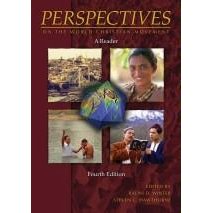 The following articles I had read and written some short thoughts down all came from Perspectives on the World Christian Movement : A Reader by Ralph D. Winter (4th Edition).
Glasser, Arthur F. “The Apostle Paul and the Missionary Task” in Perspectives on the World Christian Movement, Fourth Edition, ed. Ralph D. Winter and Steven C. Hawthorne, 149- 153. Pasadena, CA: William Carey Library, 2009.
How was this article helpful? I ever enjoyed the fact that the article was focused solely on one specific area in dealing with the apostles mission. I like even more how the author relayed their mission coming out of the Jewish faith.
What was confusing or questionable? Did Paul really not know the relationship between his band and his new congregations?… Interesting…
Does this article change the way you think about this subject? Made me think that the apostles, namely Paul all had to suffer in missions for the sake of God’s name. Also, I found it interesting that he saw an importance in Paul’s teaching before he became a believer in how that got him ready for his missions work.
Ladd, George Eldon. “The Gospel of the Kingdom” in Perspectives on the World Christian Movement, Fourth Edition, ed. Ralph D. Winter and Steven C. Hawthorne, 83-89. Pasadena, CA: William Carey Library, 2009.
How was this article helpful? Was helpful to me seeing the importance looking at the meaning of the Kingdom is to the mission of the Old Testament, King, and to what authority it is by. I also liked his focus on the peoples part and their role in the mission of the Kingdom. His Gospel-centered view on the kingdom and bringing both roles together seems to be right were I am in Biblical Theology of Missions. I also enjoyed his asking of questions, and answering them – makes an easy read.
What was confusing or questionable? I can see how an article like this could be somewhat confusing and not understanding to the typical Amil. Reformed circles.
Does this article change the way you think about this subject? I enjoyed near his ending in how the role of the believer is then realistically played out in their everyday life.
Snyder, Howard A. “The Church in God’s Plan” in Perspectives on the World Christian Movement, Fourth Edition, ed. Ralph D. Winter and Steven C. Hawthorne, 154-158. Pasadena, CA: William Carey Library, 2009.
How was this article helpful? His distinction between Kingdom and Church is good in that he spends his time explaining the church’s role in the Kingdom. Even more in that they are worker’s of the Kingdom both today and that in the future.
What was confusing or questionable? He seems to have only believe that “orthodox christians” will inherit the kingdom of God? Really!?
Does this article change the way you think about this subject? It is ever grateful to dwell upon that the New Testament Church is not plan “B” but yet is part of the wonderful mission that God has done for his people.
Verkuyl, Johannes. “The Biblical Foundation for the Worldwide Missions Mandate” in Perspectives on the World Christian Movement, Fourth Edition, ed. Ralph D. Winter and Steven C. Hawthorne, 42-28. Pasadena, CA: William Carey Library, 2009.
How was this article helpful? Verkuyl does a good job in describing God’s motif being universal, giving Scriptural support (Gen. 10) to all the nations for His mission.
What was confusing or questionable? I think his view of the Kingdom in the later of the article is not where I am at. Not so sure that the whole arrival of it is here, sorry. Matter of fact the whole later section I think he may have mixed a little too much biblical theology of Kingdom with the biblical theology of mission. All though there are some overlap, not as much as I see here in his article.
Does this article change the way you think about this subject? He does spend some time in the bringing arguing in how many do not spend enough time in the Old Testament having no missional mandate. While I agree in some aspect I think he should direct this back towards Dispensationalism.
Stott, John R. W. “The Bible in World Evangelization” in Perspectives on the World Christian Movement, Fourth Edition, ed. Ralph D. Winter and Steven C. Hawthorne, 21-26. Pasadena, CA: William Carey Library, 2009.
How was this article helpful? Scott’s section on the model in which the believer has in evangelism today was great. Great in that we speak with the same Word in which God and the apostles use in both the Old and New Testaments, God’s inspired Word.
What was confusing or questionable? I know this will start a fight, but does the Bible really give us a Biblical Mandate to all in the church for missions or even for evangelizing?
Does this article change the way you think about this subject? I did like his point in saying that Bible mandate to which one is to look at, practice and get their mission is from Genesis to Revelation, not only the New Testament church, but see both Testaments.
Stott, John R. W. “The Living God is a Missionary God” in Perspectives on the World Christian Movement, Fourth Edition, ed. Ralph D. Winter and Steven C. Hawthorne, 3-9. Pasadena, CA: William Carey Library, 2009.
How was this article helpful? Seeing the fulfillment of Abraham’s mission to the nations is extremely important in being apart of one’s theology of mission because with many today only looking at the “mission of the New Testament church, they forget in how the covenant is fulfilled with the gentiles coming to Christ. Once that context is set, then one can practice biblical missions practically along side the mission of God throughout all of history and not only the New Testament.
What was confusing or questionable? The christian Mission really starts at Abraham? You are telling me that Noah’s, Adam’s and Job’s mission is not the ground to start on?
Does this article change the way you think about this subject? I do see Dr. Scott’s importance in understanding Abraham’s call to the nations. I most enjoyed that the flow of history has purpose and plan in the mission of God for all his people.
Bosch, David J. “Witness to the World” in Perspectives on the World Christian Movement, Fourth Edition, ed. Ralph D. Winter and Steven C. Hawthorne, 78-82. Pasadena, CA: William Carey Library, 2009.
How was this article helpful? Bosch’s article was helpful in how he related the “Great Commission” in Matt 28:18-20 along side of the mission of witness in Acts 1:8. Near the end I also enjoyed his reasoning behind the silence for the “Great Commission” during the early church. I also liked how he showed that the Old Testament mission was different but yet not contradicting the mission of that in the Old.
What was confusing or questionable? The most confusing part in Bosch’s article was that how explained that the Old and New were the same but yet in how they were different… Did not fully understand how or what he was getting at in his de-fence of that the Old Testament was not only fully God’s hand.
Does this article change the way you think about this subject? I did enjoy the christological approach at the end in how Christ began God’s same mission in the New Testament.
Goerner, H. Cornell. “Jesus and the Gentiles” in Perspectives on the World Christian Movement, Fourth Edition, ed. Ralph D. Winter and Steven C. Hawthorne, 112-117. Pasadena, CA: William Carey Library, 2009.
How was this article helpful? This article was helpful in that it links together the prophets (Malachi) in bringing forth Christ the one who brought the mission of God to the gentiles, namely in Matthew. I enjoyed his Biblical Theology of tracing the term back throughout God’s mission in the Old Testament “Son of Man” and bringing it through the New Testament in showing it’s importance in the over arching mission of God that was always planned.
What was confusing or questionable? Not much at all…
Does this article change the way you think about this subject? The most thought provoking idea in Goerner’s article is in how one may think Christ mission was like that of the Old then he was only directing the Kingdom to his psychical nation, but yet it was still part of the overall mission of God that it would be sent to the gentiles (p. 98-99.)
Piper, John. “Let the Nations Be Glad!” in Perspectives on the World Christian Movement, Fourth Edition, ed. Ralph D. Winter and Steven C. Hawthorne, 64-69. Pasadena, CA: William Carey Library, 2009.
How was this article helpful? Classic Piper before he was known, Piper is helpful in seeing the extreme importance of how important missions really is today. Also Piper deals with how God is in the center of missions and how the church deals with that. The whole missions is not first but God is first, so therefore missions flow out of the God.
What was confusing or questionable? Pretty simple article.
Does this article change the way you think about this subject? Piper like usual brings home the passion that God has for his mission of his Word being given to all the nations. Another way of seeing missions, Piper shows the importance of suffering for God’s work and the power that his work has in the lives of those who have not heard.
Piper, John. “Discipling All the Peoples” in Perspectives on the World Christian Movement, Fourth Edition, ed. Ralph D. Winter and Steven C. Hawthorne, 132-136. Pasadena, CA: William Carey Library, 2009.
How was this article helpful? Piper places the Word’s of Christ first in missions and that is helpful in knowing exactly what the mission of God and the church is. Also helpful was that Piper’s article in how the Word’s of Christ related to the different people groups in the New Testament. He did so by drawing the connection between Genesis 12:3 and the words for people groups and the difference that brings in dealing with missions. Even more helpful is how Piper summarizes his article in giving the application of today’s church in dealing with missions in the church.
What was confusing or questionable? Confusing at times is how Piper jumps from on subject to the next, then coming back to something 3 pages later. You have to read carful being that he writes much like he speaks.
Does this article change the way you think about this subject? Piper was more practical dealing with how missions works and what it looks like then a number of the theological articles I read on missions in dealing with the Kingdom.
DeRidder, Richard R. “The Old Testament Roots of Mission” in Exploring Church Growth, ed. Wilbert R. Shenk, 171-180. Grand Rapids: Eerdmans, 1983.
How was this article helpful? I found DeRidder helpful in that he brings forth the importance of the Old Testament and in what it deals with the theology of mission. Also was helpful in explaining that Israel purpose in doing God’s mission was for all the nations and not that of only Israel.
What was confusing or questionable?
Does this article change the way you think about this subject? How often we tend to separate the Bible into two books really hurts the over aching principle and the theology of mission. De Ridder’s section on Gen. 3 and he section on dealing with the three over aching premisses through the whole of the Bible (creation, Revelation, and Redemption) helps the reader and myself see the flow of God’s mission, who God used throughout His mission, and how that influences today’s mission in the New Testament church.
Spindler, M. R. “The Biblical Grounding and Orientation of Mission” in Missiology: An Ecumenical Introduction, eds. F. J. Verstraelen, et al, 123-143. Grand Rapids: Eerdmans, 1995.
How was this article helpful? Most helpful in that it laid out the importance of having a Biblical Theology of missions and not going to the church first but yet to the Scriptures.
What was confusing or questionable? Maybe I am wrong, but he seems to have a solid Bible grounding on the theology of mission but yet does it circle around and have his mission develop his theology? I thought his article going through the New testament was great, but shouldn’t we look at Abraham, David, and the Prophets and what God’s mission was to use them in order to define our line of mission and theology of missions? Also his section on “Why Then Missions” pages 132-3 were a bit confusing in that I am not sure what he really believed in Jesus mission given to the apostles in Matt. 28:18-20.
Does this article change the way you think about this subject? I did like the small but yet section in which he focuses on how the cross and eschatology.
Newbigin, Lesslie. “The Kingdom of God in the Life of the World” in Perspectives on the World Christian Movement, Fourth Edition, ed. Ralph D. Winter and Steven C. Hawthorne, 98-99. Pasadena, CA: William Carey Library, 2009.
How was this article helpful? This article was helpful in showing that the ultimate sign of the Kingdom is found in what Christ did in his mission here on earth, namely the cross. It was also helpful in showing the giving of the Spirit to the NT-Church in aid to carry out the mission given to the peoples of God. Thus going forward then calls the church to not stand quit, but to go forth proclaiming the Gospel to all the nations.
What was confusing or questionable? Pretty strait froward and short article.
Does this article change the way you think about this subject? I have never thought before how Jesus had worked in his mission towards the sick since satan had hurt God’s children. Thinking of this practically today in the NT-Churches in how they should look upon those that satan himself have easily taken astray and hurt psychically so that they would be blinded are in much need of the good news of Christ Jesus, the Gospel.
Theology for a Missional Ministry
Posted: September 29, 2009 Filed under: Biblical Theology of Missions Leave a commentThe books of Romans is a systematic theology that Paul’s writes with missional intent. The bookends of this letter form a missional inclusio that reveals this intent:
Romans 1:5 – “through (Jesus Christ) whom we have received grace and apostleship to bring about the obedience of faith for the sake of his name among all the nations.”
Romans 15:18 – “For I will not venture to speak of anything except what Christ has accomplished through me to bring the Gentiles to obedience…”
Romans 16:25-27 – “Now to him who is able to strengthen you according to my gospel and the preaching of Jesus Christ, according to the revelation of the mystery that was kept secret for long ages but has now been disclosed and through the prophetic writings has been made known to all nations, according to the command of the eternal God, to bring about the obedience of faith— to the only wise God be glory forevermore through Jesus Christ! Amen.”
Why Does Church Membership Even Matter?
Posted: September 29, 2009 Filed under: Kevin DeYoung 1 CommentKevin DeYoung explains,
“For many Christians membership sounds stiff, something you have at your bank or the country club, but too formal for the church. Even if it’s agreed that Christianity is not a lone ranger religion, that we need community and fellowship with other Christians, we still bristle at the thought of officially joining a church. Why all the hoops? Why box the Holy Spirit into member/non-member categories? Why bother joining a local church when I’m already a member of the universal Church?
I’ve found that some people just won’t be convinced of church membership no matter what you say or how many times “member” actually shows up in the New Testament. But many people have not given serious thought to church membership. They are open to hearing the justification for something they’ve not thought much about.”
Read it all here.
Biblical Theology of Missions: A Course Reader – Part 2
Posted: September 29, 2009 Filed under: Biblical Theology of Missions Leave a commentBosch, David J. “Mission in Biblical Perspective” International Review of Mission, 74 (1985), 531-38.
How was this article helpful? The article showed me just how important Dr. Blauw’s work truly was in the biblical theology of missions during the mid-1900’s. The books reviewed give a better understanding to both the positive and negatives to the church’s mission during their time.
What was confusing or questionable? In the article there were some mentions that a missiologist and a bible scholar were not in the same occupation. I’m having a hard time wondering why those that become a missiologist do not become bible scholars first. Now I know why so many mission programs end in failure.
Does this article change the way you think about this subject? Never thought once that catholic missions even still existed?
DeRidder, Richard R. “God and the gods: Reviewing the Biblical Roots.” Missiology 6:1 (Jan 1978), 11-28.
How was this article helpful? Mostly in that idolatry is one if not the largest issue in OT, NT and today’s mission in relaying the Gospel to others. Also, that brought about a reality of seeing the importance of studying the other gods in order to know exactly what one may deal with in missions themselves.
What was confusing or questionable? A little confusing in the reasoning behind why some many “brief comments” that the writer feels he has to constantly make before getting into the just of his article (p.13-14).
Does this article change the way you think about this subject? I found it thought provoking and quite convicting in that the writer mad some mention in that God’s mission is that the same of His peoples mission in to declare his deeds, as he has called us out of the darkness 1 Peter 2:9 (p. 15-17).
Köstenberger, Andreas J. “The Place of Mission in New Testament Theology: An Attempt to Determine the Significance of Mission within the Scope of the New Testament’s Message as a Whole.” Missiology 27:3 (July 1999), 347-362.
How was this article helpful? I really enjoyed in how the writer placed the theology of mission in the New Testament in what constitutes what a mission even is. Most of the articles or books I have read so far assume that you already know what it is exactly without giving in some detail exactly what his stance and view of missions are. Also the writer does this with the nature of missions from pages 348-350 which I found helpful.
What was confusing or questionable? Questionable, yes. I for one tended to agree with Dr. Ladd’s theology of missions for the future kingdom of God, however the review here that is writing is a for sure Amil. I think Ladd gave due respect to both the Kingdom of this age today and a proper treatment of missions in its’ dealing with the future Kingdom. However, the writer and the Amil. May not either agree nor see.
Does this article change the way you think about this subject? I like how his theology of missions started before the NT Church and before the early church. Not really a fan of Dr. Bultmann’s theology of missions in the New Testament.
Biblical Theology of Missions: A Course Reader – Part 1
Posted: September 28, 2009 Filed under: Biblical Theology of Missions Leave a commentThe past few days I have posted several small book reviews of a few titles I have been reading for a class that I am taking next week September 21-25 with Dr. Brain DeVries. For the next few days I will post my VERY short thoughts on a number of different articles, selected chapters of books, theological journal articles, etc. Maybe if you are interested in the a Biblical Theology of Missions being that it seems to be a “hot” topic today, the articles and titles I list over the next two to three weeks will help you.

Bavinck, Johan H. “The Foundation of Missions” in An Introduction to the Science of Missions, J. H. Bavinck, trans. David H. Freeman, 11-76. Grand Rapids: Eerdmans, 1960.
How was this article helpful? The article was helpful in that it first deals with the Biblical Theology in missions from genesis and in subject detail when in the New Testament. I like most from after explaining its’ Biblical Theology it explains in small depth in how Missions is the work of God today.
What was confusing or questionable? Questionable in some since that are we to bring the Gospel to the Jews today in the same way that we do elsewhere? (p.69-76)
Does this article change the way you think about this subject? This article made me see in how Missions and Eschatology can go hand in hand in that all missions work are brought under Christ at the end (p.48-50).

How was this article helpful? So far has been maybe the best book I have read in shaping the way I look at the theology of missions and even more the Pauline Theology of it (p.30-34).
What was confusing or questionable? It maybe hard for the layman that does not understand proper logical reasoning being that the author spends some time on building arguments in making theological assumptions from Paul’s Theology on Missions (p. 47-67).
Does this article change the way you think about this subject? I found it quite interesting that the disciples during their time with Christ had not much of a theology at all, but yet only faith that would later have to become their theology for their mission.
How was this article helpful? This article was helpful in that it brought much thought to the fact that there is a theology of Mission, but only from Genesis 3:15 to Rev.20… Nothing of it in the Garden nor will there be any in the New Jerusalem.
What was confusing or questionable? Was Judaism a missional religion in intertestamental period? And if not, then was the Mission of God through His chosen nation put on hold?
Does this article change the way you think about this subject? This short section really made me think in how often neglected the Theology of Mission is forgotten in Systematic Theology.
Among the Redeemed
Posted: September 27, 2009 Filed under: Sundays with Spurgeon Leave a commentLo, the people shall dwell alone, and shall not be redeemed among the nations. (Numbers 23:9)
Who would wish to dwell among the nations and to be numbered with them? Why, even the professing church is such that to follow the Lord fully within its bounds is very difficult. There is such a mingling and mixing that one often sighs for “a lodge in some vast wilderness.”
Certain it is that the Lord would have His people follow a separated path as to the world and come out decidedly and distinctly from it. We are set apart by the divine decree, purchase, and calling, and our inward experience has made us greatly to differ from men of the world; and therefore our place is not in their Vanity Fair, nor in their City of Destruction, but in the narrow way where all true pilgrims must follow their Lord.
This may not only reconcile us to the world’s cold shoulder and sneers but even cause us to accept them with pleasure as being a part of our covenant portion. Our names are not in the same book, we are not of the same seed, we are not bound for the same place, neither are we trusting to the same guide; therefore it is well that we are not of their number. Only let us be found in the number of the redeemed, and we are content to be off and solitary to the end of the chapter.
A Biblical Theology of Missions – The Missionary Nature of the Church: A Survey of the Biblical Theology of Mission
Posted: September 26, 2009 Filed under: Biblical Theology of Missions Leave a comment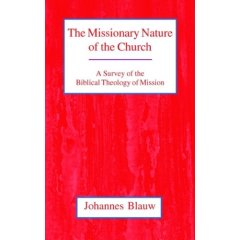 Book Review: The Missionary Nature of the Church: A Survey of the Biblical Theology of Mission
How was this helpful?
I found The Missionary Nature of the Church helpful in that Blauw gives both a Biblical and Theological importance behind the goal in the Old Testament (p.15-54) and New Testament (p.65-103). It was most helpful as the last chapter – “Towards a Theology of Mission” – laid out the idea that how one does missions can only come from a proper understanding of the Biblical Theology of missions that is taught in the Scriptures. In the later part of Blauw’s book, he shows that the theology of missions is no different than the theology of the church (p.126), which was insightful to think about – particularly to think of Christ as the cornerstone of both the church in the local setting and in the missional setting, of one who plants churches. In all, the greatest point is that the church’s mission throughout all of history – in the Old Testament and in the New Testament – is to proclaim to not just one selected group or race, but to bring all to the understanding of the Gospel. In other words, a proper theology of missions is not a side theology of the church, but is the theology of the church.
What was confusing or questionable?
I found it confusing in some ways when looking at the topic of the mission of the Old Testament being only centered upon universalism (p.29-54).
Would you recommend this book to others, if so, to whom?
Yes and no. I would recommend it to one who is seriously studying the Biblical Theology of Missiology, and also to one who is serious about church planting as a pastor. It would also be helpful for those who are studying the theology of missions for either overseas or in their own homeland. But I would by no means recommend the book to the layman, nor to a typical theologian. Although it is only 150 pages, it is not an easy read, as the wording is not for the typical 20-year-old Bible student.
A Bibliography for the Biblical Theology of Missions
Posted: September 25, 2009 Filed under: Biblical Theology of Missions Leave a commentBavinck, Johan H. “The Foundation of Missions” in An Introduction to the Science of Missions, J. H. Bavinck, trans. David H. Freeman, 11-76. Grand Rapids: Eerdmans, 1960.
Bosch, David J. “Mission in Biblical Perspective” International Review of Mission, 74 (1985), 531-38.
Bosch, David J. “Witness to the World” in Perspectives on the World Christian Movement, Fourth Edition, ed. Ralph D. Winter and Steven C. Hawthorne, 78-82. Pasadena, CA: William Carey Library, 2009.
DeRidder, Richard R. “God and the gods: Reviewing the Biblical Roots.” Missiology 6:1 (Jan 1978), 11-28.
DeRidder, Richard R. “The Old Testament Roots of Mission” in Exploring Church Growth, ed. Wilbert R. Shenk, 171-180. Grand Rapids: Eerdmans, 1983.
Gilliland, Dean. “Introduction,” Approaching Paul’s Theology,” and “Paul’s Theological Assumptions for Mission” in Pauline Theology and Mission Practice, 9-67. Grand Rapids: Baker Book House, 1983.
Glasser, Arthur F. “The Apostle Paul and the Missionary Task” in Perspectives on the World Christian Movement, Fourth Edition, ed. Ralph D. Winter and Steven C. Hawthorne, 149- 153. Pasadena, CA: William Carey Library, 2009.
Goerner, H. Cornell. “Jesus and the Gentiles” in Perspectives on the World Christian Movement, Fourth Edition, ed. Ralph D. Winter and Steven C. Hawthorne, 112-117. Pasadena, CA: William Carey Library, 2009.
Köstenberger, A. J. “Mission” in New Dictionary of Biblical Theology, eds. T. D. Alexander, B. S. Rosner, D. A. Carson, and G. Goldsworthy, 663-668. Downers Grove: IVP, 1993.
Köstenberger, Andreas J. “The Place of Mission in New Testament Theology: An Attempt to Determine the Significance of Mission within the Scope of the New Testament’s Message as a Whole.” Missiology 27:3 (July 1999), 347-362.
Ladd, George Eldon. “The Gospel of the Kingdom” in Perspectives on the World Christian Movement, Fourth Edition, ed. Ralph D. Winter and Steven C. Hawthorne, 83-89. Pasadena, CA: William Carey Library, 2009.
Newbigin, Lesslie. “The Kingdom of God in the Life of the World” in Perspectives on the World Christian Movement, Fourth Edition, ed. Ralph D. Winter and Steven C. Hawthorne, 98-99. Pasadena, CA: William Carey Library, 2009.
Piper, John. “Discipling All the Peoples” in Perspectives on the World Christian Movement, Fourth Edition, ed. Ralph D. Winter and Steven C. Hawthorne, 132-136. Pasadena, CA: William Carey Library, 2009.
Piper, John. “Let the Nations Be Glad!” in Perspectives on the World Christian Movement, Fourth Edition, ed. Ralph D. Winter and Steven C. Hawthorne, 64-69. Pasadena, CA: William Carey Library, 2009.
Snyder, Howard A. “The Church in God’s Plan” in Perspectives on the World Christian Movement, Fourth Edition, ed. Ralph D. Winter and Steven C. Hawthorne, 154-158. Pasadena, CA: William Carey Library, 2009.
Spindler, M. R. “The Biblical Grounding and Orientation of Mission” in Missiology: An Ecumenical Introduction, eds. F. J. Verstraelen, et al, 123-143. Grand Rapids: Eerdmans, 1995.
Stott, John R. W. “The Bible in World Evangelization” in Perspectives on the World Christian Movement, Fourth Edition, ed. Ralph D. Winter and Steven C. Hawthorne, 21-26. Pasadena, CA: William Carey Library, 2009.
Stott, John R. W. “The Living God is a Missionary God” in Perspectives on the World Christian Movement, Fourth Edition, ed. Ralph D. Winter and Steven C. Hawthorne, 3-9. Pasadena, CA: William Carey Library, 2009.
Verkuyl, Johannes. “The Biblical Foundation for the Worldwide Missions Mandate” in Perspectives on the World Christian Movement, Fourth Edition, ed. Ralph D. Winter and Steven C. Hawthorne, 42-28. Pasadena, CA: William Carey Library, 2009.
***A special thanks to Dr. Brian DeVries for putting this great list of materials together.
Stellman writes back towards Wilson’s review
Posted: September 23, 2009 Filed under: Doug Wilson, Jason Stellman, Two Kingdom Theology Leave a commentStellman answers with saying,
“I realize that my view is not exactly the mainstream one, and I would hope that my FV-leaning brothers would empathize with the plight of an oft-misrepresented minority. Although you all are not always treated with the dignity you deserve, it is my sincere hope that you take the high road and demonstrate the charity that you are (unfortunately) sometimes denied and make every effort to understand the 2K position and read it in the best and most charitable light. Sure, you still may disagree, which is fine with me. I just hope the discussion is a profitable one for everyone involved.”
You can read his Stellman’s note here.
Puritan Audio Resources
Posted: September 23, 2009 Filed under: Danny Hyde, Puritans Leave a commentMy seminarian brother Danny Hyde has posted a selected audio resources on the puritans.
Biblical Theology for Missions: A Selected Bibliography for Additional Research
Posted: September 23, 2009 Filed under: Biblical Theology of Missions Leave a commentAllen, Roland. Missionary Methods: St. Paul’ s or Ours? Grand Rapids, MI.: Eerdmans, 1962. Barrett, C. K. “The Gentile Mission as an Eschatological Phenomenon” in Eschatology and the
New Testament, 65-75. Hendrickson, 1988. Bauckham, Richard. Bible and Mission: Christian Witness in a Postmodern World. Grand
Rapids: Baker Academic, 2003. Bevans, Stephen B. and Roger P. Schroeder. Constants in Context: A Theology of Mission for Today. Maryknoll, NY: Orbis Books, 2004.
Boer, Harry R. Pentecost and Missions. Grand Rapids: Eerdmans, 1962.
Bosch, David J. Transforming Mission: Paradigm Shifts in Theology of Mission. Maryknoll: Orbis Books, 1991.
Bosch, David J. Witnesses to the World: The Christian Message in Theological Perspective. Eugene, OR: Wipf & Stock, 1980.
Bowers, W. P. “Mission” in Dictionary of Paul and His Letters, eds. Gerald F. Hawthorne, Ralph P. Martin, and Daniel G. Reid, 608-619. Downers Grove: IVP, 1993.
Burnett, David. The Healing of the Nations: The Biblical Basis of the Mission of God. Carlisle: Paternoster, 1996.
Carver, William. Missions in the Plan of the Ages: Bible Studies in Missions. Nashville: Broadman Press, 1951.
Culver, Robert. A Greater Commission: A Theology for World Missions. Chicago: Moody Press, 1984.
DeRidder, Richard R. Discipling the Nations. Grand Rapids: Baker Book House, 1975.
Gilliland, Dean. Pauline Theology and Mission Practice. Grand Rapids: Baker Books, 1983.
Glasser, Arthur F. Announcing the Kingdom: The Story of God’s Mission in the Bible. Grand Rapids: Baker Academic, 2003.
Glover, Robert Hall. The Bible Basis of Missions. Los Angeles: Bible House of LA, 1946. Gnanakan, Ken. Kingdom Concerns: A Biblical Theology of Mission Today. Leicester: Inter-Varsity, 1993.
Greenway, Roger S. GO and Make Disciples: An Introduction to Christian Missions. Phillipsburg, NJ: P&R Publishing, 1999.
Hedlund, Roger E. The Mission of the Church in the World: A Biblical Theology. Grand Rapids: Baker Book House, 1991.
Hiebert, Paul G., and Tite Tiénou. “Missions and the Doing of Theology” in The Urban Face of Missions: Ministering the Gospel in a Diverse and Changing World, ed. Manuel Ortiz and Susan S. Baker, 85-96. Phillipsburg, NJ: P&R Publishing, 2002.
Kane, J. Herbert. Christian Missions in Biblical Perspective. Grand Rapids, Baker, 1976. Köstenberger, Andreas J., and Peter Thomas O’Brien. Salvation to the Ends of the Earth: A Biblical Theology of Mission. Downers Grove, IL: InterVarsity Press, 2001.
Labuschagne, C J. Incomparability of Yahweh in the Old Testament. Leiden: E J Brill, 1966.
Larkin, William J.; and Joel F. Williams, eds. Mission in the New Testament: An Evangelical Approach. Maryknoll, NY: Orbis Books, 1998.
Newbigin, Lesslie. The Open Secret: Sketches for a Missionary Theology. Grand Rapids: Eerdmans, 1979.
Peters, George W. A Biblical Theology of Missions. Chicago: Moody Press, 1972. Piper, John. Let the Nations Be Glad!: The Supremacy of God in Missions. Grand Rapids, MI.:Baker Books, 1993.
Rowley, Harold H. The Missionary Message of the Old Testament. London: Carey Press, 1944.
Senior, Donald, and Carroll Stuhlmueller. The Biblical Foundations for Mission. Maryknoll, NY: Orbis Books, 1983.
Stott, John R. W. Christian Mission in the Modern World. Downers Grove, IL: IVP, 1975.
Van Engen, Charles E. God’s Missionary People. Grand Rapids: Baker Book House, 1991.
Van Engen, Charles E. Mission on the Way: Issues in Mission Theology. Grand Rapids: Baker Book House, 1996.
Vicedom, Georg. The Mission of God: An Introduction to a Theology of Mission. St. Louis, MO: Concordia Publishing House, 1965.
***A special thanks to Dr. Brian DeVries for putting this great list of materials together.
Doug Wilson Reviews Jason Stellman’s new title Dual Citizens
Posted: September 22, 2009 Filed under: Doug Wilson 1 CommentDoug blogs,
“The problem arises with the implications of what we should be doing instead. These implications are not shown with the pictures. What would the symbolism have been if his header had a picture of Bonhoffer and Hitler? Or Ambrose and Theodosius? Or Alfred and Guthrum? Or John the Baptist and Herod? In short, when a prophet meets a king, or a godly king meets and ungodly one, there are possibilities other than the slapping of backs and the telling of a joke or two.”
Read the full review here.
Judgment According to Works Bibliography
Posted: September 22, 2009 Filed under: Just for Fun Leave a commentMark Jones gives a Bibliography on “Judgment According to Works” saying,
“If you are interested in both old and modern views on how the Reformed orthodox have typically argued for a judgment according to works I think you may find the following references helpful in the first instance. I’m not saying that the Reformed have always said the same thing on this issue. In fact, I rarely ever say that. Several of the first of ten references are going to form the substance of an essay I am writing on this theme in Reformed orthodoxy.”
New from Reformation Trust Publishing
Posted: September 22, 2009 Filed under: Reformation Trust Leave a commentCrucial Questions by RT as they write,
“We are pleased to announce the arrival of the newly revised and expanded editions of Crucial Questions from Reformation Trust Publishing. This series is designed to present Dr. Sproul’s insights on various questions that tend to come up often in the minds of evangelicals today. The booklets deal with issues that trouble us, frustrate us, or confuse us. Dr. Sproul brings his trademark clarity and biblical and theological acumen to each topic.”
See here for more information.

 Gospel-Centered Musings