Jesus Christ The Fulfillment of the Old Testament
Posted: April 26, 2011 Filed under: Just for Fun 2 CommentsJesus Christ fulfilled the Messianic Prophecy foretold by the Old Testament authors. Study the prophecies yourself and consider the probability of just one person fulfilling even a few of these specific prophecies! Luke 24:44 says, “Then he said, ‘When I was with you before, I told you that everything written about me by Moses and the prophets and in the Psalms must all come true.'”
Consider these Old Testament prophecies and the New Testament fulfillment by Christ…
Born in Bethlehem (Micah 5:2, Matthew 2:1; Luke 2:4-7)
Born of a virgin (Isaiah 7:14; Matthew 1:21-23)
as a descendant of Abraham (Genesis 12:1-3; 22:18; Matthew 1:1; Galatians 3:16)
of the tribe of Judah (Genesis 49:10; Luke 3:23, 33; Hebrews 7:14)
and of the house of David (2 Samuel 7:12-16; Matthew 1:1)
Herod killing the infants (Jeremiah 31:15; Matthew 2:16-18)
Taken to Egypt (Hosea 11:1; Matthew 2:14-15)
Heralded by the messenger of the Lord (John the Baptist) (Isaiah 40:3-5; Malachi 3:1; Matthew 3:1-3)
Anointed by the Holy Spirit (Isaiah 11:2; Matthew 3:16-17)
Preached good news (Isaiah 61:1; Luke 4:14-21)
Performed miracles (Isaiah 35:5-6; Matthew 9:35)
Cleansed the Temple (Malachi 3:1; Matthew 21:12-13)
Ministered in Galilee (Isaiah 9:1; Matthew 4:12-16)
Entered Jerusalem as a king on a donkey (Zechariah 9:9; Matthew 21:4-9)
First presented Himself as King 173,880 days from the decree to rebuild Jerusalem (Daniel 9:25; Matthew 21:4-11)
Rejected by Jews (Psalm 118:22; 1 Peter 2:7)
Then….
Died a humiliating death (Psalm 22; Isaiah 53)
involving: rejection (Isaiah 53:3; John 1:10-11; 7:5,48)
betrayal by a friend (Psalm 41:9; Luke 22:3-4; John 13:18)
sold for 30 pieces of silver (Zechariah 11:12; Matthew 26:14-15)
silence before His accusers (Isaiah 53:7; Matthew 27:12-14)
being mocked (Psalm 22: 7-8; Matthew 27:31)
beaten (Isaiah 52:14; Matthew 27:26)
spit upon (Isaiah 50:6; Matthew 27:30)
piercing His hands and feet (Psalm 22:16; Matthew 27:31)
being crucified with thieves (Isaiah 53:12; Matthew 27:38)
praying for His persecutors (Isaiah 53:12; Luke 23:34)
piercing His side (Zechariah 12:10; John 19:34)
given gall and vinegar to drink (Psalm 69:21, Matthew 27:34, Luke 23:36)
no broken bones (Psalm 34:20; John 19:32-36)
buried in a rich man’s tomb (Isaiah 53:9; Matthew 27:57-60)
casting lots for His garments (Psalm 22:18; John 19:23-24)
Rose from the dead! (Psalm 16:10; Mark 16:6; Acts 2:31)
Ascended into Heaven (Psalm 68:18; Acts 1:9)
Sat down at the right hand of God (Psalm 110:1; Hebrews 1:3)
Chaos and Equality: Part 2
Posted: April 21, 2011 Filed under: Just for Fun | Tags: chaos, equality, Job, patriarchy Leave a commentTwo weeks ago I wrote on my engagement with Job via Brown’s The Ethos of the Cosmos (read Part 1 here). I left off with Job envisioning an undoing of creation in an imaginative peeling back the layers of reality to reveal the chaos into which God spoke and brought forth life and order (see Job 3). On the other side of Job’s reality he sees equality. Gone are the social stratifications, inequalities, and powerful systems that separate people into spheres of worth by gender, class and race. Job sees glimpses of a new reality, new social and familial structures–he sees something radically different than the patriarchy he is exclusively familiar with.
When Job finally has his chance to duke it out with Yahweh, something completely unexpected happens. Yahweh invites Job into the wild. Job is assaulted with a whirlwind of questions about an assortment of undomesticated animals, through which Yahweh ultimately points to the fact that every last one of them is dependent upon the Divine. Contrasted to Adam, Job is brought before the wild animals rather than the other way around. Job is, figuratively, in their territory. Job has left the safety of civilization and community and comfort and is introduced to a vast array of nonhuman life.
Job learns that beyond the scope of civilization and order and human life is a world that God cares for deeply. The distinctions between civilized and uncivilized melt before Job, as Yahweh is revealed to have created all and therefore value all. Brown notes that “Job comes to see that he is a child of God as much as all these creatures are shown to be nurtured and set free by Yahweh” (Brown, 376). These creatures exist and thrive entirely outside of and independent from humanity. “The outer limits of creation,” Brown says, “serve double duty for Job by deconstructing and restoring his character” (Brown, 377). Brown makes the observation that not once during Job’s introduction to the wild do any of the creatures “bless or praise their Maker”; there lacks any mention of “wild animals rendering due honor to God as a consequence of divinely rendered care, in contrast to the exilic prophet’s vision of the transformed desert (Isa 43:20). Nature does not praise God, in contrast to its role in the psalms of praise” (Brown, 377) . The wild and uncivilized realm of oxen and onagers and lions and ravens is the landscape of Job’s discipleship journey. “Rather than praising God, Job comes to a clearer perception of God and, consequently, of himself” (Brown, 377). After Job’s pride has been thoroughly dismantled, he has new eyes to see the world as Yahweh sees it. The value, worth, autonomy and independence of the natural and uncivilized world under the creative hand of Yahweh levels prior hierarchical distinctions between created beings. Bringing Job to the furthest outposts of creation where Behemoth and Leviathan play around chaos’ border, Yahweh teaches Job that all life, all people, all things are good, and very good. “These denizens of the margins are ultimately for Job symbols laden with the power to reorient his praxis within the community to which he must return” (Brown, 379).
My ears had heard of you but now my eyes have seen you. Therefore I despise myself and repent in dust and ashes. (Job 42:5-6)
Job returns home a different man. He no longer sees himself at the top of a chain of power, but as an integral link in a community of partner relationships rather than subject-object relationships. Job begins this new example within his own family by extending an inheritance to his three daughters “along with their brothers” (42:15). The sapiential tradition that once dominated Job’s ethic fades upon discovering that “the ethic of merit and retribution has no home in the wild . . .Now it has lost its pride of place in Job’s own home, so his new conduct indicates. Servility too is banished from the hearth: distinctly lacking in the epilogue is any mention of the numerous slaves in Job’s household” (Brown, 379).
Yahweh answers Job’s undoing of creation by thrusting Job into an alternately uncivilized world, certainly a chaotic realm for a person of means such as Job. As a result, Job sees that the structured inequality and stratification and distinctions of patriarchal culture are socially constructed. Job realizes that he is as much created and cared for and dependent upon the functioning of the biosphere as the ostrich, the donkey, and the lion. This realization leads to a new relationship with both the earth and its inhabitants. The question of who is Job’s neighbor sits at the center of his experience.
A part of our calling to realize the kingdom of God here on earth, proclaiming good news to the poor, restoring freedom, and lifting oppression, lies within our ability to sense our place within creation and seek equality and peace within our reality. Domination and anthropocentrism do not fit into this equation. We must find new ways to relate to one another and to the earth.
Placeholder
Posted: April 14, 2011 Filed under: Just for Fun Leave a commentI’ve been swamped with reading and writing this week as I am two weeks from the close of my semester. Suffice it to say that I’ll finish my discussion on Job and equality next week.
In the mean time, I was really stoked to come across this last week. A company in my town is turning plastics into fuel on the cheap. It doesn’t necessarily address our dependence on foreign oil, but it is still remarkable and something that can possibly lead towards more sustainable communities.
Plastics to oil, and the end of ‘gardeners guilt‘
I’ve been reading a lot of statements and articles from the Eastern Orthodox tradition regarding the care for the environment. This one by Dr. Elizabeth Theokritoff is a pretty good representation of where the tradition currently stands. Thoughts?
The Orthodox Church and The Environment
Chaos and Equality: Part 1
Posted: April 7, 2011 Filed under: Just for Fun | Tags: blessing, chaos, equality, Job, wisdom Leave a commentThe Book of Job has been a text that I’ve never really known how to approach, and have always been confused and troubled by. William P. Brown offers a phenomenal commentary on the poetic tale of Job in The Ethos of the Cosmos: The Genesis of Moral Imagination in the Bible. Brown shows how the relationship between Job and Yahweh radically confronts the wisdom tradition and critiques the privileged patriarchy that Job so piously identifies himself with. The supposedly righteous Job losing everything flies in the face of ancient wisdom teachings. This is a good thing! Admittedly, I’m not a fan of Proverbs. While there is genuinely good advice and truth to be found in its wisdom, it presupposes a cosmic/divine submission to the implementation of moral and ethical aphorisms; it is wisdom in a vacuum. The issue of injustice is greater than my personal adherence to the maxims of Proverbs. My facing adversity, failure, and hardships are not results of my failure to live up to a particular standard of moral or spiritual conduct. Likewise, the oppression endured by millions around the world is not a result of their failure to live up to a moral or spiritual standard. And conversely, the success, health, good fortune, and abundance that we enjoy in the West and Global North is also not the result of our righteousness, spiritual fervor, and ability to carve out a moral society that reflects biblical values. The connections between wealth, success, and divine blessing are deeply woven into the cosmology ancient Judaism and other Near East religions as well.
Enter Job. Here is a person of incredible means who is in want of nothing, and believes he doing everything right. Brown writes,
Befitting his eminence, Job is a man of unprecedented blessing, hard evidence for the satan to challenge Yahweh (1:10). In the satan’s own words, Job’s possessions have ‘broken out over’ or ‘overrun’ the land. As Job’s wealth has transgressed the land, as it were, so Yahweh has violated all sense of equity in favoring Job (Brown, 321).[1]
Job’s identity lies within his righteousness, wealth, status, and piety. The wisdom tradition says that Job has done everything correctly, yet Job does not reap the benefits of blessing and wealth. Job becomes the archetype of privilege, blessing, and wealth lost. Job is now caught in poverty, desperation, and confusion, and has come to become who he detests. Rather than losing his status, Job curses his existence and would rather see a massive reversal and undoing of creation than to be on the bottom of society, sitting on an “ash heap, bereft of the trappings of patriarchy: ownership, honor, and stature” (321).[2] Job’s new situation is a destructive threat to his worldview, as he now believes himself to be a “victim of God’s abusive whim (7:12-15; 9:17-19, 30-32; 10:16-17)” (322).[3] Carrying on the imagery of his own undoing, Job “envisions existence in Sheol as one that encompasses all walks of life, both great and small . . .Social divisions are erased, and the inhabitants of Sheol enjoy the eternal blessings of freedom . . .Job, one the wielder of wealth, can now identify with those who forever have lacked material means” (323).[4]
It is only in this realm of Sheol that Job sees a veritable equity. Princes and slaves are side by side; the “small and the great” together (3:19). Job’s worldview, preoccupied with wealth, status, blessing, and stratification, cannot imagine this equality in reality. Job finds liberation within his call for cosmic undoing. His imagined chaos frees him from the shackles of his unjust reality. However, it is not simply a selfish freedom. The liberating chaos of his imagination levels all. Brown notes,
Chaos serves to erase all form and structure associated with life and community on this side of existence. For Job, this is indeed salutary, even liberating. Chaos has paved the way to freedom; it packs a revolutionary wallop. As the subversive instrument that disrupts and breaks down the cosmos, chaos ushers in new possibilities of social existence. The ancient sages long equated social upheaval with cosmic upheaval (324). [5]
Job is exploring the other side of structure and the other side of patriarchy and sees an equality. The opposite of structure and order is chaos. Because patriarchy and governance is associated with structure and order, envisioning egalitarianism and radical equality is equated with chaos and anarchy. Equality becomes an enemy of structure and order. The sacrifice of power is too great and too threatening to yield to any new social, familial, ecclesial, or political order on this side of life. Appealing to the equality in which we stand before God but not seeking to implement and live out that equality “on earth as it is in heaven” is a result of the love of power that thrives on comfortable structure and order.
Only in death can Job reside in such a community of equals, one so radical in its orientation that only predatory chaos can clear away the cosmic clutter and set the stage for a new morphology of community. Only in the land of the dead, stripped of all stratification, can freedom and equality reign, so Job imagines. The dissolution of the cosmic community is ultimately its rehabilitation (324).[6]
Rehabilitation, discipleship, and restoration next week.
___________________________
Brown, William P. The Ethos of the Cosmos: The Genesis of Moral Imagination in the Bible. Grand Rapids: Wm. B. Eerdmans, 1998.
Gebara on Anthropology
Posted: March 31, 2011 Filed under: Just for Fun | Tags: Anthropology, ecofeminism, egalitarianism, hierarchy Leave a commentA major component in the eco-theology discussion is Christian anthropology and the ordering of humanity within the cosmos; human relationship and positioning to God and to the universe.
Ivone Gebara responds to the question, “What are you proposing when you say we must change the anthropological basis upon which Christianity is built?”
I suggest that we must first change our image of men and women within the cosmos. And when we change that image, our image of God changes. Any image of God is nothing more than the image of the experience or the understanding we have of ourselves. We must re-situate the human within –not above – the cosmos. This is diametrically opposed to a Christian anthropology that insists humanity is ‘Lord of Creation’ ordered by the Creator to ‘increase and dominate the Earth.’ In the current anthropology, the human’s right to dominate, control, and posses has been legitimized by the Creator and thus becomes part of human nature, pre-established – and therefore impossible to change. [1]
A few weeks ago I briefly detailed the hierarchical ordering of the cosmos derived from the creation poem in Genesis. Classical theism is dependent upon this structure, but is this anthropology one that is essential to Christianity? Is this a framework that is biblically consistent?
Here are two options for reconfiguring our anthropological situation into more linear renderings:
1. God
Humanity Animal life Nature
2. Humanity Animal life God Nature
The first still maintains the God-World transcendence of classical theism. The second, something of an incarnational anthropology, brings God into the center of the world, intimately involving God with the ebb and flow of creation. What implications do both of these renderings present?
The second rendering moves beyond an emphasis on God’s transcendence from the world and places God within the world, necessarily deconstructing the dualist separation between matter and spirit. However, as Gebaras states, this can only occur through egalitarianism. Gender is the paradigm through which our anthropology shifts or remains the same.
How does the classic hierarchical structure compare to the more linear structures vis-a-vis the stewardship of creation? Does the classic structure import an ethical responsibility for the care of all of life? Can gender-equality be assumed within the hierarchical structure without radical reconstruction?
______________________________________________
[1] Gebara, Ivone. “Ecofeminism and Panentheism,” in Readings in Ecology and Feminist Theology. Edited by Mary Heather MacKinnon and Moni McIntyre (Lanham: Sheed and Ward, 1995), 210-11.
St. Basil, Ecology, and Fellowship: Part 3
Posted: March 24, 2011 Filed under: Just for Fun | Tags: conservation, dominion, dualism, ecology, St.Basil Leave a commentMay we realize that they live not for us alone
but for themselves and for thee,
and that they love the sweetness of life.
-St. Basil, 4th Century
______
The largely unexamined view of creation that exists within much of Evangelicalism is that nonhuman creatures and the rest of creation do not have intrinsic value, but derive their value from human usage. This view towards creation goes hand in hand with traditional theism’s understanding of the dominion language of Genesis 1, and the hierarchical divides outlined in Part 2 of this series. In his book, For the Beauty of the Earth, Steven Bouma-Prediger examines seven realms of ecological thought on a continuum ranging from the “Conservation Movement” to the opposite end in the “Deep Ecology” movement (which we will look at another time). It is my presumption that the “Conservation Movement” is the prevailing position of Evangelicalism. It is also my presumption that faithfulness to God and to the earth requires Christianity to move beyond this realm of “Conservation,” the basic outline of which Bouma-Prediger states thusly:
“Nonhuman creatures do not have intrinsic value. Their value is derived exclusively from their usefulness for humans––trees are for lumber, water for human consumption, the prairie for grazing cattle. The natural world is valuable only as a means of serving human interests. The scope of what is morally considerable is relatively small––only humans count morally, and usually only humans here and now.” [1]
What are your thoughts and reactions to this position? Do you see it reflected within the Christian community today? Does this position seem too human-centered? Also, do you see it as a biblical position? The questions raised by this ethic are: What is the value of a tree? Of a wetland? A mountain? A spider? Do they have value? If so, how much value do they possess and at what point does the human community sacrifice its power for something nonhuman?
I purposefully made quite a jump from exploring the intrinsic value of nonhuman life to the competing interests between human and nonhuman life. That logical jump is firmly rooted within the anthropocentric view of creation espoused by the “Conservation Movement,” assuming that valuing nonhuman life is a slippery slope towards the impediment to human progress and growth.
When we begin to examine these questions from just outside of our traditional Western (and dualistic) worldviews, we can evaluate them in a new light. Recognizing the influence of modern science on the way we think, we often fail to process the individual entities listed above within their ecological contexts. They remain isolated and examined within the realm of substance. Stated another way, we fail to comprehend the relations that each of these entities engage in because we tend to extract individuals and valuate them apart from the community they exist in. John Cobb asserts that,
“The effort to study things in abstraction from their relations is based on a misunderstanding. This misunderstanding is that things exist as independent entities and only incedentally are related to one another. This is the misunderstanding that lies at the base of the materialistic view of nature (which is shared by both the dualistic and the materialistic worldviews).” [2]
Cobb joins in the critique of Western dualism and its difficulty in viewing things in relation to one another. The relational vision of all creation proposed here is what is precisely what is meant by the term ecology. Ecology deals explicitly with relationships within ecosystems. Everything is in relationship. Nothing exists in a vacuum. Once we remove objects, people, animals, or other components of creation from their relational context, we strip them of life. Relationship is the language of creation. Therefore, developing an ecological theology is in a sense, to borrow from St. Basil, part of enlarging our “sense of fellowship.” This requires a shift from our understanding of nature and creation as the backdrop for human history to an understanding of nature and creation as intimately and indispensably related to human history.
As we finish our look at this ecologically minded poem from St. Basil, his final stanza places an intrinsic value on the nonhuman community. His hope is wrapped up in a vision of an earth community that embraces all of life, eschews dominion as domination, and sees all of creation as possessing great worth because it was made by the hand of God. Animals, plants, and the earth exists not for humanity alone, but for all of life in a great web of relationship. Throughout history many prominent theological voices have proclaimed the beauty of creation as witness to God’s glory. This is not merely an aesthetic beauty experienced upon creation as it is pleasing to the human eye, but the inherent beauty in the systems and cycles of creation that occur in transcendence to human experience and participation. This is nothing new or radical. However, the implications of recapturing an inclusion of the greater earth community (human and nonhuman life) within our enlarged sense of fellowship requires a shift in not only our environmental ethics, but also our political ethics, and our economic ethics as well.
Our attendance to the world’s current environmental situation is deeply connected to both our theologies of creation and anthropology. These prophetic words of St. Basil that we have explored over the past three weeks speak arguably more loudly to us today than to their original audience. Over the past three weeks, Basil has been the avenue through which I have laid down some statements, ideas, and thoughts that I am currently seeking to work out and explore in my own personal academic and spiritual journey. I feel that these issues of ecology are deeply important to the Church today as it seeks to curate hope in a world desperately seeking purpose, community, and answers. They are also intimately tied to our views of God, the Incarnation, and the restoration we hope for in Jesus, which makes wrestling with an ecological theology even more important for us today.
Dialogue, feedback, criticism, and amens are welcomed and encouraged. Thanks for reading.
St. Basil, Ecology, and Fellowship: Part 2
St. Basil, Ecology, and Fellowship: Part 1
_______________
Notes
1. Bouma-Prediger, Steven. For the Beauty of the Earth: A Christian Vision for Creation Care, 2nd Edition (Grand Rapids: Baker Academic, 2010), 128.
2. Cobb, John B. “Ecology, Science, and Religion: Toward a Postmodern Worldview,” in Readings in Ecology and Feminist Theology. Edited by Mary Heather MacKinnon and Moni McIntyre (Lanham: Sheed and Ward, 1995), 241.
Why do Bad Things Happen in this World?
Posted: March 21, 2011 Filed under: Just for Fun Leave a commentI cannot think of a more clear explanation than the one Paul writes of in Romans 8,
18 For I consider that the sufferings of this present time are not worth comparing with the glory that is to be revealed to us. 19 For the creation waits with eager longing for the revealing of the sons of God. 20 For the creation was subjected to futility, not willingly, but because of him who subjected it, in hope 21 that the creation itself will be set free from its bondage to corruption and obtain the freedom of the glory of the children of God.22 For we know that the whole creation has been groaning together in the pains of childbirth until now. 23 And not only the creation, but we ourselves, who have the firstfruits of the Spirit, groan inwardly as we wait eagerly for adoption as sons, the redemption of our bodies. 24 For in this hope we were saved. Now hope that is seen is not hope. For who hopes for what he sees? 25 But if we hope for what we do not see, we wait for it with patience.
26 Likewise the Spirit helps us in our weakness. For we do not know what to pray for as we ought, but the Spirit himself intercedes for us with groanings too deep for words. 27 And he who searches hearts knows what is the mind of the Spirit, because the Spirit intercedes for the saints according to the will of God. 28 And we know that for those who love God all things work together for good, for those who are called according to his purpose. 29 For those whom he foreknew he also predestined to be conformed to the image of his Son, in order that he might be the firstborn among many brothers. 30 And those whom he predestined he also called, and those whom he called he also justified, and those whom he justified he also glorified.
St. Basil, Ecology, and Fellowship: Part 2
Posted: March 17, 2011 Filed under: Just for Fun | Tags: dominion, dualism, ecology, Genesis 1, hierarchy, St.Basil Leave a commentWe remember with shame that in the past
we have exercised the high dominion of humankind with ruthless cruelty
so that the voice of the earth, which should have gone up to thee in song,
has been a groan of travail.
This second stanza from the poem of our Cappadocian father, St. Basil, is one of repentance, humility, and vision for a better reality. Before continuing the exegesis of St. Basil’s poem where I left off last week, I’d like to share a little bit of the perspectives from which I am writing. One of the major threads that has woven itself into our theology – and which I wish to unravel and deconstruct – is dualism. Its absorption into Christianity has much to do with our Western thought processes of either/or instead of being able to hold a both/and in tension and embrace mystery and paradox within our faith. The most prominent way in which dualism manifests itself is the separation between the spiritual and material. The blending of the spiritual and material to form the adam from the adama in Genesis 2 presents us with a wild pattern for creation that ultimately finds its culmination in the Incarnation. Secondly, our dualism also locks us into limited metaphors for God. None of our language for God is completely adequate, nor can our metaphors and images of God be taken literally in ways that bind God because they all break down at one point or another. Thirdly, because of this dualism, Christianity has prescribed an anthropocentrism that sharply divides between human and non-human based on an understanding of the imago Dei as located within the human soul and equated with rationality. Recognizing and breaking free from these dualistic tendencies allows us to enter into paradox in a way that enables us to see God, creation, and ourselves afresh–enabling us to see God in all people and in all things, and in ourselves as well.
Returning to St.Basil’s poem, we are confronted with the notion of the “high dominion of humankind.” Bound up in this language of Genesis 1 are the dual ideas of privileged relationship and tremendous responsibility. It’s striking to imagine what St. Basil meant by such ruthless cruelty in his pre-Industrial Age, fourth-century context while we read from our own twenty-first century era of ecological unrest and strife.
The first chapter of Genesis is our source for this dominion language.
So God created humankind in his image, in the image of God he created them; male and female he created them. God blessed them, and God said to them, “Be fruitful and multiply, and fill the earth and subdue it; and have dominion over the fish of the sea and over the birds of the air and over every living thing that moves upon the earth. (Gen 1.27-28 NRSV)
This notion has been the justification for centuries of harm to the earth, to animals, and to other humans in the name of Christianity. The misinterpretation of this dominion language is a result of our previously mentioned dualism. “Dominion” has not been tempered by servanthood. Basil aptly laments that humanity actively silences the song, life, and fecundity of the earth, God’s creation. Dominion has been understood to mean ours for the taking, for our benefit, power to manipulate, absolute sovereignty over. While these concepts do speak to dominion, they fail to capture the fullness of dominion. They promote ownership without responsibility; leading without serving; consuming and not refilling. Those are not the traits of healthy, fulfilling relationships. Our understanding of dominion has been constructed outside of the Gospel. For God, dominion entailed not strength and power, but weakness and servanthood. It meant becoming human. The incarnation–the blending of the material and the spiritual says something about God, and it says something about the way in which we live our lives in reflection of God. A dominion that is not lived out through a servanthood that tracks with God the worth, value, and beauty of the creation is illegitimate and has failed to enter into the radical reversal of the Gospel: everyone and everything matters.
Our vision of dominion establishes a hierarchy from creation that denies that everyone and everything matters. It looks like this:
God
Male
Female
Animal
Earth
This hierarchy plays out in the following ways. Closeness to God is about spirituality, which means becoming less human and more divine so as to escape the physical obstructions that stand between us and God. God is understood to be intimately close to humans, but not intimately close to the rest of creation. Male is over and above female. Male and female both are over and above the animals. The feminist critique recognizes a line between Male and Female, denoting Female association with nature and maternal processes within non-human life, dividing the hierarchy between God and Male, and the rest of creation. Animals sit below humans. Lastly, the earth – consisting of all non-animal life – sits at the bottom of this hierarchy. With such sharp separations between humanity and the earth, and between the earth and God, we lose a sense of God within all of creation. Dualism yields separation, and separation results in enmity. This separation and enmity has caused us to remove God from the very foundational elements of creation, life, and sustainability: arable soil, adama. When we remove God from something or someone, it doesn’t matter what we do to it, or him, or her. Is God present in the dirt? Is God the dirt (which is different than asking “is the dirt God?”)? What are your reactions to these notions?
Is this observed hierarchy God’s construction? The biblical authors’ constructions? Genesis 3 is often appealed to as the source for this hierarchy vis-a-vis the fall, but here is the question we must ask ourselves: is this hierarchy prescriptive or descriptive. Is this the way things will be ordered in a fallen world in which sin is chief? Or is it a description of how humanity fails to live in proper relationship to one another, to God, and to creation, from which we strive to evolve?
Basil sees that the self-sustaining and self-regulating fecundity with which God has created is being systematically interrupted by dominion. Within the framework I have outlined, dominion and fellowship are in opposition. Our fellowship is limited by anthropocentrism, preventing us from seeing God alive and present within non-human creation. This desacralizes both human and non-human life, rendering us unable to see the thread of God stitching all of life together within creation’s interdependent ecosystems.
Given the global consequences of our disassociation with creation, removal of God from creation, and subsequent abuses of nature, it is our responsibility to reconcile dominion and fellowship if we wish to be faithful to the earth, to humanity, and to God. We must come to realize that there is no environmental injustice that is not also a social injustice, that is not also painful to God.
Why Believe in God?
Posted: February 25, 2011 Filed under: Just for Fun Leave a comment God’s existence is demonstrated three ways: from the light of conscience implanted within us, from his handiwork in the light of creation, and from the light of the canon, which presents God’s character.
Sample Chapters: PDF
“Danny Hyde offers encouragement for Christians that is intelligent, winsome, and pastoral. It does not cave in to atheistic demands, but sets out from the conviction that the one true God exists and has left his testimony in this world. Christians will be encouraged to profess their faith more boldly and to call others to join them in acknowledging God as the Lord of heaven and earth.” – David VanDrunen, Robert B. Strimple professor of systematic theology and Christian ethics, Westminster Seminary California
Author: Daniel R. Hyde (Th.M., Puritan Reformed Theological Seminary) is the Pastor of the Oceanside United Reformed Church in Carlsbad/Oceanside.
Fishing Humor
Posted: February 24, 2011 Filed under: Just for Fun, Video of the Week Leave a commentReformed and Puritan: Perspectives on Prayer
Posted: January 12, 2011 Filed under: Just for Fun Leave a comment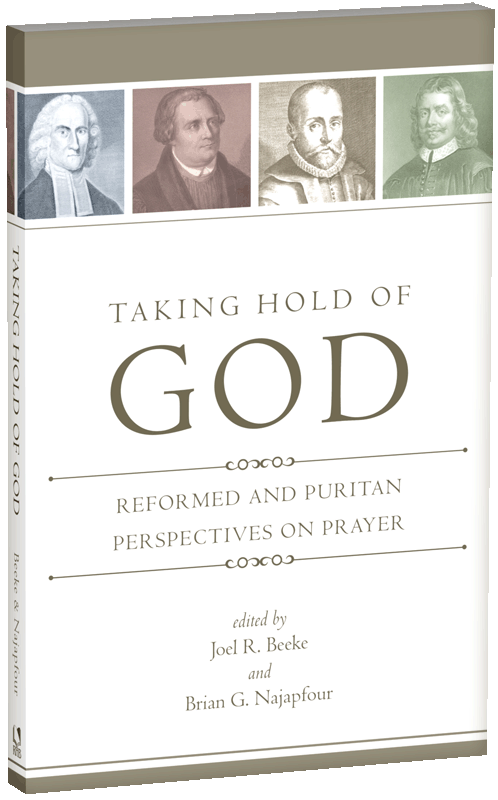 I was recently made aware of the coming title by RHB publications. I am really excited for two reasons.
1. One, because I sit close to one of the editors literally I sit right next to him. In the library (during my seminary years) my study desk was next to Brian Najapfour. I watched him for two years study Bunyan, Owen and Edwards on the issue of prayer and I am very excited to read this particular work that he and my M.A.R. advisor Dr. Beeke has worked on.
2. Secondly, because the Puritans on prayer were the master’s so it seems on the topic. Then again… that may have something to do with hearing Brian constantly talk about the Puritans and prayer for over two years day in and day out. I cannot for the title.
Edited by Joel R. Beeke and Brian G. Najapfour
Description: In Taking Hold of God, you will enter the treasury of the church of Jesus Christ and discover some of its most valuable gems on the subject of Christian prayer. The writings of the Reformers and Puritans shine with the glory of God in Christ, offering us much wisdom and insight today that can make our own prayer lives more informed, more extensive, more fervent, and more effectual. Six contemporary scholars explore the writings and prayer lives of several Reformers and Puritans—among them Martin Luther, John Calvin, William Perkins, Matthew Henry, and Jonathan Edwards—guiding us to growth in prayer and a more grateful communion with God.
Full Endorsements:
“Taking Hold of God is a veritable gold mine on the subject of prayer. Beeke and Najapfour have brought together in one volume the teaching on prayer of the giants of the Reformation and Puritan eras: Luther, Calvin, Knox, Perkins, Bunyan, Henry, Edwards, and others. I was personally encouraged and stimulated to take my own prayer life to a higher and hopefully more productive level. All believers who have any desire to pray effectively will profit from this book.” — Jerry Bridges, a longtime staff member of the Navigators and author ofThe Pursuit of Holiness
“Many of us feel either infants in the school of prayer or intimidated and beaten down by those who accuse us of being prayer-less but do not teach us how to be prayer-full. But here can be found nourishment, example, instruction, encouragement, and, yes, deep challenge, all in one volume. May these pages serve as a tonic for our weakness, a remedy for our sickness, and an inspiration to greater prayerfulness in our churches!” —Sinclair B. Ferguson, senior minister of First Presbyterian Church of Columbia, South Carolina, and professor of Systematic Theology at Redeemer Theological Seminary, Dallas, Texas
“The Protestant Reformation brought a revolution to the life of prayer. This book opens up the story of how the Reformers like Luther and Calvin, followed by the Puritans like William Perkins and Matthew Henry, teach us a surprisingly new approach to the life of prayer.” —Hughes Oliphant Old, John H. Leith Professor of Reformed Theology and Worship, Erskine Theological Seminary, Due West, South Carolina
“Together, Beeke and Najapfour have produced a marvelously helpful and instructive volume on prayer drawn from such giants as Martin Luther, John Calvin, John Bunyan, Matthew Henry, and Jonathan Edwards. It is a veritable potpourri of spiritual insight and godly advice. Books on prayer often induce more guilt than help. Taking Hold of God, as the title itself suggests, aims at doing the latter. It beckons us, allures us, into the challenge of prayer itself: laying hold of a gracious Father who longs for our presence and delights to commune with His children. If you aim to read just one book on prayer this year, choose this one.” —Derek W. H. Thomas, John E. Richards Professor of Systematic and Practical Theology, Reformed Theological Seminary, Jackson, Mississippi
Contents:
Preface
1. Martin Luther on Prayer and Reformation (Brian G. Najapfour)
2. John Calvin on Prayer as Communion with God (Joel R. Beeke)
3. John Knox: A Theologian of Prayer (Brian G. Najapfour)
4. William Perkins on the Lord’s Prayer (J. Stephen Yuille)
5. Anthony Burgess on Christ’s Prayer for Us (Joel R. Beeke)
6. John Bunyan on Praying with the Holy Spirit (Michael A. G. Haykin)
7. The Puritans on the Help of the Holy Spirit in Prayer (Johnny C. Serafini)
8. Matthew Henry on a Practical Method of Daily Prayer (Joel R. Beeke)
9. Thomas Boston and Praying to Our Father (Joel R. Beeke)
10. Jonathan Edwards on Prayer and the Triune God (Peter Beck)
11. Puritan Prayers for World Missions (Joel R. Beeke)
12. Prayerful Praying Today (Joel R. Beeke)
Bibliography
Scripture Index
Subject Index
Contributors:
Peter Beck, Joel R. Beeke, Michael A. G. Haykin, Brian G. Najapfour, Johnny C. Serafini, J. Stephen Yuille
About the Editors:
Joel R. Beeke is president and professor of Systematic Theology and Homiletics at Puritan Reformed Theological Seminary, and a pastor of the Heritage Netherlands Reformed Congregation of Grand Rapids, Michigan.
Brian G. Najapfour, a pastor from the Philippines, is a recent grad uate from Puritan Reformed Theological Seminary (Th.M.) and is a Ph.D. student at Southern Baptist Theological Seminary.
A New and Improved David
Posted: December 13, 2010 Filed under: Just for Fun Leave a comment(Post by Ben Thocher)
In 2 Samuel 5:6-10 we read of David laying siege to and capturing Jerusalem, the “stronghold of Zion.” This city of David will come to play a crucial role in Israel’s life and theology:
And the king and his men went to Jerusalem against the Jebusites, the inhabitants of the land, who said to David, “You will not come in here, but the blind and the lame will ward you off”—thinking, “David cannot come in here.” Nevertheless, David took the stronghold of Zion, that is, the city of David. And David said on that day, “Whoever would strike the Jebusites, let him get up the water shaft to attack ‘the lame and the blind,’ who are hated by David’s soul.” Therefore it is said, “The blind and the lame shall not come into the house.” And David lived in the stronghold and called it the city of David. And David built the city all around from the Millo inward. And David became greater and greater, for the Lord, the God of hosts, was with him.
Matthew has made the point time and time again to connect Jesus’ identity to that of David. This is especially true in his account of Jesus’ entry into Jerusalem (cf. Matt. 21:1-11). David flees Jerusalem mounted on a donkey. Jesus enters Jerusalem mounted on a donkey. David weeps for his son. Jesus weeps for God’s city. Further, David’s escape from Jersualem anticipates the spirit of the Lord rising from the temple and departing to the east. The presence of God among his people is cut off. In Jesus we see the return of God’s glory to the temple. Jesus enters Jerusalem from the east. Israel’s Davidic king has returned, and the presence of God with him.
And Jesus entered the temple and drove out all who sold and bought in the temple, and he overturned the tables of the money-changers and the seats of those who sold pigeons. He said to them, “It is written, ‘My house shall be called a house of prayer,’ but you make it a den of robbers.”
And the blind and the lame came to him in the temple, and he healed them. But when the chief priests and the scribes saw the wonderful things that he did, and the children crying out in the temple, “Hosanna to the Son of David!” they were indignant, and they said to him, “Do you hear what these are saying?” And Jesus said to them, “Yes; have you never read,
“‘Out of the mouth of infants and nursing babies
you have prepared praise’?”
And leaving them, he went out of the city to Bethany and lodged there.
When David takes Jerusalem, he is mocked. The city is so well fortified that even the “blind and the lame” could defend it against David’s attack. For this reason, David does not allow the blind or the lame to enter the temple. They are hated by David’s soul.
In Jesus we see a king who is like David, but more importantly, a king who is unlike David, a king who will rule with perfect justice and righteousness. Jesus is a better David. Upon clearing out the temple and disrupting its worship, we read that “the blind and the lame came to him in the temple.” The very people that had banned from the temple are now healed there by David’s greater son. While David was filled with contempt, Jesus is filled with compassion. The true Davidic king is restoring all things to himself, setting the world to rights.
This is the only time Jesus heals in Jerusalem, and we dare not miss the profundity of the situation: the lame and blind do not come to the temple to be healed, but to Jesus. Like the wise men before them, they come to a person, not a place.
Jesus has once more revealed himself as the true center of life and worship for his people.
Additional Blogger
Posted: December 6, 2010 Filed under: Just for Fun Leave a commentI have at times wanted to turn my personal blog into a place where others played a part in contributing to it as well. Then I think twice and say no. After leaving seminary, I at times just do not feel like writing all the time, or better yet I just forget! Over the three past years I have thought if one guy was going to help me it was a good friend of mine, Ben Thocher.
Ben Thocher has a B.S. from Philadelphia Biblical University, a M.A.R. from Westminster Theological Seminary and is now in the Th.M. program at Westminster Theological Seminary. Ben also works for Westminster Bookstore and lives outside of Philadelphia PA. Although many of you readers do not know Ben, he has been a great theological buddy of mine throughout the last-8-years that I have known him (besides one-year). Over the next year in 2011, Ben will help me here at the blog writing several post for us as we think about theological issues and continue to learn and search out the Gospel.
Bloggin Back
Posted: November 15, 2010 Filed under: Just for Fun 2 CommentsI have written fewer and fewer post since I recently moved from the great midwest land of Michigan to the awful east coast city-fied state of Maryland. Thus far after four months it seems as if nothing has went as planned, besides the fact that I did find a nice library and do spend my mornings till afternoon here enjoying the Bel Air branch of the Harford Libraries. I must say, I have never seen a better library than these out here… oh wait, I did live in Grand Rapids, Calvin Colleges library is the best!
Besides that, I will be bloggin a bit more since I have more time, and am looking forward to doing shorter post, quick, one to two paragraphs of quick thoughts of whatever it is that I am working on, or thinking of at the moment. If you have any questions, or anything that you would like to see, remember leave a comment, email me and I’ll try my best to tackle whatever it is you have for me.
John MacArthur Rebukes Joel Osteen
Posted: November 4, 2010 Filed under: Just for Fun Leave a commentIs My Music Warping My Child?
Posted: October 29, 2010 Filed under: Just for Fun Leave a commentThat’s the question Dr. Russell Moore ask, and answers in what I believe to be a biblical view. Read it here.
ObamaCare: The Facts On Abortion
Posted: October 27, 2010 Filed under: Just for Fun, Video of the Week Leave a commentTesting of Your Faith
Posted: October 27, 2010 Filed under: Just for Fun Leave a commentJames 1:2-18
2 Count it all joy, my brothers, when you meet trials of various kinds, 3 for you know that the testing of your faith produces steadfastness. 4 And let steadfastness have its full effect, that you may be perfect and complete, lacking in nothing.
5 If any of you lacks wisdom, let him ask God, who gives generously to all without reproach, and it will be given him. 6 But let him ask in faith, with no doubting, for the one who doubts is like a wave of the sea that is driven and tossed by the wind. 7 For that person must not suppose that he will receive anything from the Lord; 8 he is a double-minded man, unstable in all his ways.
9 Let the lowly brother boast in his exaltation, 10 and the rich in his humiliation, because like a flower of the grass he will pass away. 11 For the sun rises with its scorching heat and withers the grass; its flower falls, and its beauty perishes. So also will the rich man fade away in the midst of his pursuits.
12 Blessed is the man who remains steadfast under trial, for when he has stood the test he will receive the crown of life, which God has promised to those who love him. 13 Let no one say when he is tempted, “I am being tempted by God,” for God cannot be tempted with evil, and he himself tempts no one. 14 But each person is tempted when he is lured and enticed by his own desire. 15 Then desire when it has conceived gives birth to sin, and sin when it is fully grown brings forth death.
16 Do not be deceived, my beloved brothers. 17 Every good gift and every perfect gift is from above, coming down from the Father of lights with whom there is no variation or shadow due to change. 18 Of his own will he brought us forth by the word of truth,that we should be a kind of firstfruits of his creatures.
Maryland Needs to Talk to Ted
Posted: September 15, 2010 Filed under: Just for Fun, Video of the Week Leave a commentSatanic Rock Artist Comes Back to the Gospel
Posted: September 4, 2010 Filed under: Just for Fun, Video of the Week 1 Comment
The Necessity of Confessions
Posted: September 3, 2010 Filed under: Just for Fun Leave a comment1. The existence of the church itself calls for confessions to be written.
The faith that is within the believers has to be confessed. The heart is full of it and must be pronounced. That counts for the individual believer but also for the church as a whole. In the Scriptures the mysteries of godliness are reflected and they are embraced by faith in the heart. The result is that the believer confesses these matters with his lips. The church knows about God, and Divine matters, about the creation and fall and sin and reconciliation through the mediator and His blessed work and about the future judgment and the final condemnation of the wicked. These matters are perfectly well known and must be confessed. Because the church exists therefore confessions must exist. It is a given. There have to be clear delineated concepts of the truth. This is not a matter that she can take or leave; it is an essential aspect of being a church. Otherwise she ceases to be a church.
2. The necessity of self-defense.
The church dwells in the midst of the world and is not of the world. Her testimony causes all kinds of reactions. Often the church must confess that there is a lethargic spiritual life, that there are all kinds of divisions. There is conformity to the world. There are other sorrowful matters and these all cause the church too often to place her confession and faith underneath a bushel. The strength of her testimony was gone.
Too often the church has withdrawn herself into a self-satisfied retreat from the world and sought her strength in her isolation. Then the church herself was the cause that the world forgot the church and had no interest in her message.
But everywhere where the church confesses and stands in the midst of the world with her confession, then the world cannot live undecided towards the church. Her testimony is too intrusive, too divisive, and too radical according to the standards of the world. Then the church does not allow people to have a calm conscience if they live outside of the Lord. The result is that hate scorn and suffering are laid upon the church.
The church may then never defend herself with carnal weapons or with sword, but with the clear testimony of the truth. To glorify her king the church will testify of God’s Word, prove her innocence and publicly proclaim what doctrine she propagates.
The church has to defend also changes and reformations why certain matters are changed.
3. To openly testify of the unity in the doctrine of the church.
Already in the days of the reformation it became clear that one of the most effective means to show the unity of faith was to make use of confessions ands creeds. The churches would send each other their creedal statements. In this way the unity of the spirit can be experienced, as we read in Eph 4:3. To promote this unity we make use of confessions.
Forefathers from the very onset of the reformation felt these matters.
Already Calvin saw the need of this statement of unity in the faith. In his preface to the catechism of Geneva he states:
“In this confused and divided state of Christendom, I judge it useful That there should be public testimonies, whereby churches which, though widely separated by space, agree in the doctrine of Christ, may mutually recognize each other. For besides that, this tends not a little to mutual confirmation, what is more to be desired than that mutual congratulations should pass between them, and that they should devoutly commend each other to the Lord? With this view, bishops were wont in old time, when as yet consent in faith existed and flourished among all, to send Synodical Epistles beyond sea, by which, as a kind of badges, they might maintain sacred communion among the churches. How much more necessary is it now, in this fearful devastation of the Christian world, that the few churches, which duly worship God, and they too scattered and hedged round on all sides by the profane synagogues of Antichrist, should mutually give and receive this token of holy union that they may thereby be incited to that fraternal embrace of which I have spoken?”
At the Synod of Armentiers in The Southern Netherlands 1565? it was decided that all elders and deacons would sign the Belgic Confession. At the Synod of Pentecost of 1565 in Antwerp this article was decided upon that at every synod all the delegates shall make a public confession of their faith to state the unity of faith and also to ascertain if something needs to be added to this confession or not. At the Synod of 1571 in Embden it was decided that in order to promote the unity in the doctrine we decided that all the delegates shall sign the Confession of faith as well as the French confession. The same in Alkmaar 1573 and in 1574 at Dort Provincial synod. Guido de Bres himself underscored the apologetic motive of the Confession, the churches saw in this confession a banner of unity.
4. To maintain the purity of doctrine.
In the course of time the church has been assaulted by damnable heresies. The church had to clearly express what she stood for. The heretics have often awakened the church and caused her to stand firm on the truth once delivered to her. Without Arius Athanasius would not have performed his life work. Without Donatus and Pelagius Augustine would not have developed to such an outstanding theologian. The church had profit even from the struggles against heretics.
The church against Arius clearly testified of Divine nature of Christ and the doctrine of the Holy Trinity as portrayed by Athanasius was made into a confession. At the council of Carthage in 418 Pelagianism was completely banished and condemned. The heretics forced the church to conduct a deep exegesis. Actually the salvation of souls was at stake. Over against deceit they had to place the truth in clear formulations. These became confessions.
To be tolerant here would have shown a lack of character. When scripture has spoken and Christ has made this message clear to the church then the church may sign no pact of tolerance but must be sharp in portraying and exposing deceit and lying.
The church used thereby the Word of God and could plead and experience and trust the promise of Christ that the Holy Spirit would lead into all truth. In clear words the church could state that she believes and confesses and condemns.
This was again the case during the reformation. Calvin wanted to maintain the purity in doctrine by also letting the children of Geneva study the truth in catechism. This catechism would lead the children to do confession of faith. The confession of the church was seen as a means to maintain the purity of doctrine.

Do I Miss Michigan?
Posted: August 5, 2010 Filed under: Just for Fun 2 CommentsNO. But 3 things I do miss…
1. PRTS & RHB
2. Michigan drivers may be the best I have meet, Maryland drivers are just stupid.
3. Michigan weather for how much people complain about it, is way better than M 92 degrees, no sun, and 105 heat index.

 Gospel-Centered Musings