My Saving Grace
Posted: March 2, 2010 Filed under: Country Lyrics 1 CommentAs those that know me, know I love country music. So maybe you’ll enjoy this short story and maybe you won’t.
It was the other night studying in the library I was listening to a newer country singer (Jamey Johnson) that I enjoy because of his at times because of his rebel sound, much like that of the 70’s and 80’s. A good many of times I never at all listen to the lyrics, I am either typing, reading, walking around the library researching with head phones and the music/beat/sound of twang is just there in my ears because I enjoy it. However it was getting late and I sit back listening to the lyrics of a song called “My Saving Grace” and how it hit me personally and that of my own life that God has planned for me in my upbringing.
Now I have no idea of Jamey Johnson’s eternal state with Christ. However if he is not a believer, than it is God’s common grace that allows him (and the many others) to sing of His special grace in the gospel that amazes me time and time again.
However as my mother made me go to church, and the stories of my drunkard father that would come home and abuse my mother, such lyrics as these speak to my own personal life in how God uses a number of situations to bring one to the Gospel of Jesus Christ in the Church.
“Daddy’s bourbon breath was strong as gasoline, An’ it seemed to fuel the rage he had inside. He’d come home just burnin’, Mad an’ drunk an’ mean an’ raisin’ hell on a Saturday night. Momma’d lock us up in her bedroom, He’d be lyin’ in the hallway on our way to Sunday school. They both, in their own way became my savin’ grace. Daddy passed out with his demons: Momma passed the offerin’ plate. An’ she’d cry out to Heaven: “Protect this son of mine,” While Daddy kept the devil off my back, By takin’ up his time.
Momma said: “Nobody’s perfect,” as we walked into Church, To ask the Good Lord to forgive him, again. I still recall that sermon, I hung on every word. That’s when I learned just exactly what a Father really meant. And the Angels and the people gathered round, I was standin’ in that water when that Preacher laid me down.
They both, in their own way became my savin’ grace. Daddy passed out with his demons: Momma passed the offerin’ plate. An’ she’d cry out to Heaven: “Protect this son of mine,” While Daddy kept the devil off my back, By takin’ up his time. An’ Daddy kept the devil off my back… By takin’ up his time.”
Coming Titles by The Dutch Reformed Translation Society
Posted: March 1, 2010 Filed under: Dutch Reformed Translation Society Leave a commentTitles in process:
Wilhelmus a Brakel, Edifying Exercises Related to the Lord Supper
Guilelmus Saldanus, The Power of the Lord’s Supper
Godefridus Undemans, The Practice of Faith, Hope, and Love
Jodocus van Lodenstein, Nine Sermons
and what I am really looking froward to… … …
Petrus van Mastricht, Theoretical and Practical Theology (4 volumes).
Can a “non-christian” Do Good Things?
Posted: February 25, 2010 Filed under: Questions & Answers, Questions that begged to be asked, Westminster Confession of Faith 3 CommentsAssuming that God is the creator of the universe (and I do)…
Can a non-christian Do Good Things? IS A great quesiton that mankind at times may think or feel that he has the answer to. However, God has already given an answer to that… And the The Westminster Confession Chapter 26:7 states it at its best,
“Works done by unregenerate men, although for the matter of them they may be things which God commands; and of good use both to themselves and others:[23] yet, because they proceed not from an heart purified by faith;[24] nor are done in a right manner, according to the Word;[25] nor to a right end, the glory of God,[26] they are therefore sinful and cannot please God, or make a man meet to receive grace from God:[27] and yet, their neglect of them is more sinful and displeasing unto God.[28]“
Be sure to click on the numbers above that provide the Scriptural references for your reading.
What in the world is a Journible?
Posted: February 24, 2010 Filed under: Journibles Leave a commentWhy the 17:18 series?
In Deuteronomy 17, Moses is leaving final instructions concerning the future of Israel. As a prophet of God, Moses foretells of when Israel will place a king over the nation (v. 14). In verse 18, the king is commanded to not simply acquire a copy of the law (the entire book of Deuteronomy) from the “scroll publishing house,” but to hand write his own copy of the law. Thirty-four hundred years later, educators are “discovering” that students that physically write out their notes by hand have a much greater retention rate than simply hearing or visually reading the information. Apparently, God knew this to be true of the kings of Israel also. From such understanding came the conception of this series of books.
How to Use These Books?
Each book is organized so that you can write out your very own copy of Scripture. You will be writing the Bible text only on the right hand page of the book. This should make for easier writing and also allows ample space on the left page to write your own notes and comments. From time to time a question or word will be lightly printed on the left page; these questions are to aid in further study, but should not interfere with your own notes and comments.
Now Available?
Proverbs; John; Romans; Galatians, Ephesians, Philippians, Colossians, 1 and 2 Thessalonians; 1 & 2 Timothy, Titus, Philemon, and Hebrews; James, 1 & 2 Peter, 1, 2 & 3 John and Jude.
Jerry Bridges writes,
“There is an old proverb that says ‘Thoughts disentangle themselves when passing over the lips and through the finger tips.’ The 17:18 Series which encourages us to actually write out the words of Scripture will be a tremendous tool in putting that proverb into action in our daily lives. I am happy to commend this project.”
Johnny Cash American V: A Hundred Highways
Posted: February 23, 2010 Filed under: Johnny Cash Leave a commentLife Reformation Blog
Posted: February 22, 2010 Filed under: Blogs 1 CommentRecently (about 5-years to late) but nonetheless most recently one of my old co-seminarians started a blog with some of his friends. If you are interested check here for their blog and their conferences which look pretty sweet.
Bird On A Wire & Down There by the Train
Posted: February 19, 2010 Filed under: Johnny Cash Leave a commentIf there are any words, lyrics, or sentences that explain my own life/personal experience in life it is this. Not very well known songs by my favorite music icon Johnny Cash, this song to me means everything I once was, dealt with, lived and experienced.
The lyrics:
“Like a bird on a wire, like a drunk in a midnight choir, I have tried in my way to be free. Like a fish on a hook, like a knight in some old fashioned book, I have saved all my ribbons for thee. And if I have been unkind, I just hope you will let it go by. And if I have been untrue, I hope you know it was never to you. Like a baby stillborn, like a beast with his horn, I have torn everyone, who reached out for me. But I swear, by this song, and by all I have done wrong, I’ll make it all up, to thee. I saw a young man (a beggar) leaning on his wooden crutch, He called out to me “Don’t ask for so much,” and a young woman leaning in her darkened door, she cried out to me “Hey, why not ask for more.” Like a bird on a wire, like a drunk in a midnight choir, I have tried in my way, to be free.”
There’s a place I know where the train goes slow, where the sinner can be washed in the blood of the lamb. There’s a river by the trestle, down by sinner’s grove. Down where the willow and the dogwood grow. You can hear the whistle, you can hear the bell, from the halls of heaven to the gates of hell, and there’s room for the forsaken if you’re there on time, You’ll be washed of all your sins and all of your crimes.
If you’re down there by the train, down there by the train, down there by the train, down there by the train, down there where the train goes slow…
There’s a golden moon that shines up through the mist, and I know that your name can be on that list. There’s no eye for an eye, there’s no tooth for a tooth. I saw Judas Iscariot carrying John Wilkes Booth.
He was down there by the train, Down there by the train, Down there by the train, Down there by the train, He was down there where the train goes slow…
If you’ve lost all your hope, if you’ve lost all your faith, I know you can be cared for and I know you can be safe, and all the shamefuls and all of the whores, and even the soldier who pierced the side of the Lord,
Is down there by the train, Down there by the train, Down there by the train, Down there by the train, Down there where the train goes slow.
Well, I’ve never asked forgiveness and I’ve never said a prayer, Never given of myself, never truly cared, I’ve left the ones who loved me and I’m still raising cain, I’ve taken the low road and if you’ve done the same…
Meet me down there by the train, Down there by the train, Down there by the train, Down there by the train, Down there where the train goes slow…
Meet me down there by the train, Down there by the train, Down there by the train, Down there by the train, Down there where the train goes slow.
My Response to Dr. Gary Herion’s Article on Why God Rejected Cain’s Offering
Posted: February 18, 2010 Filed under: Article Reviews, Gary Herion 3 CommentsYou can read Dr. Herion’s Article: Gary A. Herion “Why God Rejected Cain’s Offering: The Obvious Answer,*” Fortunate the Eyes that See: Essays in Honor of David Noel Freedman In celebration of His Seventieth Birthday, ed. Astrid B. Beck, Andrew H. Bartelt, Paul R. Raabe, and Chris A. Franke. (Eerdmans: Grand Rapids, 1995), pp. 52-65.
My Response:
Survey
Gary A. Herion is a professor of Religious Studies in the Humanities Department at Hartwick College in Oneonta, New York. Herion teaches on a number of different levels at The Hartwick College Religion Department; ranging from Introduction courses such as Understanding Religion and Introduction to the Bible; Intermediate courses such as Judaism, Christianity, Islam, Hebrew Scriptures/Old Testament and New Testament; to several Advanced courses like Jesus in Myth, Tradition and History, Hebrew Storytelling, The Prophets of Israel, and Paul’s New Testament Writings. Herion has also contributed to two well-known books in his field (and editing one of them): The Anchor Bible Dictionary published by Doubleday in 1992, and Ancient Israel’s Faith and History: An Introduction to the Bible in Context, published by Westminster John Knox Press in 2001. However, it is the book that Herion contributed to in 1995, published by Eerdmans, entitled, Fortunate the Eyes that See: Essays in Honor of David Noel Freedman In celebration of His Seventieth Birthday that caught my eye while reading it. In this book, Herion wrote an article entitled “Why God Rejected Cain’s Offering: The Obvious Answer.*” It is in this article that Herion defends his belief that the rejection of Cain’s offering was simply because it was from the ground.
Amongst his vast field of religious studies, Herion spent some time studying under David Freedman during his graduate work, and was also his coworker on the Anchor Bible Dictionary. His involvement in so many areas – from introduction courses of religion, to teaching both the Old and New Testament full-time, to in-depth classes about the Torah, the Gospel, Jesus, and the prophets – seems to me, vast as the ocean. Although he is so knowledgeable in such a variety of fields, this particular article is focused upon the field of Old Testament Biblical Theology, and he wrote it not from the angle of a Jew or Christian, but simply a scholar of the Holy Bible. However, doing so, he lacks one of the major important presumptions that Christians carry when coming to Old Testament biblical theology—that is, using the New Testament to help interpret the Old Testament. Herion seems to use the Old Testament alone when dealing with God, and because of that he is somewhat mislead in his view of the character of God and the theology of the Old Testament because he does not allow the whole of the Canon to speak for how God works with mankind. This is easily seen in his article “Why God Rejected Cain’s Offering,” because the answer to this question does not lay in the Old Testament, but rather in the New Testament where God later revealed it.
Summarize
Herion breaks down his defense—that the ground was the reason why Cain’s offering was not accepted—by looking at what he calls the thematic elements in the text. This includes looking at the man, soil, and the geography of Eden in Genesis 2; the fate of the man and the soil in Genesis 3; Cain, Abel, and the soil in Genesis 4; and Noah and the soil in Genesis 5, 8, and 9. Herion’s reason behind breaking his article down in such sections is to prove and give his explanation to the question which is the title of his article: “Why God Rejected Cain’s Offering.” Herion begins his article stating the problem of there being no answer in the given text of the narrative in Genesis 4. Although this may be true of the text, it is not true of the whole Canon. He takes the stand that Genesis 4 does not give an answer, but the surrounding texts make “The Obvious Answer” clear to the reader. Herion then goes from identifying what he thinks is a problem (God giving no answer to Cain), to then defending his own answer to it, gleaning from Genesis 3, 5, 8, and 9. Herion tries to show how the ground being cursed in Genesis 3:17-19 is the “obvious answer.” From here he then looks to the post chapters (after Genesis 4), dealing with why the flood came and the affects in Genesis 8 and 9—that is, how the ground has affected that before God’s sight. Although some of what he says is true, he still misses the fact that it is not simply because of the ground’s curse, because did not the animals have a curse as well? The article tries its best to contribute to his mentor and friend in an area in which people are restless in finding reasons in Genesis 4 only; however, overall, the article is a laugh at best.
Evaluate
If one was to write an article that was to be a contribution to a 600-page book for my 70th birthday, I would be quite thrilled and honored. However, if one did so with their theological conclusion in the article being dead-wrong, I wouldn’t be very happy, nor would I even want the article to be “in honor” of me. Herion titles his article, “Why God Rejected Cain’s Offering: The Obvious Answer*” and it is that subtitle that is the biggest problem of his article. I, like Herion, think the answer of “Why God Rejected Cain’s Offering” is very “obvious” as well, but somehow did not come up with the same “answer.” But then it was the “*” that caught my attention when skimming down through the different articles in the table of contents.
Mr. Herion begins his article defending the “*” in his title. He starts by saying,
“It may seem arrogant to subtitle an article, “The Obvious Answer.” Indeed, if there remain any great unanswered questions in biblical studies, surely on of them has been: “Why did God reject Cain’s offering?” If the answer to this question is obvious, why have scholars during the past two millennia not seen it?”
Yes, it is very arrogant to subtitle your article “The Obvious Answer,*” but it is even more so ignorance than arrogance to say, “if there remain any great unanswered questions in biblical studies, surely one of them has been: “Why did God reject Cain’s offering?”” The last time I checked, the answer was given crystal clear by God Himself to the writer of the letter to the Hebrews in chapter 11 to the very question Herion addresses. Hebrews 11:1-7 states;
“11:1 Now faith is the assurance of things hoped for, the conviction of things not seen. 11:2 For by it the people of old received their commendation. 11:3 By faith we understand that the universe was created by the word of God, so that what is seen was not made out of things that are visible.11:4 By faith Abel offered to God a more acceptable sacrifice than Cain, through which he was commended as righteous, God commending him by accepting his gifts. And through his faith, though he died, he still speaks. 11:5 By faith Enoch was taken up so that he should not see death, and he was not found, because God had taken him. Now before he was taken he was commended as having pleased God. 11:6 And without faith it is impossible to please him, for whoever would draw near to God must believe that he exists and that he rewards those who seek him. 11:7 By faith Noah, being warned by God concerning events as yet unseen, in reverent fear constructed an ark for the saving of his household. By this he condemned the world and became an heir of the righteousness that comes by faith.”
Although the answer to Herion’s question is found mainly in verse four (“By faith Abel offered to God a more acceptable sacrifice than Cain”), it is important to see the overall focus of the whole passage, and to notice how exactly Hebrews 11 sheds light on answering Herion’s question. How Herion cannot see clearly why God did not accept Cain’s offering is beyond me. The writer here says explicitly, “Abel offered to God a more acceptable sacrifice than Cain;” but why is it more acceptable? The answer is given in the beginning of the verse—“By faith.” So it was because of Abel’s “faith” that God accepted his sacrifice, and it was by Cain having no faith that God did not accept his offering. Any other answer contrary to that, which is given here in Hebrews 11:4, is false and should not be accepted.
We see in Hebrews 11:1 that those who had faith also had their assurance in the things to come. In 11:2 we see the author shedding more light on the center of the passage (faith), stating that it is by faith that one has their assurance of the things hoped for; or on the other hand, receives their condemnation by not having faith. In 11:3 we see that God created everything not out of a matter, but out of non-matter, and it is the faith of the person that leads to understanding such truth. Following this, the first example the author of Hebrews has for us in 11:4 is that of Cain and Abel’s offerings telling us that God accepted Abel’s because of his faith, and that he was commended as righteous and his gifts were accepted. To what kind of faith Abel had, the author does not leave room for more questions or multiple answers. In every way the faith which Abel had was a saving faith; and through this faith, he still speaks. In summary, the acceptance of the offering was evidence of God’s acceptance of the person, which “still speaks.” The story of Abel’s faith as recorded in the Bible, still speaks to generation after generation, and still to this day. This mention of Abel’s faith indicates that from the very outset of human history, some Old Testament figures were saved by means of faith in a sacrifice, which was a foreshadowing to the future sacrifice of Christ. This is why I made mention to reading not only Hebrews 11:4, but all of Hebrews 11:1-7. The author Hebrews reminds his readers by saying, “Now faith is the assurance of things hoped for, the conviction of things not seen.” The question is not merely “Why God rejected Cain’s offering,” but “What saved Abel?” What saved Abel was his faith in giving his sacrifice, as a foreshadowing of the coming sacrifice of Jesus Christ. To answer Herion’s question, it is because Cain did not have faith—that is, faith of a coming sacrifice for mankind to which he would have known from his covenant parents Adam and Eve.
However, what is even more provoking than claiming that the question does not have an answer, is Herion’s statement, “I do not claim to have found the answer myself.” Really, if you do not know the answer or claim to, than why write a 13-page article, giving 4 proofs to defend the answer? And on top of that, why subtitle the article “The Obvious Answer” when you said you “do not claim to have found the answer.” Herion goes on in the article to describe the event which shed light on answering his question when a first year student at Hartwick College asked him the very question, “Why did God reject Cain’s offering?” He answered like always, “the text really does not tell us.” My response to that is simply that the text in Genesis 4 is not shedding light into why the sacrifice was not accepted, as it is more to the pivotal point in which the line of wicked (Cain) and the line of Seth (The Lord’s people) spilt. However, God did not let the question go unanswered; for when the history of redemption is reviewed by the writer of Hebrews, as we saw, the answer is clearly because Cain did not have faith.
Herion then gives the reason why it is he wrote the article saying that a student said out-loud one day in his class, “I thought it was because of Cain offered produce from the ground, which in the preceding chapter had been cursed by God.” Herion says to that, “he was delighted to encounter the haggadic tradition… This confirmed my suspicion that the solution is indeed so obvious and simple that either an American high school graduate or a medieval Jewish exegete could apprehend it.” Just before, Herion stated that he did “not claim to have found the answer,” and yet he nevertheless continues to defend his position that the lexical and thematic elements in namely Genesis 4 (but also throughout Genesis chapters 3 to 9) give us the “obvious answer” to why God rejected Cain’s offering. Herion makes mention that “viewing the curse in this way, we have glossed over the effect that the curse had on the character who pronounced it – God,” thus setting the stage for what he planned to defend in his four sections mentioned before.
In this, not only does the writer of Hebrews destroy Herion’s idea, but so does Genesis 3:14. Herion is arguing the whole time that the ground was cursed in Genesis 3:17-19; yet in Genesis 3:14 the animals were cursed also. Genesis 3:14 reads, “The Lord God said to the serpent, “Because you have done this, cursed are you above all livestock and above all beasts of the field; on your belly you shall go, and dust you shall eat all the days of your life.” Did Herion not see that both the animals and the ground were cursed, yet the animals were above everything else? If Herion’s argument were to exist, wouldn’t have Abel’s sacrifice not been accepted either? For both were cursed at the fall of mankind. When seeing this, that all of creation at man’s fall was cursed—mankind, animals, and the ground—then only the writer of Hebrews’ answer stands: that Cain was without faith in his sacrifice, and because of that, God did not, nor would he ever, allow any sacrifice.
Creeds, Confessions, and Catechisms
Posted: February 17, 2010 Filed under: and Catechisms, Reformed Confessions Leave a commentThe 1689 London Baptist Confession of Faith
The New Hampshire Confession of Faith
The Philadelphia Confession of Faith
The Second Helvetic Confession
The Thirty-Nine Articles
The Westminster Confession of Faith
The Westminster Shorter Catechism
My question is why the London Baptist 1642 is not placed a part of the Reformed Confessions? Oh well…
ANNOUNCING www.refo500.nl
Posted: February 16, 2010 Filed under: David Hall, Philipp Melanchthon 1 Comment(Post by David Hall)
Happy Birthday on Tuesday February 16th to Philipp Melanchthon!! And Greetings to friends of Calvin and the Reformation. Like most of you, 2009 was a wonderful year for me. And some very fine folks that we met at Calvin500 have found a way to extend the best of the historical and commemorative spirit; accordingly, I want to commend Refo500 to you.
A thrilling new attempt to make the strengths of the Reformation known and lively for today is now launching under the capable direction of Dr. Herman Selderhuis of The Theological University of Apeldoorn in the Netherlands. Refo500 is holding a press conference on Tuesday and launching its website. I encourage any of you who enjoyed Calvin500 to see this next step and participate as you may.
Please visit the website after 6:00 PM on Tuesday and often (English version forthcoming) here.
And I hope you enjoy the overview in the extracts from the attached Press Release.
God bless.
See also this…
What is The Precise Character of Kingship?
Posted: February 16, 2010 Filed under: Christ’s Lordship Leave a commentMy professor, my advisor of my Th.M. and friend Dr. Jerry Bilkes has taught me that,
“What appears from a close examination from the texts that set forth Christ‟s kingship is that this is an economical kingship. It is true; he has an essential kingship in his unity with the Father, as Sovereign God. But, he was given the kingship economically or officially, so that now, on the basis of his accomplishments, he is now exalted. He reigns over both his church and the world in his office as king. He was endowed with this office, and assumed this office in the covenant of redemption. Therein he has an office which man was given in his creation, but which he basically lost because of his fall. He had been commissioned to subdue the earth and have dominion over it (Gen 1:28). “Thou madest him to have dominion over the works of thy hands; thou hast put all things under his feet” (Ps 8:6). Man, however, subjected himself willingly to the rule of the devil (Rom 6:16). God, however, declared war upon Satan and his hosts: “I will put enmity” (Gen 3:15). This Christ fulfilled: 1 John 3:8: “For this purpose the Son of God was manifested, that he might destroy the works of the devil” (1 John 3:8). He is given this dominion not simply as Divine Person, for nothing could be given to him that he did not already have. But as Mediator, he is given these things; he accomplishes these things, and applies them in his capacity as the Mediator till this very day.”
The Presentation of Christ’s Lordship
Posted: February 15, 2010 Filed under: Christ’s Lordship Leave a comment1. OT Typologically:
Melchisedec, Moses, David, Solomon Prophetically: Ps 110:1Isa 9:6; 11:1-3
2. Gospels
Mark 14:62: Ye shall see the Son of man sitting on the right hand
Mark 16:19: to sit on the right hand of the power of God
Luke 22:69: sit down on the right hand of the Majesty on high
John 3:35; 5:22: He loveth the Son, and hath given all things into his hand; committed all judgment to his Son
3. Acts
Acts 2:36: made him to be Lord and Christ; 30: raised him up to sit on his throne
Acts 5:31: Him hath God exalted with his right hand, to be a Prince
Acts 7:56: standing on the right hand of God
Acts 10:41: He had ordained him to be a Judge of quick and dead
4. Paul
Rom 8:22: to be on the right hand of God
1 Cor. 15:25: risen as Lord
Eph 1:20-22: He hath set him on his own right hand in the heavenly places
Phil 2:9: He hath high exalted him
Heb 1:13; 2:7-9; 8:1; 10:12; 12:2: sat down on the right hand of God
5. General Epistles
1 Pet 3:22: to sit at the right hand of God
Note: “On the right hand” means: To obtain a degree of honor with him at whose hand they are said to stand (Ps 45:9; 1 Kgs 2:19; Matt. 20:21, 23)
Christ’s Lordship
Posted: February 12, 2010 Filed under: Christ’s Lordship Leave a commentGuthrie:
“The astonishing development of an exalted view of Christ in the thought of the early disciples demands an adequate explanation. That explanation can be found only in the resurrection. No approach to NT Christology is possible without coming to terms with the resurrection.
Jonathan Edwards:
“Christ‟s ascension into heaven was, as it were, his solemn coronation, when the Father set him upon the throne, and invested him with the glory of that kingdom which he had purchased for himself, that he might thereby obtain the success of his redemption in conquering all his enemies. … God the Father did in a visible manner set him on the throne as king of the universe. He then put the angels all under him, and subjected to him heaven and earth, that he might govern them for the good of the people for whom he died. Eph 1:20-22 (History of Redemption, sections II-III).
The Exaltedness of Christ’s Person in John’s Gospel
Posted: February 11, 2010 Filed under: The Exaltedness of Christ’s Person Leave a commentTitles
a. The Word (1:1)
b. That true Light (1:9)
c. The Lamb of God (1:29)
d. [Angels ascending and descending (1:51)]
e. Temple of his Body (2:21)
f. Messias, which is called Christ (4:26)
The “I am’s”
a. I am the bread of life (John 6:35,48)
b. I am the light of the world (8:12; 9:5)
c. I am the door (10:7,9)
d. I am the good shepherd (10:11,14)
e. I am the resurrection and the life (11:25)
f. I am the way, the truth, and the life (14:6)
g. I am the vine (15:1,5)
The emphasis on the glory of Christ
a. eternal glory (1:14)
b. official glory
c. miraculous glory (2:11; 11:4)
d. glory in his people (17:10)
e. given to his people (17:22)
f. everlasting glory (17:24)
g. passionate glory (12:23)
h. Triune glory (17:5)
The Biblical Theology of Johannine Soteriology
Posted: February 10, 2010 Filed under: Biblical Theology 1 Comment1. Man’s Condition – Unbelief and Evil
12:37: “But though he had done so many miracles before them, yet they believed not on him.”
7:7: “The world hateth me, because I testify of it, that the works thereof are evil.”
8:44; “Ye are of your father the devil, and the lusts of your father ye will do.”
2. Eternal Life as a Gift
17:2: “Thou hast given him power over all flesh, that he should give eternal life to as many as thou hast given him.”
12:40: “He hath blinded their eyes, and hardened their heart; that they should not see with their eyes, nor understand with their heart, and be converted.”
5:21: “Even so the Son quickeneth whom he will.”
3. Substitionary Atonement
10:15: “I lay down my life for the sheep.”
13:1: “having loved his own which were in the world, he loved them unto the end.”
4. Sovereign Grace
6:36: “All that the Father giveth me, shall come to me.”
6:39: “that of all which he hath given me I should lose nothing.”
6:45: “every man therefore that hath heard, and hath learned of the Father, cometh unto me.”
6:44,65: “No man can come unto me, except the Father draw him/ it were given unto him of my Father.”
17:2: “Thou hast given him power over all flesh, that he should give eternal life to as many as thou hast given him.”
5. Effectual Grace
10:29: “no man shall pluck them”
17:24: “Father, I will that they also, whom thou hast given me, be with me where I am, that they may behold my glory.”
18:9: “Of them which thou gavest me have I lost none.”
6. Necessity of Faith
7:17: “If any man will do his will, he shall know of the doctrine, whether it be of God, or whether I speak of my myself.”; John 4:10: “If thou knewest the gift of God, and who it is that saith to thee, Give me to drink; thou wouldest have asked of him, and he would have given thee living water”
6:29: What shall we do, that we might work the works of God? Jesus answered and said unto them, This is the work of God, that ye believe on him whom he hath sent
7. The Order of Salvation
a. 6:40: “And this is the Father’s will which hath sent me, that of all which he hath given me I should lose nothing, but should raise it up again at the last day” – – responsibility: “And this is the Father’s will of him that hath sent me, that every one which seeth the Son, and believeth on him, may have everlasting life.”
b. 6:44: “No man can come to me, except the Father which hath sent me draw him: and I will raise him up at the last day.” — responsibility: “Every man therefore that hath heard, and hath learned of the Father cometh unto me” (6:45).
c. 6:65: Therefore, said I unto you, that no man can come unto me, except it were given unto him of my Father — responsibility: Will ye also go away? Lord to whom shall we go? thou hast the words of eternal life (6:68).
d. The necessity of regeneration (3:3,5-8) and the way of faith (3:15-21,36)
8. The Connection Between Self-revelation and Faith
a. I am the bread of life (John 6:35,48). He that cometh to me shall never hunger
b. I am the light of the world (8:12; 9:5). He that followeth me.
c. I am the door (10:7,9). By me if any man enter in, he shall be saved
d. I am the good shepherd (10:11,14). My sheep hear my voice, and I know them, and they follow me.
e. I am the resurrection and the life (11:25). he that believeth in me, though he were dead, yet shall he live.
f. am the way, the truth, and the life (14:6). No man cometh unto the Father but by me.
g. I am the vine (15:1,5). He that abideth in me, and I in him, the same bringeth forth much fruit; for without me ye can do nothing.
The Glory of God in Systematic Theology
Posted: February 9, 2010 Filed under: Systematic Theology Leave a comment1. Glory and Bibliology: 2 Cor 3:7-10. Now if the ministry of death, carved in letters on stone, came with such glory that the Israelites could not gaze at Moses’ face because of its glory, which was being brought to an end, will not the ministry of the Spirit have even more glory?For if there was glory in the ministry of condemnation, the ministry of righteousness must far exceed it in glory. Indeed, in this case, what once had glory has come to have no glory at all, because of the glory that surpasses it.
2. Glory and Theology: 1 Tim 1:17. To the King of ages, immortal, invisible, the only God, be honor and glory forever and ever. Amen.
3. Glory and Anthropology: Rom 1:18-25. For the wrath of God is revealed from heaven against all ungodliness and unrighteousness of men, who by their unrighteousness suppress the truth. For what can be known about God is plain to them, because God has shown it to them. For his invisible attributes, namely, his eternal power and divine nature, have been clearly perceived, ever since the creation of the world, in the things that have been made. So they are without excuse. For although they knew God, they did not honor him as God or give thanks to him, but they became futile in their thinking, and their foolish hearts were darkened. Claiming to be wise, they became fools, and exchanged the glory of the immortal God for images resembling mortal man and birds and animals and creeping things. Therefore God gave them up in the lusts of their hearts to impurity, to the dishonoring of their bodies among themselves, because they exchanged the truth about God for a lie and worshiped and served the creature rather than the Creator, who is blessed forever! Amen.
4. Glory and Christology: 2 Cor 4:6. For God, who said, “Let light shine out of darkness,” has shone in our hearts to give the light of the knowledge of the glory of God in the face of Jesus Christ.
5. Glory and Soteriology: Eph 1:6. to the praise of his glorious grace, with which he has blessed us in the Beloved.
6. Glory and Ecclesiology: Eph 3:21. to him be glory in the church and in Christ Jesus throughout all generations, forever and ever. Amen.
7. Glory and Eschatology: Col 1:27. To them God chose to make known how great among the Gentiles are the riches of the glory of this mystery, which is Christ in you, the hope of glory.
8. Glory and Doxology: Rom 11:36. For from him and through him and to him are all things. To him be glory forever. Amen.
What is The Message of Acts?
Posted: February 8, 2010 Filed under: New Testament Theology Leave a comment- Christ’s exalted rule empowers, guides, and extends the church in accordance with the prophesied word.
- God’s plan was evidenced in the death and resurrection of Christ and provides life and healing and hope for Jews and Gentiles.
- The outpouring of the Spirit confirms Christ’s exaltation and the fulfillment of the plan of redemption; through that Spirit, there is life and witness and growth and joy in the church.
- Prayer and praise are the church’s work in conjunction with witness. It is what God uses to make his reign and kingship known.
- The church is extended through the word being preached by the apostles, as they witness to God, His supremacy in the face of idols, His grace in the face of man’s sin and misery, His plan right through all the devices of principalities and powers.
The Kingdom and The Church
Posted: February 5, 2010 Filed under: New Testament Theology Leave a commentRidderbos says,
“The basileia is the great divine work of salvation in its fulfillment and consummation in Christ; the ekklesia is the people elected and called by God and sharing in the bless of the basileia.” The kingdom “… represents the all-embracing perspective, it denotes the consummation of all history, brings both grace and judgment, has cosmic dimensions, fills time and eternity. The ekklesia in all this is the people who in this great drama have been placed on the side of God in Christ by virtue of the divine election and covenant. They have been given the divine promise, have been brought to manifestation and gathered together by the preaching of the gospel, and will inherit the redemption of the kingdom now and in the great future” (354-355).
Looking for more material on the Kingdom of God? I’d read the following:
- Herman Ridderbos, The Coming of the Kingdom (Philadelphia: P & R, 1962)
- Graeme Goldsworthy, Gospel and Kingdom (Exeter, Paternoster, 1981)
- Leonhard Goppelt, Theology of the New Testament (2 vols; Grand Rapids: Eerdmans, 1981)
RHB Publishing Initiative of the Westminster Assembly Project
Posted: February 4, 2010 Filed under: Westminster Assembly Project Leave a commentOkay this is amazing. The Below post is taken from Reformation Heritage Books.
“The Westminster Assembly Project, best known for the edition of Assembly minutes and papers to be published by Oxford University Press, has now entered an extensive publishing agreement with Reformation Heritage Books.
John Bower has joined historian Chad Van Dixhoorn in launching three new series of books by the Westminster Assembly, and one series of new and classic studies on the Assembly, all being published by Reformation Heritage Books. It is hoped that both texts and studies will stimulate further research in the Assembly and the religious dimension of English civil war politics. Certainly future publications on British post-Reformation theology and Puritanism will be enriched by these publications, briefly described here.
Principal Documents of the Westminster Assembly. This series will produce the six chief works authored by the Assembly for covenanted uniformity of religion in England: the Confession of Faith, Larger Catechism, Shorter Catechism, Directory for Public Worship, Directory for Church Government, and The Psalter. Each volume will contain a historical introduction, a critical text, and multi-column comparisons of original manuscripts and early editions. The inaugural volume, The Larger Catechism, has been prepared by John Bower and scheduled for a launch in March 2010.
Writings of the Westminster Divines. The aim of this series is to provide scholarly editions of texts by Westminster Assembly members and commissioners. Volumes will include previously unpublished manuscripts as well as republications of rare editions. Carefully determined editorial standards will be used to ensure an authoritative product that is accessible to modern readers, while remaining reliable for students and scholars.
Westminster Assembly Facsimiles. With this new series, Reformation Heritage Books and the Westminster Assembly Project are providing electronic and print access to publications by Assembly members in their original form. Free PDF downloads will be made available through the Westminster Assembly Project website. The same text can be purchased for your collection in paperback and hard cover from Reformation Heritage Books.
Studies of the Westminster Assembly. Complementing the primary source material in the other series, the Assembly studies will provide access to classic studies that have not been reprinted and to new studies, providing some of the best existing research on the Assembly and its members.
For more information visit the Westminster Assembly Project. Be sure to check for more information on and about this project at our RHB website and blog.”
Now Introducing the One-pound Journal
Posted: February 3, 2010 Filed under: PRTS, Puritan Reformed Journal Leave a comment And no, I am not joking, it seriously weights a little over a pound at over 400-pages. I actually heard rumor that it was to be over 500-pages, but they cut it down to just a little over 400.
At any rate, it is published and available to buy through RHB.
Echoes from a Geneva Pulpit: The Sermons of Calvin 500
Posted: February 2, 2010 Filed under: Calvin 500 2 CommentsIn case you didn’t have the $6000 plus it cost to attend, you can now buy the sermons preached this past summer in 2009 from John Calvin’s pulpit from Ligonier. The Speakers include none other than my buddy Joel Beeke, and many more like; Iain Campbell, Bryan Chapell, Ted Donnelly, Ligon Duncan, Sinclair Ferguson, Robert Godfrey, Martin Holdt, Hywel Jones, Steven Lawson, Peter Lillback, Henry Orombi, Philip Ryken, Derek Thomas, and Geoffrey Thomas.
 Can a centuries-old pulpit still broadcast life-changing messages? These do. If the life of one who is dead may still speak (Hebrews 11:4), there is little reason to think that echoes of that earlier message cannot enrich still. July 5–10, 2009 witnessed an international quincentenary of the birth of John Calvin, called Calvin500, purposefully held in the church building that witnessed so much of his reform. Fifteen expository messages were delivered during Calvin500, and they provide both models of preaching as well as a primer to re-introduce Calvinism to a modern world. Some of these preachers are at the apex of their ministries, others still on the ascent. The echoes continue; after all, in the beginning was the Word. That Word which was with God and that was God is proclaimed by these sermons. The truths from this Genevan pulpit are the same as those trumpeted by Calvin himself. Our prayer is for this Word to return to God with his intended blessings.
Be Ready to Be Raptured!
Posted: February 1, 2010 Filed under: Dispensationalism, Just for Fun Leave a commentUSA Today said, “Wildy popular – and highly controversial.” Is not that the truth…
Finally at last after all these years we can buy The Left Behind Series Collectors Edition! This is more exciting than having to wait for the Lord of the Rings Collectors Edition.
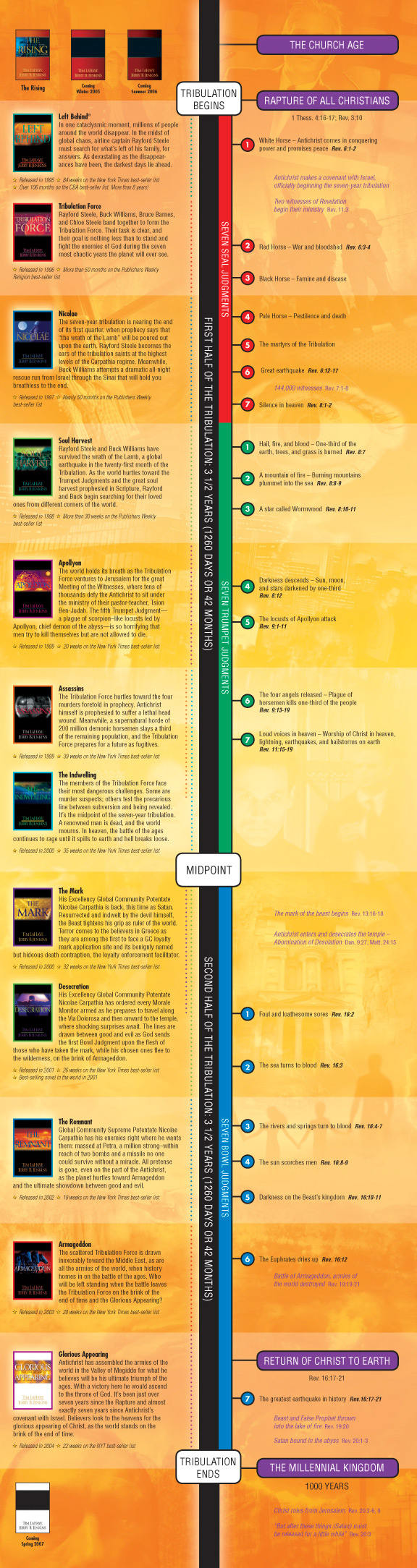
Misleading and giving false hope to people for over a decade and selling over 63,000,000 copies (no I did not accidentally add three zeros), is the Left Behind series. In case you were wondering where exactly Tim LaHaye and Jerry B. Jenkins books lined-up in the timeline of God’s eschaton, well guess what I have for you…
I have for you Raymond Steele’s Classical Chart of the “end times” so that you can see what books you’d be interested in reading of God’s plan for the rebuilding of His temple, identifying the antichrist, figuring out the day of the rapture, and what super-cool technology to collect if you are “left behind” if you want to start your own Tribulation Force. Here ya go in case you really wanna know.
For those serious Left Behind fans, be sure to get your end times wallpaper for your PC or Mac.
Some OLD Voices on the Kingdom of God
Posted: January 29, 2010 Filed under: New Testament Theology Leave a comment- Ladd, Matt 12:29 (How can one enter a strong man’s house and plunder his goods, unless he first binds the strong man? Then indeed he may plunder his goods – embodies “the essential theology fo the Kingdom of God. Instead of waiting until the end of the age to reveal his kingdly power and destroy satanic evil, Jesus declares that Go0d has acted in his kingly power to curb the power of Satan. In other words, God’s Kingdom in Jesus’ teaching has a twofold manifestation: at the end fo the age to destroy Satan, and in Jesus’ mission to bind Satan” (63-64).
- Goppelt: “I: 71: “The very heart of God’s reign is summed up in the relationship between God and people becoming whole.”
- Ridderbos: 20-21: “The coming of the kingdom is first of all the display of the divine glory, the re-assertion and maintenance of God’s rights on earth in their full sense.”
What is the Kingdom of God?
Posted: January 28, 2010 Filed under: New Testament Theology Leave a commentJerry Bilkes,
“The Kingdom of God is the radical manifestation and comprehensive effectuation of God’s saving reign at the culmination of redemptive history. Thus it has revelatory, redemptive, and eschatological dimensions.”
What the Old Testament says on the Kingdom from Goldsworthy,
“We first see the Kingdom of God in the Garden of Eden. Here Adam and Eve live[d] in willing obedience to the word of God and to God’s rule. In this setting, the Kingdom is destroyed by the sin of man – and the rest of the Bible is about the restoration of a people to be the willing subjects of the perfect rule of God” [47].

 Gospel-Centered Musings