Click below

Amazon right now is having a huge Blu-ray DVD SALE right now, do not miss out!
PDF of class lecture
Site for Dispensationalist Research
Site for Dispensationalist Chart
Achtemeier, Elizabeth. Minor Prophets I. New International Biblical Commentary. Ed. Robert
L. Hubbard and Robert K. Johnston. Peabody, MA: Hendrickson, 1996.
. Preaching from the Minor Prophets. Grand Rapids: Eerdmans, 1998.
Alexander, Desmond, David W. Baker, and Bruce Waltke. Obadiah, Jonah, Micah. Tyndale
Old Testament Commentaries. Vol. 23A. Ed. D. J. Wiseman. Downer’s Grove, IL:
InterVarsity, 1988.
Alfaro, Juah I. Justice and Loyalty: A Commentary on Micah. International Theological
Commentary. Ed. George A. F. Knight and Fredrick C. Holmgren. Grand Rapids:
Eerdmans, 1989.
Allen, Leslie C. The Books of Joel, Obadiah, Jonah, and Micah. New International
Commentary on the Old Testament. Ed. R. K. Harrison. Grand Rapids: Eerdmans, 1976.
Anderson, Francis I., and David Noel Freedman. Hosea. Anchor Bible. Vol. 24. Ed. William
Foxwell Albright and David Noel Freedman. Garden City, NJ: Doubleday, 1980.
______. Micah. Anchor Bible. Vol. 24E. Ed. William Foxwell Albright and David Noel
Freedman. New York: Doubleday, 2000.
(Disclaimer: These are to be taken as humor to my dear brothers, and not as a slam.)
You might be a Dutch-Calvinist if… you…
1. Don’t own or watch TV
2. Don’t attend Movie Theaters
3. Don’t have a DVD Player
4. Don’t have the internet
5. Don’t listen to any form of Rock Music
6. Always wear a head covering
7. Don’t work for an Union
(Post from Gary’s Rather Sad Blog)
As part of the general Open Season on Calvinists, the Beaker Folk would like to offer the following…
How can you tell if you’re on a Calvinist train?
– They’re all Calvinist trains. You’re only going where they want you to go…
How many Calvinists does it take to change a lightbulb?
– Well, is the lightbulb meant to be changed? Maybe this lightbulb was never intended to change. Maybe this light bulb is meant to stay dark.
How do you confuse a Calvinist?
– Offer them three cakes and say it’s up to them which one they eat.
What do you call a Calvinist ex-prisoner?
– A Reformed character.
And a final teaser…. how hard would a qualification in Theology be for a Calvinist if all the questions were multiple-choice? What would the instructions say – “Only put a tick against the answer you are intended to think it is…”
He has done it. Remember Joseph, Israel in Egypt, Manasseh, Jeremiah, Peter, and many others. He can do it still. He breaks the bars of brass with a word and snaps the fetters of iron with a look. He is doing it. In a thousand places troubled ones are coming forth to light and enlargement. Jesus still proclaims the opening of the prison to them that are bound. At this moment doors are flying back and fetters are dropping to the ground.
He will delight to set you free, dear friend, if at this time you are mourning because of sorrow, doubt, and fear. It will be joy to Jesus to give you liberty. It will give Him as great a pleasure to loose you as it will be a pleasure to you to be loosed. No, you have not to snap the iron hand: the Lord Himself will do it. Only trust Him, and He will be your Emancipator. Believe in Him in spite of the stone walls or the manacles of iron. Satan cannot hold you, sin cannot enchain you, even despair cannot bind you if you will now believe in the Lord Jesus, in the freeness of His grace, and the fullness of His power to save.
Defy the enemy, and let the word now before you be your song of deliverance; “Jehovah looseth the prisoners.”
One of the first Calvin500 Sponsors was Greenville Presbyterian Theological Seminary. They are hosting what is perhaps the most in depth US conference so far this year. Several Calvin500 speakers will give addresses (Terry Johnson, David Hall, Joel Beeke, and George Knight), and several other speakers will gather (Carl Trueman, Jim McGoldrick, Joseph Pipa, Timothy Terrell, Mark Garcia, Ian Hamilton, and Paul Helm) for this conference. Find the schedule and all the information here.
This looks like a wonderful conference hosted by GPTS.
XI. Apostasy from evangelical worship
Theses:
“That which was proposed to be considered in the last place is that apostasy which is in the world from the purity of the worship of the gospel as appointed by Jesus Christ; and herein principally did consist that great defection foretold by our apostle, 2 Thessalonians 2:3-12, which is also prophesied of in the Revelation, and did accordingly come to pass.”[1]
Summary:
Although the shortest chapter in length in John Owen’s work on apostasy, chapter eleven is by no means lacking in thought-provoking content. This chapter deals with an area that does not first come to mind when mentioning apostasy. Owen works here in dealing with apostasy from the point of view of evangelical worship – going over the doctrines of the sacraments (the doctrine of baptism and much focus on the Lord’s Supper). He brings forth the issue of mystical beliefs in the practice of worship and how often apostates tend to misuse them. In this small section discussing worship, Owen focuses on two areas in particular: first, the worship that takes place in the sacraments, and secondly, how worship is corrupted in the sacraments.
Outline:
I. Apostasy from Worship
A. Call for the Worship of God
1. Worship in the Sacraments
2. Worship Corrupted in the Sacraments
XII. Inference from the forgoing discourses- The present danger of all sorts of persons, in the prevalency of apostasy form the truth and decays in the practice of evangelical
Theses:
“The last part of this discourse is designed for cautions unto those who yet stand, or think they stand, with respect unto that general defection from the gospel whose causes and occasions we have thus far inquired into.”[2]
Summary:
Apostasy is easily spread from one to another like a disease that carries tremendous judgment. In chapter twelve John Owen deals with the dangers of how apostasy can easily spread among those who are working and living in the gospel. Owen begins with a biblical reminder of what exactly apostasy is. In the first half of this chapter, he discusses and sets forth what he describes as the six warnings of dangers that harm the church. These are:
1. Apostasy is a worldly-mindedness
2. Apostasy is a great danger
3. Apostasy consumes man
4. Apostasy is deceitful
5. Apostasy consumes the soul
6. Apostasy will have no Savior[3]
In the second portion of this chapter, Owen then moves on to detail exactly what the danger signs can be that tell what apostasy is.[4] In the process of going over these, he gives seven dangers of apostasy and then shows how they affect the person’s view of Christ. After this, Owen completes this section by looking at the power of sin; specifically its power over man as it creates what we call apostasy. Similar to other chapters, Owen gives the negative and then the positive – here giving the three powers that sin has over man, then the victory that man has over sin.[5] Owen ends this section by once again proclaiming the hope of the gospel – Jesus Christ – and how in Him alone man has power over sin.
Outline:
II. Apostasy Widespread
A. A Biblical Reminder Apostasy
B. Apostasy is a Worldliness mindset
C. Apostasy is a Great Danger
D. Apostasy Consumes Man
E. Apostasy is Deceitful
F. Apostasy Consumes the Soul
G. Apostasy Will Have No Savior
H. The Seven Dangers Signs of Apostasy
I. The Powers of Sin
1. The Three Powers
2. The Power Over Sin
XIII. Directions to avoid the power of a prevailing apostasy
Theses:
“UNTO the warnings given in the precedent chapter some directions may be added, perhaps not unuseful unto them who would be preserved from the occasions, causes, and danger, of the apostasy thus far inquired into; for although, as hath been declared, a watchful attendance unto all gospel duties, and a vigorous exercise of all gospel graces in general, are required unto our preservation, yet there are some things which have an especial respect unto the present state of the causes and circumstances of the evil insisted on, which ought in an especial manner to be remembered.”[6]
Summary:
Chapter thirteen is the last in John Owen’s great work (quite possibly being the greatest work on apostasy in existence). In his closing arguments on apostasy, Owen ends with quite a lengthy section in dealing with how to avoid apostasy. He doesn’t have several major points in this chapter, but rather focuses on one major point: Defending the believer of the gospel against apostasy. In this he gives a number of sub-points that look at how one who confesses the belief of the gospel is to continue living a life that honors and lives out the gospel in obedience. Below is listed the areas that John Owen discusses in this chapter:
1. Defend from the temptations of apostasy by using prayer
2. Defend from the temptations of apostasy by the believer’s faith
3. Defend from the temptations of apostasy by having a heart for the gospel
4. Defend from the temptations of apostasy by being aware of those who may be in the church to deceive it
5. Defend from the temptations of apostasy of certain types of worship
6. Defend from the temptations of apostasy for the sake of the gospel
7. Defend from the temptations of apostasy against national sins
8. Defend from the temptations of apostasy by having a mindset against sin[7]
Outline:
III. How to Avoid Apostasy
A. The Believers Defense Against Apostasy
1. Defend from Temptations by Prayer
2. Defend from Temptations by Faith
3. Defend from Temptations by the Heart
4. Defend from Temptations that May Linger in the Church
5. Defend from Temptations of Certain Types of Worship
6. Defend for the Sake of the Gospel
7. Defend from Nationalized Sins
8. Defend the Mind from Sin
Conclusion:
This final chapter fits exactly into John Owen’s goal, which is to make those who are believers of the true gospel aware that there are dangers everywhere – even among believers – that try to take hold of the human soul and cast them into a life which only leads to hell. The point of this chapter is for the reader to see the significance in John Owen’s tremendous work on apostasy and for it to stir up thoughts and attention on the issue today. This work should be read even today in the postmodern world. With movements coming and going, and theology seeming to change endlessly, the true believer of the gospel must know the dangers that are around him. Going to John Owen’s work about today’s issues like this is by no means out-dated. The culture today may look different, however, the same apostasy issues that John Owen dealt with in the 17th century is still dealt with today in the 21st century by the believer – and maybe even more so!
During his time, John Owen saw that the loss of the gospel had started to seep into the church – the true believing church of God. He shares this when he states in his work:
The doctrine of the gospel (as to its peculiar nature, the causes, motives, and ends of it) was generally lost, partly through the horrible ignorance of some, and partly through the pernicious errors of others, whose duty it was to have preserved it. And how impossible it is to maintain the life and power of obedience when this spring of it is dried up or corrupted, when this root is withered and decayed, is not hard to apprehend. Sometimes truth is lost first in a church, and then holiness, and sometimes the decay or hatred of holiness is the cause of the loss of truth; but where either is rejected, the other win not abide, as we have declared. And so it fell out in that fatal apostasy; these evils promoted and furthered each other.[8]
He saw what needed to be addressed during his time, and it is something that must be constantly address throughout all times of the church; to those that claim to know Christ, love the gospel, say with their lips that they are believers, but show no signs of living accordingly to the Scripture and following the commands of the Word of God.
In a day where more people tend to say, “I believe in God,” we also see those same people fall into apostasy. More drunkards, more slanderers, more gluttony, more prideful and boastful individuals, more adulterers, more lustful addicts, more coveters of material possessions, and more ear-entertainers of the Bible say today that they “know Christ” and yet have no sign at all of the truth of the good news of Jesus Christ.
If anything at all, two things should be taken from Owen’s works here, and they are as follows: First the believer should live a life that is according to the Word of God so that they are seen as image-bearers of God. And secondly, those that do know the gospel are not to let such filth and such corrupt beings dismantle the church one by one. In the time and culture in which we live today, believers must stand for truth firmly in a society that is decaying rapidly. Owen speaks in great length of these types of people in the church that claim the gospel as this:
The church never lost finally either truth or holiness by the violent persecutions of its avowed enemies. But I speak not of the outrages committed on the flock of Christ by wolves in their own skins, but by such as have got on sheep’s clothing; for these things, in whomsoever they are, proceed from the uncured, wolfish nature in persons on whom the gospel hath not obtained its promised efficacy, Isaiah 11:6-9. It is professing Christians persecuting one another, about some differences among themselves concerning their apprehensions of spiritual things and practice of divine worship, that I intend. And this hath been so great, especially in the latter ages of the church, that it is questionable whether there hath not greater effusion of the blood of Christians, ruin of families, and devastation of nations, been made by them who have professed the same religion in general, than by all the Pagans in the world since the first promulgation of it. He that shall impartially read the Gospel will not be able to discern how it was possible that any such things should ever fall out among those who pretend to avow it as their rule and guide in any measure; for the whole design and all the rules of it are so expressly contradictory unto any such practice, as that no man who had not learned the contrary from the event could possibly conjecture that any persons could ever fall into it without an antecedent renunciation of the gospel itself.[9]
As believers today, we must be more sound than even those in John Owen’s day. For there is far greater numbers of apostates than ever before working against the church, and even in the church.
There is no greater work to sit down and go through on the area of apostasy than that of John Owen’s The Nature and Causes of Apostasy. It is arguably the greatest work of Owen himself, and unfortunately can often be overlooked. However, breaking it down in the above areas, showing Owen’s theses of each chapter, explaining the points which he was getting across, providing an outline of each chapter to help search and see his main points, and the summaries of each chapter, should aid anyone that wants to look at specific areas of this work with ease. Enjoy!
Puritan Reformed Theological Seminary is hosting its first major conference on August 27-29, 2009. With eleven nationally and internationally known speakers, you will not want to miss this year’s event! Early registration will secure your spot. Take advantage now and save $25 per registration. This offer is good only through June 26, 2009. As of June 27, conference pricing is $90 per person. All college and seminary students can register for $45 per person.
To register online for this year’s conference, you can do so here.
Speakers and topics at C21 will include:
Joel Beeke: “Why is Calvin important Today?”
Gerald Bilkes: “Calvin on the Word of God”
Ligon Duncan: “The Resurgence of Calvinism in America” & “Calvin on the Early Church”
Michael Haykin: “Calvin and Missions for the 21st Century” & “Christian Marriage in the 21st Century”
Nelson D. Kloosterman: “Calvin on Ethics”
David Murray: “Calvin on Preaching Christ from the Old Testament” & “What Kind of Love is This”
Joseph Pipa: “The Work of the Holy Spirit for the 21st Century”
Cornelis Pronk: “Calvin on the Church”
Donald Sinnema: “Calvin on Reprobation”
Derek Thomas: “Redemption: Speaking Peace in the 21st Century” & “Reforming the Church”
Cornelis Venema: “Calvin on the Believer’s Benefits”
Click below
If there is interest and availability, as part of Calvin500, we’d love to set aside an afternoon (probably either July 8 or July 9) for brief papers by Young Calvin Scholars. If you are interested and will be present, please contact David Hall or myself. Please send paper proposals or abstracts asap so we can make a decision on this. Help pass the word.
Well… I’ll be excited to see if this guy is right in life (2029 A.D.)
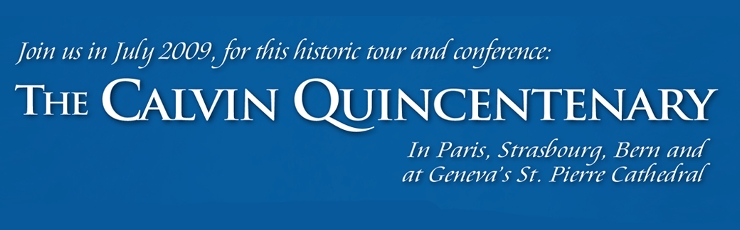
I bought my ticket yesterday and I cannot wait for the Commemorating Calvin Conference: A 5-day international symposium with leading Ministers in Geneva (July 5-9, 2009). For those wishing to appreciate the theology and spirituality of Calvin, the Commemorating Calvin Conference will be without parallel. Both conferences will be located in Geneva’s Old Town. If your interested in going, hurry up and get with the program and, it’s not too late to sign up for the entire tour (http://calvin500blog.org/tour/), June 30-July 10, which follows the footsteps of Calvin and visits key Reformation era sites.
If you are attending, let me know! If you have any questions on the Tour or about it, please be sure to ask me as well! As well, make sure to keep check on their blog!

Online registration is now available – Click here.
Conference accommodations at the Prince Center are limited to 450 attendees, so sign-up early to avoid disappointment. (only 400 left!!!)
Conference Pricing (per participant):
Early Registration (through June 26, 2009) $65.00
Regular Registration (between June 27 and August 8, 2009) $90.00
Student Registration (including college and seminary students) $45.00
Send all questions and/or comments related to the Puritan Reformed Conference to conference@puritanseminary.org or call Chris Hanna at 616.977.0599, ex. 138.
You may write the seminary at:
2965 Leonard Street NE
Grand Rapids, MI 49525
You might be an Calvinist if… you like this review on Dr. Clark’s reprint Caspar Olevian and the Substance of the Covenant.

It is the believer’s privilege to use this language. If he is looking for aught from the world, it is a poor “expectation” indeed. But if he looks to God for the supply of his wants, whether in temporal or spiritual blessings, his expectation” will not be a vain one. Constantly he may draw from the bank of faith, and get his need supplied out of the riches of God’s lovingkindness. This I know, I had rather have God for my banker than all the Rothschilds. My Lord never fails to honour His promises; and when we bring them to His throne, He never sends them back unanswered. Therefore I will wait only at His door, for He ever opens it with the hand of munificent grace. At this hour I will try Him anew. But we have “expectations” beyond this life. We shall die soon; and then our “expectation is from Him.” Do we not expect that when we lie upon the bed of sickness He will send angels to carry us to His bosom? We believe that when the pulse is faint, and the heart heaves heavily, some angelic messenger shall stand and look with loving eyes upon us, and whisper, “Sister spirit, come away!” As we approach the heavenly gate, we expect to hear the welcome invitation, “Come, ye blessed of my Father, inherit the kingdom prepared for you from the foundation of the world.” We are expecting harps of gold and crowns of glory; we are hoping soon to be amongst the multitude of shining ones before the throne; we are looking forward and longing for the time when we shall be like our glorious Lord-for “We shall see Him as He is.” Then if these be thine “expectations,” O my soul, live for God; live with the desire and resolve to glorify Him from whom cometh all thy supplies, and of whose grace in thy election, redemption, and calling, it is that thou hast any “expectation” of coming glory.
It’s not too late to join.
We are now offering a “Conference Only” Package if you wish to join us for the sermons, lectures, and worship of Calvin500 this July. If you have frequent flyer miles or wish to arrange your own lodging yourself, there is now a way for you to attend all the conference sessions of this historic event. We cordially invite you to join us and hundreds of other friends to commemorate the life and work of John Calvin in Geneva this summer at St. Pierre Cathedral.
To register online, please go here.
Please check our blog (www.calvin500blog.org) for the most recent updates and information. And, it’s not too late to sign up for the entire tour (http://calvin500blog.org/tour/), June 30-July 10, which follows the footsteps of Calvin and visits key Reformation era sites.
Please help us by passing the word to any of your friends, elders, staff members, presbyteries, or colleagues. Free downloads are available for bulletin inserts (http://calvin500blog.org/downloads/). Would you please help us by announcing this as appropriate?
We hope to see you in Geneva for this unique opportunity for witness and praise. For the schedule of the incredible lineup of speakers, see the back of this letter.
John Calvin is of course one of the most significant theologians of the reformation, who was based in Geneva and whose name is known throughout the world. Therefore seven Protestant Churches of London are taking the opportunity to celebrate his anniversary together.
Several events will take place around this jubilee:
18.03.09 Introduction of the Calvin events doors open 6.30pm – event starts 7pm
Host: Hungarian Church
29.04.09 Calvin’s understanding of Communion doors open 7pm – event starts 7.30pm
Speaker: Rev Allan Smith; Host: Lumen United Reformed Church
08.05.09 Protestantism et Europe (French) doors open 7.30pm – event starts 8pm
Speaker: Patrick Cabanel; Host: French Institute
14.05.09 Organ concert doors open 6.30pm – event starts 7pm
Organists: Anne Page and David Titterington; Host: Dutch Church
11.06.09 Calvin and Capitalism doors open 6pm – event starts 6.30pm
Speaker: Rev Dr Frank Jehle; Host: Swiss Embassy, SCL, BSCC
27.09.09 Calvin on creation and redemption (Dutch) event starts 12.45pm following Sunday Service
Speaker: Dr Rinse H. Reeling Brouwer; Host: Dutch Church
28.09.09 Light and shadow of the reformation doors open 6.30pm – event starts 7pm
Speaker: Dr Rinse H. Reeling Brouwer; Host: Dutch Church
06.10.09 Calvin’s significance for today doors open 7pm – event starts 8pm
Speaker: Prof David Fergusson; Host: Crown Court Church
08.10.09 Modernity of Calvin (French) doors open 6.30pm – event starts 7pm
Speakers: Max Engammare and Jean-Paul Willaime; Host: French Institute
31.10.09 Theatrical Portrait doors open 7pm – event starts 7.30pm
Directed by Joy Leslie Gibson; Host: Swiss Church
28.11.09 Jubilee Celebration doors open 4pm – event starts 4.30pm
With Bishop Bolcski Gusztàv Bölzcskei; Host: Swiss Church
The Crisis of Credit Visualized from Jonathan Jarvis on Vimeo.
X. Other causes and occasions of the decay of holiness
Theses:
“Multitudes are led into and countenanced in the ways of sin and profaneness, freely indulging unto their lusts and corrupt affections, by a false appropriation of justifying names and titles unto them, in ways of sin and wickedness.”[1]
Summary:
In this chapter John Owen deals with a number of additional reasons that may – and will – cause apostasy. He begins with giving several biblical examples from the books of Jeremiah, Matthew and Revelation. From there, he gives examples from the Roman Catholic Church, and then examples stemming from the highest positions in the ministry of the church that can cause apostasy. Owen then moves into looking at causes of apostasy that believers will deal with in living for the sake of the gospel. He focuses on these areas because of difficult issues that believers were dealing with in his time, namely the Roman Catholic Church. He shows in these examples that those who persecute the true bride of Christ are apostates. Owen then spends time detailing the number of areas in which a person is supported in their life of apostasy. He explains each point of support, and how it hinders the person from coming to the truth of the gospel. The truths he discusses are:
1. Apostasy is supported by those who continue to persecute the church for believing and living for the gospel.
2. Apostasy is supported by the nature of the human man continuing in sin, keeping them from the gospel.
3. Apostasy is supported by those who make mistakes in the Christian life, falling away from the gospel.
4. Apostasy is supported by Satan himself keeping those who are in sin from the grace of the gospel.
5. Apostasy is supported by those who in Christendom make divisions in the church and make the gospel look useless to the life of a believer.[2]
Outline:
I. Further Causes of Apostasy
A. Biblical Examples of Apostasy
B. Romanish Examples of Apostasy
C. Highest Positions of Ministry Can Cause Apostasy
D. Apostates Persecute the Church
E. Apostasy Supported by Human Sin
F. Apostasy Supported by Mistakes of Christianity
G. Apostasy Supported by Satan
H. Apostasy Supported by Useless Christians
I. Summary of Apostasy
Pastor Kevin Boling of Knowing the Truth Radio interviews Mary Beeke, author of The Law of Kindness.
A Quibble with McKnight’s “Neo-Reformed” Essay
See Mars Hill video here.
and for my favorite…
 Most Helpful: In Christopher Wright’s volume entitled Knowing Jesus Through the Old Testament there is much helpful subject matter for one who may want to look deeper at learning how to properly see Christ in the Old Testament. Though short in length, this book (containing five chapters) covers immense depth as Wright manages to include the most important areas that must be dealt with when coming to this topic; touching upon crucial things that a seminary student or layman ought to know. The areas of this book that I personally found to be most helpful include:
1. The explanation of Jesus in the number of different ways that He is portrayed throughout the Old Testament.
2. The importance of knowing the Old Testament so that a proper view of Christ is given to the individual.
A very helpful thing – as noted above – was how Wright laid out clear, precise, and very understandable information dealing with Christology in the Old Testament. It is important to see how the gospel was brought together by the person and work of Jesus Christ, but even more so to see how the whole plan of redemption is laid out from the very beginning. Having the whole Bible complete before us makes it that much more revealing today as we are able to see the overall plan of redemption, making it all the more enjoyable to the person studying and learning these truths in the Word of God. There are a number of points Wright gives to his readers that are very helpful, such as: looking at Jesus as a story throughout the whole Old Testament, Jesus and promises, Jesus and Old Testament identity, Jesus and His mission, and Jesus’ Old Testament values. Throughout these chapters, one of the most helpful areas was how he dealt with showing Christ’s identity in the Old Testament. This is a focus often overlooked in Christological books I have read that deal with the Old Testament, and it brings much thought into the matter. Two things that were particularly helpful on this subject were:
1. The way (and number of times) the author relayed the book of Matthew back into the Old Testament.
2. Showing the use of typology in the Old Testament and the history of it so that the reader can get a better understanding of the actual use of doing typology in a manner that is correct, rather than falling into the misuse of it that can so often occur.
Another area of great importance that was looked at in Knowing Jesus Through the Old Testament was in the topic of knowing the Old Testament so that a proper view of Christ can be given to an individual. As Wright lays out his topics he brings much to light by giving examples of ways that one can look in the Old Testament and see Christ. One way in particular that I had not thought of before was found in the fifth chapter, as Wright shows how Jesus’ life aligned with the moral and ethical teachings in the Old Testament. In looking at this, he brought both the Old and New Testament together by using Christ as the ethical principle for the reader’s life. It was enjoyable and very informative as he showed examples of ethical living from the Mosaic Law and then from Christ’s teaching in the New Testament.
Wright also spent a lot of time looking at and expelling Christ’s mission as seen throughout the Old Testament. This was very helpful because of the fact that oftentimes man’s sight and focus in the Scriptures is quite different than what God intended. Through this section, Wright shows what Christ was/is to the world – why He was needed, what He accomplished, etc – in the Old and New Testament, which greatly helps the reader to see the absolute importance of Christ in both Testaments. This brought to mind in great detail how even today countries, powers, militaries, groups, and individuals all have some sort of mission, just as Christ did.
Most Unhelpful: A negative factor about this book is that the chapters were 50 plus pages, and because of that it was easy to forget what the beginning of the chapter was specifically dealing with because it would go off in a different direction on a smaller area of detail, which lost its gravity because it wouldn’t quite stay with the over-arching point of the chapter. For example, as you began to read a chapter you could understand fully the point of that chapter, then within a few pages you would begin to touch upon things other than what that first point was. After 50 pages dealing with minor sub-topics, it was easy to forget how exactly these sub-topics fit into the beginning topic, and felt like chasing rabbits down several trails and leaving what the initial focus was. This particular problem is most evident in chapters 1 and 4.
Another negative aspect is that Wright’s lack of material when dealing with the covenants was not helpful, especially for those who may be deeper in theology. At times there was much room left where more needed to be said, but because of the size of the book (250 pages) he was unable to expound on the specific information which would have been desired. However, this is most likely because of the massive amounts of Christ and the Covenants books there are available to read; but in this book it was definitely lacking.
Want to learn, see, and know what NeoRormed means or what it is? Read below.
Post by Scot McKnight, Who are the NeoReformed? & What are the NeoRormed? 2
Post by Trevin Wax, Thoughts on NeoReformed (thoughts on the above articles)

 Gospel-Centered Musings