2008 Latest Edition – Did You Know 3.0 – From Meeting in Rome this Year
Posted: December 6, 2008 Filed under: Video of the Week Leave a commentJohn Owen on Apostasy – Part Two
Posted: December 5, 2008 Filed under: Apostasy, John Owen on Apostasy Leave a commentFor the next 13 to 14 weeks, my plan is to go through John Owen’s work on Apostasy and address each Chapter the following way:
Thesis – Will be John Owens own thesis from taken from each individual section.
Outline – Will be an outline showing the importance of John Owens points tin each chapter in dealing with apostasy.
Summary – Will be a brief summary giving a rundown over each individual chapter.
I. The nature of apostasy from the gospel declared, in an exposition of Hebrews 6:4-6
Theses:
“Intending an inquiry into the nature, causes, and occasions of the present defection that is in the world from the truth, holiness, and worship of the gospel, I shall lay the foundation of my whole discourse in an exposition of that passage in the Epistle of Paul the apostle unto the Hebrews, wherein he gives an account both of the nature of apostasy and of the punishment due unto apostates; for as this will lead us naturally unto what is designed, so an endeavor to free the context from the difficulties wherewith it is generally supposed to be attended, and to explain the mind of the Holy Ghost therein, may be neither unacceptable nor unuseful.”
Summary:
In his first chapter, John Owen gives an introduction to the background and history of the Nature and Cause of Apostasy from Hebrews 6:4-6. Out of all 13 chapters, this is the longest and the one with the most substance due to its framework which it lays out for the continuing 12 chapters. He begins with giving the context and the description of how apostates had once been touched by the gospel, but leaving it in this way they could never come back to constitutional rights of the gospel. Owen then gives the characteristics, obedience, and faithfulness that one is to live by as a believer, and continues on to the rights, privileges, and blessings that the believer is to have – including illumination, a tasting of the gospel, receiving the Holy Spirit, receiving the Word of God, and being able to stand against the powers of the world.
Owen then begins dealing with the text of Hebrews 6:4-6 itself, detailing a number of areas that are often mentioned in debate, such as: are these true believers, spiritual privileges, and if they fall away. Here Owen works with exactly what this text says of apostasy and how it is impossible to bring one back from it to repentance. He focuses on three major areas in this section: all events depend on God, things are impossible because of who God is, and, things are possible and impossible with God who appoints all things to happen. In these sections Owen deals with both issues of how it is possible for one to come back to the gospel after leaving it, and how one cannot come back to the gospel, both emphasizing God being in control over all things for His reasoning only. Lastly, Owen ends with an explanation about the fact that if man alone tries to bring the one who has left the gospel back to it, no matter what man may do, it is impossible. He points out that one cannot “renew” another back to right relationship with God, unless God Himself has done the work of the gospel inside the one who had tasted it. Owen finishes with 2 final thoughts: to continue always to preach the gospel and make that gospel clear to all men, and how man alone cannot come to repentance of his apostasy.
Outline:
I. The Nature of Apostasy (Exegesis of Hebrews 6:4-6)
A. The History of Apostasy
B. Exegesis of Hebrews 6:4-6
1. Context of the Passage
2. Apostasy Described
1. Characteristics of Salvation
2. Believers Follow in Obedience
3. Believers Live by Faithfulness of God
C. The Great Privileges
1. Having Spiritual Illumination
2. Tasting the Heavenly Gift
3. Partakers of the Holy Spirit
4. Tasting the Word
5. Powers Over the Coming Age of this World
D. Apostasy and the Text of Hebrew 6:4-6
1. All Future Events Depend Alone on God
2. Some May never Return to the Gospel
3. The True Believer Should Help to Renew Those who Fall
E. Bringing Apostasy to Repentance
1. Preaching the Gospel Clear
2. Renewing Fallen Individuals to the Gospel
Reasoning, Prohibitions, & Inauguration of the Sabbath (Thought #3)
Posted: December 4, 2008 Filed under: Sabbath Study Leave a commentI have not posted many thoughts due to studies in seminary and my workload at the time. I however took an hour to set a side this week to look once more at the issue of the Sabbath, and issues within the Sabbath. Below is a list of assessments I made this week on the Sabbath and just my thoughts on it.
Reasoning behind the Sabbath – It seems from Scripture that the Sabbath was made by religious and social concerns. Meaning that the Lord made the commandment in Exodus to his people to show a timetable. This timetable is that the Lord’s people follow the seven-day week that the Lord had made at creation. However it as well is not only a social but also a sign. The Sabbath mentioned in Exodus is a covenant made between God and his people.
Prohibitions – Seems once more from the Scriptures that work, all occupational work is to be ceased.
Inauguration of the Sabbath – Now I know that I may get a lot of flack for this, matter of fact I can assure you that many of my dear brothers my get quite upset at my thoughts at this section. However the question basically boils down to two areas of thought:
1. Is the Sabbath a universal institution given at creation by ordinances from the Creator, given to all of mankind?
2. Is the Sabbath Israelite institution based on a pattern and eschatological stance in which has purpose and goal in it to fulfill?
At this point in life, study, and seminary I have seen many faults in Dispensationalism and even yes, Reformed Theology. Now I happen to yes learn one way more than the other, but by no means do I stand on one ground or the other. And every time I do, usually that side I stand upon ends up kicking me out. However I see clearly from the Scriptures my own position on the above questions and will end today’s thoughts here.
Traditional Reformed, The Puritans, and many others believe that at creation God was setting ordinance that were to be followed for all of creation, man, animal, etc. They see that the day of rest given at creation was a divine plan of creation in order to make the creation ordinance.
To this my thoughts… that this world has yes come from the hand of God, and been ruined by that of man’s hand. This logic would only lead one to then see, that today’s world is not exactly that of creation itself nor is what God intended as the final plan. Today’s world does not have that of which finality will hold. So, the term “creation ordinance” is inadequate. Why is it not? Simply the divine rest is not made for all of mankind, so therefore how can the Sabbath shadow that of what Christ offers? I hear oh so often that Genesis 2 was given to all of mankind, however when I look at the text, I see nothing given of a “Sabbath”, nothing of a religious festival, nothing mentioned of a moral law, no actual command given to be kept in anyway. No, all we are given is simply this, God finished his creation and rested (not Sabbath) and ceasing from all activities that day blessing it. Yes, God did bless the 7th day, and now I often then hear, “that the language is the same from Gen. 2 and Ex. 20.” However the similarities are not identical, nor is the reasoning for mentioning the day the same. Matter of fact my thought is that yes at creation god blessed the day, then commanded that later to Israel so that if they kept it, then they would be blessed because he had already done previously.
None the less I end with this, that the Sabbath day can in now way be given perfectly in human terms but can finds its end goal in revelation in the New Testament in the gospel of Jesus Christ what it foreshadowed. I end with two thoughts:
1. Gen. 1-2 was to proclaim the creation of God, showing his holiness, sovereignty, majesty, and power, which he truly is. The act of creation was not “man-centered” so to speak but centered on the glory of God.
2. Therefore, Genesis 2 does not speak of a “creation ordinance” nor does it speak of the actual “Sabbath” that was given to Israel in Exodus 20. This mention of the day of rest in which God took was a day that yes was based on the account of creation, in which would become a sign (Exodus 20) of God’s redemptive goal for mankind, namely the Gospel of Jesus Christ.
Be sure to check out the next thoughts on the Sabbath dealing with the Sign, Promise, and Observance of the Sabbath.
You Use Twitter?
Posted: December 3, 2008 Filed under: Just for Fun Leave a commentIf you happen to use Twitter, please let me know either through email, comments, facebook or whatever means you’d like. If you are not using Twitter, please join then tell me.

How to Mark a Book
Posted: December 3, 2008 Filed under: Just for Fun 2 CommentsA friend shared this on twitter and I found it quite helpful (right away)!
By Mortimer J. Adler, Ph.D.
There are all kinds of devices for marking a book intelligently and fruitfully. Here’s the way I do it:
- Underlining (or highlighting): of major points, of important or forceful statements.
- Vertical lines at the margin: to emphasize a statement already underlined.
- Star, asterisk, or other doo-dad at the margin: to be used sparingly, to emphasize the ten or twenty most important statements in the book. (You may want to fold the bottom comer of each page on which you use such marks. It won’t hurt the sturdy paper on which most modern books are printed, and you will be able take the book off the shelf at any time and, by opening it at the folded-corner page, refresh your recollection of the book.)
- Numbers in the margin: to indicate the sequence of points the author makes in developing a single argument.
- Numbers of other pages in the margin: to indicate where else in the book the author made points relevant to the point marked; to tie up the ideas in a book, which, though they may be separated by many pages, belong together.
- Circling or highlighting of key words or phrases.
- Writing in the margin, or at the top or bottom of the page, for the sake of: recording questions (and perhaps answers) which a passage raised in your mind; reducing a complicated discussion to a simple statement; recording the sequence of major points right through the books. I use the end-papers at the back of the book to make a personal index of the author’s points in the order of their appearance.
Read the whole article here.
The Importance of Hell
Posted: December 2, 2008 Filed under: Tim Keller Leave a commentTim Keller who often gets a lot of junk for his views or thoughts on “Hell” has a nice article here.
Divergences of the gospels
Posted: December 2, 2008 Filed under: Catholic questions on the Gospel, The Gospel Leave a commentQuestion: What is the Divergences of the gospels to the Roman Catholic Church?
Answer: The existence of numerous and, at times, considerable differences between the four canonical Gospels is a fact which has long been noticed and which all scholars readily admit. Unbelievers of all ages have greatly exaggerated the importance of this fact, and have represented many of the actual variations between theEvangelical narratives as positive contradictions, in order to disprove the historical value and the inspiredcharacter of the sacred records of Christ’s life. Over against this contention, sometimes maintained with a great display of erudition, the Church of God, which is “the pillar and ground of the truth” (1 Timothy 3:15), has always proclaimed her belief in the historical accuracy and consequent real harmony of the canonicalGospels; and her doctors (notably Eusebius of Cæsarea, St. Jerome, and St. Augustine) and commentatorshave invariably professed that belief. As can readily be seen, variations are naturally to be expected in four distinct, and in many ways independent, accounts of Christ’s words and deeds, so that their presence, instead of going against, rather makes for the substantial value of the Evangelical narratives. From among the various answers which have been given to the alleged contradictions of the Evangelists we simply mention the following. Many a time the variations are due to the fact that not one but two really distinct events are described, or two distinct sayings recorded, in the parallel passages of the Gospels. At other times, as is indeed very often the case, the supposed contradictions, when closely examined, turn out to be simply differences naturally entailed, and therefore distinctly accounted for, by the literary methods of the sacredwriters, and more particularly, by the respective purpose of the Evangelists in setting forth Christ’s words anddeeds. Lastly, and in a more general way, the Gospels should manifestly be treated with the same fairness and equity as are invariably used with regard to other historical records.
To borrow an illustration from classical literature, the ‘Memoirs’ of the Apostles are treated [by unbelievers] by a method which no critic would apply to the ‘Memoirs’ of Xenophon. The [Rationalistic] scholar admits the truthfulness of the different pictures of Socrates which were drawn by the philosopher, the moralist, and the man of the world, and combines them into one figure instinct with a noble life, half hidden and half revealed, as men viewed it from different points; but he seems often to forget his art when he studies the records of the Saviour’s work. Hence it is that superficial differences are detached from the context which explains them. It is urged as an objection that parallel narratives are not identical. Variety of details is taken for discrepancy. The evidence may be wanting which might harmonize narratives apparently discordant; but experience shows that it is as rash to deny the probability of reconciliation as it is to fix the exact method by which it may be made out. If, as a general rule, we can follow the lawwhich regulates the characteristic peculiarities of each Evangelist, and see in what way they answer to different aspects of one truth, and combine as complementary elements in the full representation of it, we may be well contented to acquiesce in the existence of some difficulties which at present admit of no exact solution, though they may be a necessary consequence of that independence of the Gospels which, in other cases, is the source of their united power (Westcott).
Time in a Postmodern Culture
Posted: December 1, 2008 Filed under: Just for Fun Leave a commentI often read that some of reformers/puritans would study the Scriptures 16-20 hours a day. What life would be without sports, computers, blogs, twitter, facebook, myspace, movies, TV, video games and the massive publications of books…
Puritan Thanksgiving
Posted: December 1, 2008 Filed under: You Might be a Calvinist if..., You might be a Fundamentalist if Leave a commentYou might be a Calvinist if… you dressed like this for Thanksgiving.

You might be a fundamentalist if… you dressed like this…

Exposition: 1 John 3:1-10
Posted: November 30, 2008 Filed under: Sundays with Spurgeon Leave a comment“Whosoever abideth in him sinneth not: whosoever sinneth hath not seen him, neither known him.”
This plain, simple verse, has been twisted by some who believe in the doctrine of perfection, and they have made it declare that it is possible for some to abide in Christ, and therefore not to sin. But you will remark that it does not say, that some that abide in Christ do not sin; but it says that nonewho abide in Christ sin. “Whosoever abideth in him sinneth not.” Therefore this passage is not to be applied to a few who attain to what is called by our Arminian friends the fourth degree—perfection; but it appertains to all believers; and of every soul in Christ it may be said, that he sinneth not. In reading the Bible, we read it simply as we would read another book. We ought not to read it as a preacher his text, with the intention of making something out of every word; but we should read it as we find it written: “Whosoever abideth in Christ sinneth not.” Now we are sure that cannot mean that he does not sin at all, but it means that sins not habitually, he sins not designedly, he sins not finally, so as to perish. The Bible often calls a man righteous; but that does not mean that he is perfectly righteous. It calls a man a sinner, but it does not imply that he may not have done some good deeds in his life; it means that that is the man’s general character. So with the man who abides in Christ: his general character is not that he is a sinner, but that he is a saint—he sinneth not openly wilfully before men. In his own heart, he has much to confess, but his life before his fellow creatures is such a one that it can be said of him: “Whosoever abideth in him sinneth not; but whosoever sinneth [the sins of this world. in which the multitude indulge] hath not seen him, neither known him.”
Calvinism & Arminianism
Posted: November 29, 2008 Filed under: Calvinism, Mark Driscoll, Video of the Week Leave a commentJohn Owen on Apostasy – Part One
Posted: November 28, 2008 Filed under: Apostasy, John Owen on Apostasy Leave a commentWhy John Owen, the Puritan?
Puritans – you know, those people with crazy hair, wearing black and white outfits with some type of white ruffle around their neck, perhaps wearing a goofy looking cap, always making large families, and living in villages all by themselves as they tried to reform the Church of England… at least, that’s what may come to mind for some people. However, truthfully it seems that there has never been another group of individuals in history that can quite compare to the Puritans, who, spanning for over 200 years, knew the Scriptures, loved the Scriptures, and lived them out as they did. Their work ethic makes many of those today who are in seminaries, ministries, and even those in the pulpit, look lazy. The lives of the Puritans confirmed them as believers that were sold on a purifying doctrine and worship to the Christ. This they took extremely seriously as they continued to bring about the Reformation that Luther, Zwingli, and Calvin had started so fervently. With the intentions that the Puritans had – that is, for the Scriptures to spread to all of mankind – they did not take apostasy lightly. John Owen explains the problem of apostasy best when he addresses the reader to The Nature and Causes of Apostasy from the Gospel. He states:
Religion is the same that it ever was, only it suffers by them that make profession of it. What disadvantage it falls under in the world, they must at length answer for those in whose misbelief and practice it is corrupted. And no man can express greater enmity unto or malice against the gospel, that he that’s should assert or maintain that the faith, profession, lives, ways, and walkings of the generality of Christians are a just representation of its truth and holiness.
If one would want to further study the topic of apostasy, it is always best to look at those who have gone before them and written reliable material on the subject. There are a number of different men such as Samuel Eyles Pierce, A. W. Pink, Horatius Bonar, Gardiner Spring, and today’s Richard Phillips, that have written thorough pieces and dealt with the topic correctly, and are well worth the time to read. As for the Puritans’ writings on the topic, one may easily go in a number of different directions. It would be good to take the time to look at Thomas Brooks, Ebenezer Erskine, Thomas Boston, and Richard Sibbes. However, when delving into the topic of apostasy it is most important to spend some time on the greatest work done on it by the “Master” of it himself: John Owen. In the seventh volume of his works (printed by Banner of Truth Trust), Owen has a massive 259 pages dealing with apostasy.
Today in the 21st century John Owen is known for a number of different topics and areas like, Mortification of Sin, Biblical Theology, Communion with God, The Glory of Christ, The Holy Spirit, his seven-volume work on the book of Hebrews, and his sixteen-volume set of works. Additionally, people may often think of Justin Taylor’s passion for Owens’ works, namely, Communion with the Triune God and Overcoming Sin and Temptation. On top of all that, Own is also known to be the cause of almost every seminarian’s complaint, “I cannot read his lengthy sentences!” No matter how many degrees one has, what seminary one graduated from, or how brilliant one is, it is always hard to grasp the long-winded mind and thought of John Owen brought forth through the ink of his pen. But that is exactly why this chapter is being written – so that you, the reader, will get a review of the often-overlooked writing on apostasy that Owen did, and how then to relate that to any man living today.
 With that said, there is not much of an introduction needed in describing John Owen. A man of Welsh decent, born in the town of Stadhampton, Oxfordshire, and a student of Queen’s College, he was born and raised a Puritan. John Owen was a husband, father, and, most of all, a man of God who spent his whole life studying the Scriptures. He lost 10 of his 11 children at birth, and later his 11th to drinking herself to death. John Owen knew suffering – that is for certain. The importance of John Owens’ sufferings in this matter (Apostasy) is to see how easily Owen himself could have turned hard-hearted toward the gospel and become an apostate. However, John Owen never lost sight of his victor, Jesus Christ. He took his work, ministry, and study very seriously – living out his faith in Christ.
When one speaks or hears about the Puritans, it is hard to not think or have at least one mention of the most popular one: John Owen. The church, throughout her life, has been given a number of gifted and talented individuals with minds like nothing else, and which are even more powerfully seen when they use it while suffering for the kingdom of Christ – as John Owen did. Owens’ work can still be used today for all who may be dealing with apostasy or an apostate, as many living in this postmodern culture claim the title of “Christian” but show no fruit or sign and are then branded “Apostate!” For that very reason, the Nature and Causes of Apostasy from the Gospel should not be overlooked when dealing with Owens’ works. In the world we live in today, Owens’ tremendous work on apostasy brings much aid in helping one see the importance of the power of apostasy and how to deal with those that have become apostates.
Learning From John Owens’ work on Apostasy
Often times, people overlook those who lived before them and have deeply studied the Scriptures. Some think with culture change – times passing away – what one had said hundreds of years ago is not needed or not “good enough” for today’s times. People even say that what may have been true then is not true now. That is exactly why John Owens’ work is a “must read” for our culture, as Christianity continues through the paths of time that tries to consume those who are a part of it.
For the one who is solid in their walk and is living a life that is pleasing to the Lord according to His law, this is particularly important in mainly two ways. First, in times where the world is progressing, it is vital to know the truths of the Word and have proper doctrine that is in obedience to what God has intended for His people through His Word given to them. Secondly, in a culture where people call themselves “believers” by their own standard and own beliefs – and not that of what God has intended – one must be able to discern what is and is not the true mark of a believer who lives out the Scriptures in accordance with them, practicing them in obedience.
John Owen wrote 13 different chapters/sections focusing on the nature and causes of apostasy. To deal with them all here could easily lead to a book in itself; maybe even multiple volumes on each area. However, this short chapter’s aim is to bring out the main points of John Owens’ work on apostasy and show the importance of the truths of it today. In each of John Owens 13 sections I plan to give a thesis, outline and summary, of John Owens work on dealing with apostasy.
Click below on the “Read More” for the footnotes.
RHB Deal
Posted: November 27, 2008 Filed under: Uncategorized Leave a commentCheck out RHB’s deal, only left for four more hours!
To Bad Thanksgiving ain’t Like it Used to Be…
Posted: November 26, 2008 Filed under: Quotes Leave a commentSo once in every year we throng Upon a day apart, To praise the Lord with feast and song In thankfulness of heart. ~ Arthur Guiterman, The First Thanksgiving
Twitter Me
Posted: November 25, 2008 Filed under: Just for Fun Leave a commentJust started finally to figure this out, and like it! If you twitter, hit-me-up so that I can follow you as well. You can follow me here.

Looking for Books on Apostasy
Posted: November 24, 2008 Filed under: Apostasy Leave a commentWorking on a chapter of a book that I plan to have done in the next two years on Apostasy.
Asking you, for help. If you have an idea of a book, that I may not know of, please give me the title and author so that I can get it, and take a look! I am looking for books namely on the topics of Man’s Mind and Apostasy, worship and apostasy, the pastor and apostasy, and defenses against apostasy.
PS- Do not tell me John Owen, vol. 7… I already know that!
Want some Amazon Cash?
Posted: November 24, 2008 Filed under: Uncategorized Leave a commentFind out more here.
Black Friday
Posted: November 24, 2008 Filed under: You Might be a Calvinist if... 3 CommentsYou might be a Calvinist if… you have no clue what “Black Friday” is.

Acquiring Perseverance
Posted: November 23, 2008 Filed under: Sundays with Spurgeon Leave a commentThe Lord thy God will put out those nations before thee by little and little. (Deuteronomy 7:22)
We are not to expect to win victories for the Lord Jesus by a single blow. Evil principles and practices die hard. In some places it takes years of labor to drive out even one of the many vices which defile the inhabitants. We must carry on the war with all our might, even when favored with little manifest success.
Our business in this world is to conquer it for Jesus. We are not to make compromises but to exterminate evils. We are not to seek popularity but to wage unceasing war with iniquity. Infidelity, popery, drink, impurity, oppression, worldliness, error; these are all to be “put out.”
The Lord our God can alone accomplish this. He works by His faithful servants, and blessed be His name. He promises that He will so work. “Jehovah thy God will put out those nations before thee.” This He will do by degrees that we may learn perseverance, may increase in faith, may earnestly watch, and may avoid carnal security. Let us thank God for a little success and pray for more. Let us never sheathe the sword till the whole land is won for Jesus.
Courage, my heart! Go on little by little, for many littles will make a great whole.
John Owens Definition of the Gospel
Posted: November 22, 2008 Filed under: John Owen, The Gospel 1 CommentJohn Owen giving his definition of the Gospel.
1. The mystery of its doctrine, which is the object of faith;
2. The holiness of its precepts, which are the matter of our obedience; and,
3. The purity of its institutions of worship, which is the trial of our faith and obedience as to their profession.[1]
Question that Came to Mind
Posted: November 21, 2008 Filed under: Questions that begged to be asked 2 CommentsHow can a Reformed Theologian take an allegorical approach to the Prophets, Song of Solomon, and Revelation but yet when another person approaches the Book of Genesis using the same approach they are called a Liberal Theologian?
Puritan Reformed Journal, Vol. 1
Posted: November 20, 2008 Filed under: PRTS 4 Comments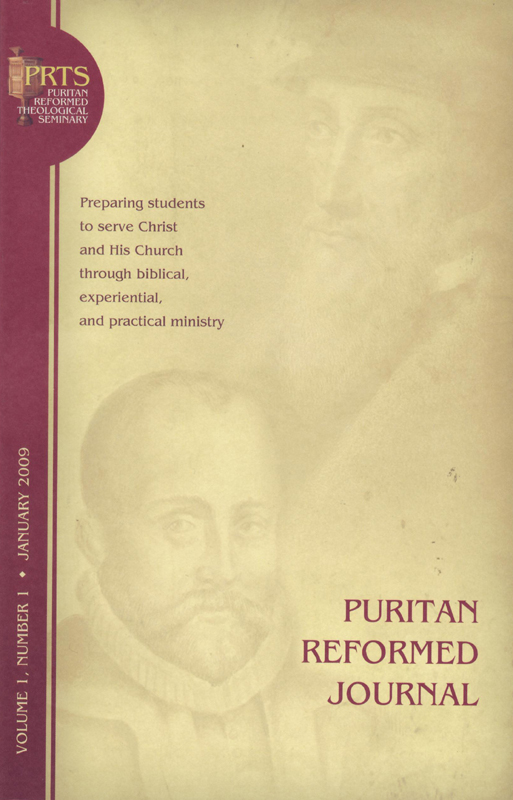 In this inaugural issue of the Puritan Reformed Journal, Joel R. Beeke provides the appropriate doorway of introduction by emphasizing our great need for God-centered ministry.
Contributors include: PRTS professors, Dr. David Murray on “Preaching Christ from the Old Testament” and Dr. Gerald Bilkes on “Ezra as a Model of Continuing Reformaiton; PRTS students, Antoine Theron on “The Christology of Adolphe Monod, Jonnie Serafini on “The Command against Eating Blood” and Daniel Hyde on “Preaching the Heidelberg Catechism”; there are also articles by Michael Haykin, John J. Murray and others.
We pray that this unique journal, which is aimed at both scholars and laymen will add to the body of rich literature that has been used to build the Body of Christ
Gospel Watered down by Tradition
Posted: November 19, 2008 Filed under: Gospel Quote of the Week, John Owen Leave a comment“So today in many churches gospel silver has become nothing else but dross, its pure wine watered down by the traditions and reason of the church.” – John Owen
It seems that John Owen had a few of the same problems that legalistic people in the church still tend to do today to the gospel…
The Sabbath Texts, Thought #2
Posted: November 18, 2008 Filed under: Sabbath Study Leave a commentI did NOT expect the number of readers that actually read my first thought on the Sabbath, which is fine I guess. The thoughts I plan on to mention in the writing below are only a short one to two sentences over the Pentateuch’s mentioning of the Sabbath and what the Sabbath is literally. I think it is good at times to know what exactly this Sabbath is in order to know what we are talking about for future reference when dealing with it, and defining it accordingly to Scriptures definition and not some confession or some opinion, or even dictionary.
Ex. 23:12 – This here is the first session of the giving of the Law and only but a brief mention of the Sabbath is given, and might I add that it seems to include a social concern as reason in mentioning it. In context here, first the Sabbath is mention among the regulations that govern Israel’s social behavior among the other nations. Second, it seems as if this mention of the Sabbath here is giving a transition to the celebration of feast and in the offering of sacrifices, hence the reason that the Sabbath was incorporated as a celebration for the nation of Israel.
Ex. 31:12-17 – Here God concludes his list of instructions on the building of the tabernacle by the repeating the Sabbath Law. Here it must be kept or death. Here the Sabbath is shown as a type/sign of the covenant showing what God had done in His creation work in resting. Might I add that this sign was for only God and His people to cease work, or death.
Ex. 34: 21 – This here is one reminder that is given in the second tablets of the Moral Law.
Ex. 35:2-3 – Here the Sabbath has been reminded as a contribution of building the temple, and is mostly shown in law keeping more than any of the other mentions, allowing the woman to cook, bake, etc. most likely referring to Ex. 16:23.
Lev. 19:3,30 – Here in its shortest form, and here God claims for the first time as the Sabbath “my sabbaths.”
Lev. 23:3 – Here shows that the feasts begin with the Sabbath.
Lev. 26:2 – Repeats the theology and doctrine of the Sabbath from Lev. 19:30.
Duet. 5:12-15 – Here the Sabbath is done in repetition of the Decalogue, however here the Sabbath instead of being told to “remember” it is said to “observe.” In addition here the Law of the Sabbath is told to not use an “ox or ass” in its list of workers, as well as “menservants and maidservants.”
Concluding Thoughts I have made from this:
#1 The Sabbath in these passages is now introduce, the Law of it, and the keeping’s of it for the first time.
#2 All daily work must cease for everyone on the Sabbath.
#3 Those that break the law of the Sabbath must die.
#4 No fire can be made in the homes on the Sabbath.
Changing Hymns
Posted: November 17, 2008 Filed under: You Might be a Calvinist if... 1 CommentYou might be a Calvinist if… you have ever purposefully sung a different word in a hymn to conform to scripture.
Speaking of Calvinist, check out the PRTS’s new website!

 Gospel-Centered Musings