Dual Citizens: Worship and Life between the Already and the Not Yet
Posted: September 2, 2009 Filed under: Reformation Trust 5 Comments Last week on Thursday (1st day of the Puritan Reformed Conference) I received from Reformation Trust my copy of Dual Citizens. I hadn’t even heard of the book until I took it with me to read during the Conference when people left and right started coming up to me and asking, “How much will you take for that book?” I told them you can purchase a copy like always on Ligonier’s store. Looking at the book, I had not a clue who Jason Stellman was, but looking at the title, Dual Citizens: Worship and Life between the Already and the Not Yet, I figure he had graduated from Westminster Seminary California.
Seems that today’s younger Reformed crowds are starting to make quite the distinction between Redeeming the Culture Kuyperianism and the old school Puritanism Two Kingdom Theology. Then there are some that think they can take the middle ground… Ha! Good-luck with that! Nonetheless, when I was 21, 22 graduating College I remember coming to Neo-Calvinism, redeeming everything in my path I touched, I saw, I listen to… You get the picture of what I mean. However after about two-years studying at Puritan Reformed Theological Seminary that left and seeing the importance of being a Citizen of Two-Kingdoms made much more theological sense.
After Kevin DeYoung spoke two months ago at my churches “family-camp” on Two Kingdom Theology and Neo-Kuyperians taking a middle ground on the theological issue, I myself was quite concern. Exactly what am I concern about? I am concern of the of the younger generation in theology that happens to always try two things.
Always standing in the middle trying to bridge a gap between to theological stances.
Thinking that we can actually take the best of both theological stances then make our own in the middle which is then perfect… Or better.
On August 14 Kevin then summarized what he had spoke of at Harvest OPC churches family-camp. For more information on dealing with these stances in theology see:
1. White Horse Inn Blog – Why Two Kingdoms, More on two Kingdoms, Another 2 Kingdom Perspective
Kevin DeYoung’s respond to White-Inn Horse
Darryl Hart’s Interviews on 2 Kingdom Theology – Part I & Part II
Darryl Hart’s post, “Two Kingdom Theology is the Change We’ve Been Waiting For”
Anyways back to the book…
What is Dual Citizens about?
New covenant believers live between “the already” and “not yet,” a point in redemptive history between the partial and complete fulfillment of God’s promises. This means they are exiles and pilgrims in the divinely ordained overlap of the ages. As Rev. Jason J. Stellman argues in his book Dual Citizens: Worship and Life Between the Already and the Not Yet, this biblical motif shapes the identity of Christians at every turn and affects their every activity in both the sacred and secular realms. Stellman explores the Christian pilgrimage with deep biblical insight, humor, and relevance to our contemporary context, revealing how Christians are to think of themselves and their role this side of heaven.
Who is Jason Stellman?
is a native of Orange County, California, and became a believer through the ministry of Calvary Chapel of Costa Mesa in 1989. After coming to understand and embrace Reformed theology, Pastor Stellman received his M.Div. degree from Westminster Seminary California, where he studied under such scholars as Dr. Michael Horton, Dr. W. Robert Godfrey, and Dr. D. G. Hart. After graduation, he was ordained by the Pacific Northwest Presbytery of the Presbyterian Church in America and called to plant Exile Presbyterian Church in the Seattle area. Rev. Stellman has written articles for Modern Reformation and Tabletalk magazines.
Who endorsed this well of course!
“The subject of Christ and culture has never been as popular among conservative Protestants in the United States as it is today, and the topic has never needed as much attention from the perspective of the church. It gets that attention in this important book by Jason Stellman. Dual Citizens will certainly upset those used to thinking of Christ as mainly the transformer of culture. But for genuine wisdom not only on the culture wars, but on the culture, ways, and habits of the church, Stellman’s discussion is the place to go.”-Dr. D. G. Hart
“For too long I struggled to recommend reading on the subject of living the Christian life as a ‘resident alien.’ Often I was reduced to directing readers to liberal Methodists (such as Hauerwas and Willimon) as the best embodiment of Christian convictions. At last I can point to practice that is firmly grounded in Reformed theology. Dual Citizens is written by someone who loves the world: its movies, its music, and its authors. But this is a rightly ordered love because it is a penultimate love. Here is a robust pilgrim theology that marches on to Zion while avoiding the pitfalls of asceticism and legalism. By putting earthly kingdoms in their proper place, Pastor Stellman demonstrates how rightly to use the present world even as one eagerly awaits the next.”- John Muether
Table of Contents and Sample Chapter
High-Res Image: Front Cover | Back Cover
In my personal opinion, not like it matters much, but this may be the best yet (besides RC’s The Truth of the Cross) that Reformation Trust has publish yet.
What am I Reading this Week?
Posted: September 1, 2009 Filed under: What am I Reading Today? Leave a commentThis week I am studying for a paper titled, “Law and Apostasy: The Pathway of Apostasy” for my Decalogue class with Dr. James Grier.
I am reading the follwoing…
 In The Rule of Love, J. V. Fesko gives an introductory exposition of the Ten Commandments. Beginning with the importance of the prologue, and then addressing each Commandment in turn, he sets forth a balanced and biblical approach that places the law in proper perspective. Throughout the book, Fesko analyzes the historical context of God’s giving the law in order to help us accurately understand the moral demands God places upon humanity. Yet, Fesko does not stop there; he also discusses the covenantal and redemptive context in which the law was given. Thus, he shows that the law is not presented to us in order for us to present ourselves right before God. Rather, it demonstrates our failure to love God as we should and points us to Christ and His perfect obedience in all that God requires of us. Fesko also shows how Christ applies the commandments to His people by the indwelling power and presence of the Holy Spirit. This is an excellent survey of the Ten Commandments that promises to bring about a more accurate understanding of the proper uses of the law, as well as engender profound gratitude for all that God is for us in Christ.
An Exposition of the Ten Commandments
 Maybe the most popular work of James Durham. A Practical Exposition of the Ten Commandments, by James Durham. New Edition. Newly edited and Typeset. Text has been carefully corrected and compared from several editions.
 C. H. Spurgeon said, “This volume is one of three that make up Thomas Watson’s complete Body of Practical Divinity. ‘One of the most precious of the peerless works of the Puritans, and those best acquainted with it prize it most.”
The Ten Commandments for Today
 At a time when the nation’s morality is in alarming decline it is surprising that so little has been written on the Ten Commandments. Brian Edwards gives us a modern commentary, carefully uncovering their true meaning and incisively applying them to our contemporary society. Probably never in the history of western civilisation have the Ten Commandments been more neglected and therefore more relevant than today. Andrew Anderson writes, “Brian Edwards has turned his probing mind and expositor’s skill, along with a Pastor’s heart, to this vitally significant part of God’s word. This book unpacks the crammed meaning of these terse commands and applies them pointedly to life in a deregulated age.
Calvinist…
Posted: August 31, 2009 Filed under: You Might be a Calvinist if... Leave a commentI haven’t thought of one of these in awhile and due to homework, classes, and getting over last week’s Puritan Conference I have not much time to write a blog post today. So…
You might be a Calvinist if… You own a NIV Bible and its placed in the fiction section of your library.
Solace, Security, Satisfaction
Posted: August 30, 2009 Filed under: Sundays with Spurgeon Leave a commentAlthough my house be not so with God; yet he hath made with me an everlasting covenant, ordered in all things, and sure: for this is all my salvation, and all my desire, although he make it not to grow. (2 Samuel 23:5)
This is not so much one promise as an aggregate of promises—a box of pearls. the covenant is the ark which contains all things.
These are the last words of David, but they may be mine today. Here is a sigh: things are not with me and mine as I could wish; there are trials, cares, and sins. These make the pillow hard.
Here is a solace—”He hath made with me an everlasting covenant.” Jehovah has pledged Himself to me, and sealed the compact with the blood of Jesus. I am bound to my God and my God to me.
This brings into prominence a security, since this covenant is everlasting, well ordered, and sure. There is nothing to fear from the lapse of time, the failure of some forgotten point, or the natural uncertainty of things. The covenant is a rocky foundation to build on for life or for death.
David feels satisfaction: he wants no more for salvation or delectation. He is delivered, and he is delighted. The covenant is all a man can desire.
O my soul, turn thou this day to thy Lord Jesus, whom the great Lord has given to be a covenant to the people. Take Him to be thine all in all.
The Omniscience of God
Posted: August 29, 2009 Filed under: Gospel Boasting Leave a commentPsalms 139:1-6 TO THE CHOIRMASTER. A PSALM OF DAVID. O LORD, you have searched me and known me! You know when I sit down and when I rise up; you discern my thoughts from afar. You search out my path and my lying down and are acquainted with all my ways. Even before a word is on my tongue, behold, O LORD, you know it altogether. You hem me in, behind and before, and lay your hand upon me. Such knowledge is too wonderful for me; it is high; I cannot attain it.
Hebrews 4:13 And no creature is hidden from his sight, but all are naked and exposed to the eyes of him to whom we must give account.
There is no occurrence that has slipped by God without His knowledge. God knows all things – from the largest animal to the most microscopic virus. There is not one inch upon this earth where something transpires that God does not know. The all-knowing God knows how you boast in Him, the extent to which you boast in Him, and for what reasons you boast in Him. God knows the heart of a person better than the person himself.
Oh, how great it is that the believer can boast in the God who knows all things! For God is never surprised by man’s actions nor earth’s natural disasters. God is not surprised by what may be a mishap to mankind, or something unheard of that man did not know was coming. God’s people have known this about Him throughout time – with Job, David, and Solomon and the writer of Hebrews being key examples. How great it truly is to know every day that your God knows what will happen and for what reason! Every action, every move, deed, decision, every situation that will occur, every person you will meet in a day, every bill you receive…everything up to the car wreck you didn’t see coming, to the child that dies in the womb – things that you still have no answers for – God knows. He alone knows. He knows how it will happen, as well as the reason for it. And you, the believer, can get ready for the unthinkable; you can get ready for the things that you have no clue are about to happen, so when they do, you can scream from the top of your lungs that you want now more than ever to find delight in God at that time. Then, and only then, can you enjoy the fact that God knows all things and the reasons for which all things occur, so that you can love and feel safe in boasting in the all-knowing God, whom you serve.
For the believer to boast in this allows him to enjoy God’s sovereignty. Any hardship in your family, any struggle in your private life, any financial situations – God knows them all. He knew they were going to happen, even how they were going to happen, and the very reason that they happened; and it is certain that it occurred to make Him more glorified through it. Do you, the believer, wish to find your happiness and find your contentment in God and the knowledge that He knows exactly why He has allowed you to go through problems? How often is it when believers come to the valley in life and have no vision? They forget the God that created them and the things around them – who knows everything that happens and ever will happen, for a purpose we may not know. Although believers may not find out what that purpose is at the time, or maybe even years (or ever), they can always know that God is glorified, and can praise Him for all things in which He knows. God’s people must boast in the fact that God allows His people to suffer, so that they can run to Him and find pleasure in Him for knowing all things. How much more honoring it is when His people run to Him in a time of need – the time of doubt – and jump into His arms and rest there knowing that He knows all things. This alone can give you reason and can be the cause of your affection to boast only in Him.
Collision – Part Four
Posted: August 28, 2009 Filed under: Christopher Hitchens, Collision, Doug Wilson 7 Comments
This for now will be my last post on the movie coming out soon, “Collision.” I may post something after watching the video at the Desiring God National Conference which is September 25-27 of this year, and I may not. I’m not exactly sure how much more I will say after this post. For those that are interested in buying the movie, COLLISION, it will be released on October 27, 2009. It will be available on DVD and will screen at selected theaters in New York City and Los Angeles. The DVD is available now for pre-order on Amazon.com.
I’ll be a bit honest and say that I have really slacked off of studies and reading this past summer taking it quite easy before I start my Th.M. at Puritan Reformed, which I started this week. The past two to three weeks of August I have spent a fair amount of time in reading three volumes of Christopher Hitchens works like; God Is Not Great: How Religion Poisons Everything,The Portable Atheist: Essential Readings for the Nonbeliever, and Is Christianity Good for the World? I have now watched at least 50% of Christopher Hitchens debates on Youtube, he is extremely intelligent but what hit me the most was his knowledge of the Scriptures. It is hard to believe that someone that could know, quote and read so much of the Holy Scriptures would but yet be so against it. But a few thoughts came to my mind for you to think about,
 1. Do we study Science, Philosophy, History, Logic, Critical Thinking as much as Mr. Christopher Hitchens studies our Bible that we believe so much?
2. Do we know the Scriptures as well as a atheist like Mr. Christopher Hitchens? To be able to quote passages of Scriptures left and right, knowing them by heart and memorization?
3. Are we able to stand for truth today in a time and age that truth means nothing to the secular-humanist?
4. How well do you know what you believe in the Scriptures? Not that you have to be as smart as Mr. Christopher Hitchens, but it would seem if we confess a faith that believes in absolute certainty, then we would know that faith better than anything else, better than your wife, your husband, or your own children, right?
Lastly, seeing individuals like Dr. John Piper, Evangelical circles like Christianity Today, and Evangelical Blogs like Justin Taylor’s promote Mr. Doug Wilson scares me, a lot! I honestly wonder what they are thinking when seeing blogs, individual people and magazines that claim Evangelicalism, promote Mr. Doug Wilson in some positive way. Okay Mr. Wilson is obviously a Theist, believes in the 66 books of the Bible as absolute Truth, the God of the Bible, Jesus as a Savior and the death, burial, and resurrection of Jesus Christ. But what about other major issues in the Gospel, like; his book Reformed Is Not Enough which clearly show his differences in Covenant Theology, his views on Peadocommunion, leanings toward Federal Vision, and wish-washy views on the Trinity that still seem not solid in anything that I have heard, read, or saw (too covenantal and no ontological?).
Here is what I think the issue is, and maybe I am wrong but you tell me!?
The problem is the lack of theological knowledge and the power that popularity has in Evangelicalism today.
Let me give some examples;
Paedocommunion– means nothing to the every day Evangelical because if doesn’t effect their circles and nine times out of ten they do not even know what that is.
Federal Vision – because what Doug Wilson had to say in January 2002 Auburn Avenue Presbyterian Church (PCA) in Monroe, Louisiana, never affected their circles and they never saw the damage it had done in the denominations of the OPC, PCA, and URCNA.
Many Evangelicals today I believe are lacking two main areas;
1. A solid, confessional theological standing on God’s Word.
2. A overview of Church history, knowing their roots in Christianity.
Without both, I honestly do not see how one can properly preach, and teach the Bible. But this is a blog, it is my personal blog, and so therefor it is only my opinion. What do you think?
Collision – Part Three
Posted: August 27, 2009 Filed under: Christopher Hitchens, Collision, Doug Wilson Leave a comment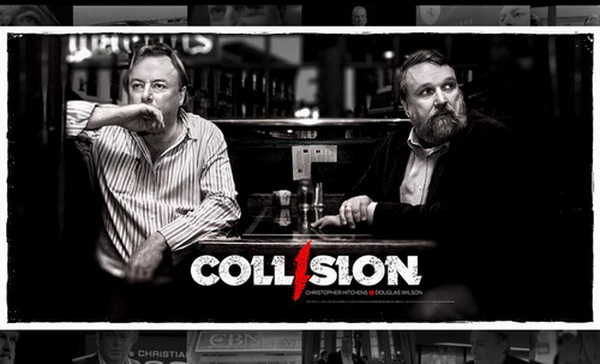 In the spring of 2007, atheist (better to say Theism-Hater) Christopher Hitchens and Douglas Wilson began talking about the question, “Is Christianity Good for the World?” When the articles came out, Christianity Today was the first there so that they many could soak the debate up. By 2008 the 3 city-site had became a book and now is being placed into video format. If you a reader of science, theism, reason, logic, thought, Christianity or any religion Hitchens is always a must read but even better to listen to.
What is the film about? (From the Collision site)
SYNOPSIS
The documentary COLLISION pits leading atheist, political journalist and author Christopher Hitchens (“God Is Not Great: How Religion Poisons Everything”) against fellow author and evangelical theologian Pastor Douglas Wilson on a debate tour arguing the topic “Is Religion Good For The World?”. Lives and worldviews collide as Hitchens and Wilson wittily and passionately argue the timeless question, proving to be perfectly matched intellectual, philosophical, and cinematic rivals. COLLISION is directed by prolific independent filmmaker Darren Doane (Van Morrison: To Be Born Again, The Battle For L.A., Godmoney).
OVERVIEW
In May 2007, leading atheist Christopher Hitchens and Christian apologist Douglas Wilson began to argue the topic “Is Christianity Good for the World?” in a series of written exchanges published in Christianity Today. The rowdy literary bout piqued the interest of filmmaker Darren Doane, who sought out Hitchens and Wilson to pitch the idea of making a film around the debate.
In Fall 2008, Doane and crew accompanied Hitchens and Wilson on an east coast tour to promote the book compiled from their written debate titled creatively enough, Is Christianity Good for the World?. “I loved the idea of putting one of the beltway’s most respected public intellectuals together with an ultra-conservative pastor from Idaho that looks like a lumberjack”, says Doane. “You couldn’t write two characters more contrary. What’s more real and punk rock than a fight between two guys who are on complete opposite sides of the fence on the most divisive issue in the world? We were ready to make a movie about two intellectual warriors at the top of their game going one-on-one. I knew it would make an amazing film.” In Christopher Hitchens, Doane found a celebrated prophet of atheism. Loud. Funny. Angry. Smart. Quick. An intimidating intellectual Goliath. Well-known for bullying and mocking believers into doubt and doubters into outright unbelief. In Douglas Wilson, Doane found the man who could provide a perfect intellectual, philosophical, and cinematic counterpoint to Hitchens’ position and style. A trained philosopher and and deft debater. Big, bearded, and jolly. A pastor, a contrarian, a humorist–an unintimidated outsider, impossible to bully, capable of calling Hitchens a puritan (over a beer).
It was a collision of lives. What Doane didn’t expect was how much Hitchens and Wilson would have in common and the respectful bond the new friend/foes would build through the course of the book tour. “These guys ended up at the bar laughing, joking, drinking. There were so many things that they had in common”, according to Doane. “Opinions on history and politics. Literature and poetry. They agreed on so many things. Except on the existence of God.”
Extra Link for you to check out…
Exclusive 13 minutes preview of Collision.
Collision – Part Two
Posted: August 26, 2009 Filed under: Christopher Hitchens, Collision, Doug Wilson Leave a commentWho is Douglas Wilson? Well according to Wikipedia,
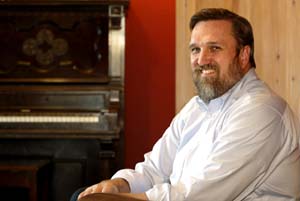 Wilson earned a B.A. in classical studies and a B.A. and an M.A. in philosophy from the University of Idaho. In addition to his role as pastor of Christ Church, he is a founder and Senior Fellow in Theology at New Saint Andrews College, founder and editor of Credenda/Agenda magazine, and founder of Greyfriars Hall, a three-year ministerial training program. He also serves on the governing boards of New Saint Andrews, Logos School (a Christian private school), and the Association of Classical and Christian Schools. Wilson was instrumental in forming the Confederation of Reformed Evangelical Churches, a religious denomination that is small but influential beyond its size. He is married to Nancy Wilson and has three children, including N. D. Wilson, and 13 grandchildren.
Who is Christopher Hitchens? Well according to Wikipedia,
 He was born April 13, 1949 and is an author, journalist, and literary critic. He has been a columnist at Vanity Fair, The Atlantic, World Affairs, The Nation, Slate, Free Inquiry, and a variety of other media outlets. He currently lives in Washington, D.C.. Hitchens is also a political observer, whose books — the latest being God Is Not Great: How Religion Poisons Everything— have made him a staple of talk shows and lecture circuits. In 2009 Hitchens was listed by Forbes magazine as one of the “25 most influential liberals in U.S. media.” The same article noted, though, that he would “likely be aghast to find himself on this list” and that he “styles himself a radical,” not a liberal. In 2007, retaining his British citizenship, Hitchens also became an American citizen after residing in the US for a quarter century.
Hitchens is a polemicist. While he was once identified with the British and American radical political left, he has more recently embraced some arguably centre right causes, notably the Iraq War. Formerly a Trotskyist and a fixture in the left-wing publications of both his native United Kingdom and the United States, Hitchens’ departure from the political left began in 1989 after what he called the “tepid reaction” of the European left following Ayatollah Khomeini’s issue of a fatwa calling for the murder of Salman Rushdie. The September 11, 2001 attacks strengthened his embrace of an interventionist foreign policy, and his vociferous criticism of what he calls “fascism with an Islamic face.” After adopting a strong pro-interventionist foreign policy, beginning to employ the term “Islamofascist” and his support for the Iraq War have caused Hitchens’s critics to label him a “neoconservative”. Hitchens, however, refuses to embrace this designation, insisting, “I’m not any kind of conservative”.
Hitchens is often regarded as one of the most fundamental figures of modern atheism. Often being described as part of the “new atheism” movement. Hitchens along with fellow atheists Richard Dawkins, Sam Harris and Daniel Dennett have often been referred to as “The Four Horsemen”. He is an atheist, humanist and anti-theist, and describes himself as a believer in the Enlightenment values of secularism, humanism and reason.
Hitchens is known for his ardent admiration of George Orwell, Thomas Paine, and Thomas Jefferson, and also for his excoriating critiques of Mother Teresa, Bill and Hillary Clinton, and Henry Kissinger, amongst others. Hitchens’ argumentative and confrontational style of debate and writing, and strong critique of usually lauded public figures, has gained him both praise by his admirers, and derision from his detractors. The San Francisco Chronicle referred to Hitchens as a “gadfly with gusto”.
In September 2008, he was made a media fellow at the Hoover Institution. Hitchens is currently writing his memoirs, due for publication in the spring of 2010.
Collision: Christopher Hitchens vs. Douglas Wilson
Christopher Hitchens talks “Collision”
Collision – Part One
Posted: August 25, 2009 Filed under: Christopher Hitchens, Collision, Doug Wilson Leave a comment
Collision… ? I have for some crazy reason not even heard of this until I got onto Desiring God’s website to look at their National Conference scheduled. I was told by Reformation Heritage Books that I would representing them in sales at the Desiring God National Conference, like the last 2-years. I have always enjoyed attending John Piper’s National Conferences in 2008 (top-ten favorite memories of my life) and enjoyed last years Conference. However when seeing the speakers list for this years coming conference I was quite upset like every other Orthodox Christian – Dutch-Reform, Reformed, American-Presbyterianism and Reformed-Baptist. (Yes Kyle Borg and Nathan Eshelman I place those that adhere to the 1644 & 1689 London and New Hampshire Baptist Confessions as a type of Orthodox Christianity.)
Reason #1 – The list of speakers in my opinion (besides Julius Kim of Westminster Seminary California) would never have crossed my mind when picking my top-five, my top-ten, nor my top-25 on dealing with the 500th anniversary of John Calvin’s birthday. It doesn’t matter who I’d pick exactly but am glad to say that I attended at Calvin500 Tour and Conference- held in Geneva with over 25 of the top re-known theologians and pastors in dealing with John Calvin and Calvinism. NOT a single ONE is speaking at this years Desiring God National Conference dealing with John Calvin, titled, “With Calvin in the Theater of God.” What Julius Kim, Marvin Olasky, John Piper, Sam Storms, Mark Talbot, and Doug Wilson have in common on dealing with the man John Calvin (even watching all the DG-videos) I still am yet to understand. Which brings me to reason number two.
Reason #2 – Bringing Doug Wilson in to speak at your conference is “risky.” Now I realize a few things…
That I will be at the Conference representing one of the many DG-Book Publisher’s in sales, therefore I need to be carful about stepping on toes.
That for whatever differences that Doug Wilson and I have in theology, does not make any difference in why he is a guest speaker at the DG-National Conference. Nor does it make any difference in what he will be speaking on at the Conference.
That John Piper in Evangelism (I hate that word) is maybe one of, if not the most influence person in the “New Calvinism” movement. He also is maybe one of the largest influences for the growth of some type of Calvinism, old or new today in America, which means bring in men like Doug Wilson is not an issue to the typical layman that knows no better.
However bringing him in for those that do know better, raises a lot of questions in my mind and the many minds that flat-out do not understand “why” John Piper.
Back to the reason for the post, and the few to come on “Collision.” When looking at the DG-National Conference schedule I notice that later on Friday night will be the showing of Collision, then after the screening John Piper and Doug Wilson will briefly discuss the film. I am still not fully in complete understanding what this has to do with John Calvin, John Calvin’s 500th Birthday, Calvinism either New or Old, nor exactly how it goes hand and hand with the theme of the Conference, “With Calvin in the Theater of God.”
Reason #3 – My fear and only hope this is not true is that Doug Wilson is there to be brought into Piper’s circle of friends so that he can gain respect from some spectrum of evangelicalism, being that he lost most of it from American-Reformed and Presbyterian circles for his book, Reformed Is Not Enough, his views on Peadocommunion, leanings towards Federal Vision, and wish-washy views on the Trinity that still seem not solid in anything that I have heard, read, or saw (too covenantal and no ontological?). Just scares me…
Nonetheless, for whatever it is worth in having him there I am extremely excited about the whole Doug Wilson vs. Christopher Hitchens debate video that they will be showing titled “Collision.” I have watched the videos that have been posted on Youtube of Doug Wilson and Christopher Hitchens at Westminster Theological Seminary, and enjoyed them very much. Yes I said it, I actually enjoyed Doug Wilson, his thoughts, and his very sharp mind in conversation with Christopher Hitchens. Although sadly enough to say at least in Philly, Hitchens seemed above and beyond Mr. Wilson’s level.
I am not sure yet to what the whole “Collision” thing is exactly (New York to Philly to D.C. I am assuming), but I would have to say that is what I am looking forward to the most at the DGNC-2009. With that said the next few post will be a little more about who Christopher Hitchens and Doug Wilson exactly are, what they do, and a link to where you can watch their pervious meeting at WTS.
Check out the trailer below.
What am I Doing this Fall?
Posted: August 24, 2009 Filed under: Masters of Theology Leave a commentI started today my Th.M. at Puritan Reformed Theological Seminary. For those that read this blog and know me, you will know that I just graduated here last May, 2009 with my M.A.R. from PRTS in Theological Studies. So what am I exactly doing this year at PRTS? I am doing a Masters of Theology, which is a little less class work and a lot more research. My Th.M. is majoring in Biblical Theology under the advisement of Dr. Jerry Bilkes, and my thesis title is, “A Biblical Theology of Apostasy.”
I did know it was a bit more work than may pervious two and half years at PRTS in my M.A.R. degree but I had no idea how much exactly. Needless to say, I will not be doing much of anything the next year but sit in PRTS’s library studying, reading, researching, and writing. Here are my classes for this coming fall 2009, and the work to do for each of them.
September 1-19 – The Decalogue
9 lectures
4 books to read
15-page paper – “The Love of Idolatry Causes Apostasy”
oral exam
September Class 21-25 – October- Missions in the OT & NT
5 lectures
3 books to read
reading reflections: 3 -1 page book reviews
reading reflections: 10 pages on course article reviews
6 page book review
25 page research paper – “The Apostasy of Israel & Mission to the Gentiles”
final exam
November – Biblical Ethics
16 lectures
3 books to read
12-15 page paper – “Is Divorce Biblically Ethical?”
3-5 page review on Kingdom Ethics
oral exam
December – Class 14-18 – Issues in OT Theology
4 lectures
class readings every night of the week of class
Meeting an OT Theologian -12 page paper – “Who Is Vos?”
2 article reviews – 7 pages each
20-25 page research paper – “Apostasy Issues in the Old Testament”
Wrath to God’s Glory
Posted: August 24, 2009 Filed under: Sundays with Spurgeon Leave a commentSurely the wrath of man shall raise thee: the remainder of wrath shalt thou restrain. (Psalm 76:10)
Wicked men will be wrathful. Their anger we must endure as the badge of our calling, the token of our separation from them: if we were of the world, the world would love its own. Our comfort is that the wrath of man shall be made to redound to the glory of God. When in their wrath the wicked crucified the Son of God they were unwittingly fulfilling the divine purpose, and in a thousand cases the willfulness of the ungodly is doing the same. They think themselves free, but like convicts in chains they are unconsciously working out the decrees of the Almighty.
The devices of the wicked are overruled for their defeat. They act in a suicidal way and baffle their own plottings. Nothing will come of their wrath which can do us real harm. When they burned the martyrs, the smoke which blew from the stake sickened men of popery more than anything else.
Meanwhile, the Lord has a muzzle and a chain for bears. He restrains the more furious wrath of the enemy. He is like a miller who holds back the mass of the water in the stream, and what He does allow to flow He uses for the turning of His wheel. Let us not sigh, but sing. All is well, however hard the wind blows.
What is Truth…? Who Knows!
Posted: August 22, 2009 Filed under: Truth Leave a commentI was reading yesterday for Biblical Ethics and The Decalogue courses that I am taking by Dr. James Grier online. After dealing with some of the courses text books, and watching a few Youtube videos dealing on debating Ethics I just happen to Google a dictionary’s definition of truth. Not that I’d believe exactly what it said, but I wanted to know if it matched what I was reading and hearing from the secular-humanist view on truth. I had no idea that what I would find this!
What is truth? Well we have 9 definitions you can chose from…
1. the true or actual state of a matter: He tried to find out the truth.
2. conformity with fact or reality; verity: the truth of a statement.
3. a verified or indisputable fact, proposition, principle, or the like: mathematical truths.
4. the state or character of being true.
5. actuality or actual existence.
6. an obvious or accepted fact; truism; platitude.
7. honesty; integrity; truthfulness.
8. ideal or fundamental reality apart from and transcending perceived experience: the basic truths of life.
9. agreement with a standard or original.
10. accuracy, as of position or adjustment.
11. Archaic. fidelity or constancy.
Wonder why the postmodern doesn’t know what to believe about truth, is because is can basically believe anything you want it to be. What is truth to you? and if you have a definition of truth, please I’d love to hear it.
Logic: The Right Use of Reason in the Inquiry after Truth
Posted: August 21, 2009 Filed under: Reformation Heritage Books, Soli Deo Gloria Leave a comment
The Puritans were convinced that the ability to think clearly was of the utmost importance. In our day, common sense is not very common and clear thinking is not very clear. This book will help discipline the mind and train the reader to discern proper thinking and argumentation in seeking the truth.
Who was Isaac Watts? Isaac Watts was born in Southampton, England, on July 17, 1674. His father had served several prison terms because of his non-conformity. In 1702, Watts became pastor of Mark Lane Chapel, a large Congregational church in London. Although ill health forced his virtual retirement within a few years, the congregation insisted that he remain pastor as long as he lived. Watts never married, though he did propose to Elizabeth Singer, who rebuffed him with these words: “Mr. Watts, I only wish I could say that I admire the casket as I admire the jewel.” Watts wrote prodigiously, and was the author of over 750 hymns. On the day of Watts’ death, Matthew Arnold declared Watts’ “When I Survey the Wondrous Cross” to be the finest hymn in the English language. Others include “O God, Our Help in Ages Past” and “Jesus Shall Reign Where’er the Sun.” Isaac Watts died on November 25, 1748 and was buried in the non-conformist burial ground at Bunhill Fields.
The Omnipotence of God
Posted: August 20, 2009 Filed under: Gospel Boasting Leave a commentJeremiah 32:17 ‘Ah, Lord GOD! It is you who has made the heavens and the earth by your great power and by your outstretched arm! Nothing is too hard for you.’
Luke 1:37 For nothing will be impossible with God.
God has done, and is able to do all things that He pleases. The power of God describes Himself: it is infinite, and there is no one that can change it in the slightest. The believer can boast in this power of the Almighty God, knowing that it was by the word of His mouth that He created the heavens and the earth.
God is unlimited in His power, and there is no scale to measure it. God’s power reigns above all of the creation that He has made. There are no influences on the power that He holds. If God wills something to be done, it is! No questions; no thought process; no “what if’s,” and no worrying about what other people may say. For when God pleases to do something, He does, and that is the final word. The largest and mightiest armies can try to overshadow God’s power, but it cannot happen. The ability which God holds in doing what He wills with His power is not only unlimited in its amount, but it is also unlimited in the way the Lord uses it. Whatever His will is pleased with is done. Many try to find ways around this power in describing God as being limited in what He can do. For believers to boast in God’s power, they need to see that it works in accordance with His will, and that what He wishes to be done in His perfect plan; He does. God will never contradict Himself in how He uses His power. God also will never use this power wickedly or immorally. And God will never use His almighty hand and word of mouth to deny His own nature in who He is, nor will He allow it to alter His plan in all eternity.
As for the believer, he must never try to fully grasp or understand how God uses His will. Rather, the believer should see the enormities of the power and limitlessness of God, and praise Him for His gracious character in allowing us to enjoy it. Oftentimes, men (and, yes, that includes believers) see themselves as untouchable or powerful in that they can achieve whatever they desire. It is most important when boasting in the gospel to realize that God could use His almighty power and merely speak the words He wishes, and whether the person be a believer or an unbeliever, his life is over. The believer can enjoy the Almighty God in whom they serve, for the word’s from his mouth speak, “Let it be” – and there it was. For the believer to boast in this, he must give God the glory due to His name. The believer must find delight in the perfections of God’s power, the certainty of His upholding, and the might of His will, which made all of creation. God can do whatever He wills, and that is all the believer can boast in. When the believer sees that God is the everlasting source of power, life, perfect activity, and is totally faultless, how can he not find his contentment with this God? How can the believer not boast in living for a God who can do all things? For there is nothing impossible for the Lord who is the maker of all things and the One who sanctions how creation is lived out. His unlimited power will endure forever, and there the believer can find rest in the arms of his God. But what leaves the believer in awe of savoring this all-powerful God is that we can know for sure that His power is always 100% perfect for His best, which is for our best as well. We see that God uses His character and His traits so that He may be boasted in among all people. Every way, every day, and every time God uses His power – from the tiniest bit of it to the enormous amount which kills thousands in seconds – it is made for His sake, and His name alone. The believer must boast in the power of God for the reason that God uses it to make Himself known and look glorious to the believer, so that he can not only glory in it, but become satisfied in it as well.
The Love of God
Posted: August 19, 2009 Filed under: Gospel Boasting Leave a commentJohn 3:16-17 For God so loved the world, that he gave his only Son, that whoever believes in him should not perish but have eternal life. For God did not send his Son into the world to condemn the world, but in order that the world might be saved through him.
The love of God for mankind is unfathomable: that He would send His Son, Jesus Christ, to die so that sinful mankind could come to know Him and boast in Him. This act of love is great and surpasses any display of love throughout all of time – past, present, and future.
Man can boast in the love of God because of the act in which God displayed His love. How thought-provoking it is that man can boast in God because of the death of God. The love of God for the gospel is deeper, stronger, wider, and longer than anything on this earth. God has planned throughout all of history a way in which the nations would see just how much He loves them. This loving God sent His Son, Jesus Christ, to take form in a human body so that He could then suffer for all of mankind. This act of love separates all types of love. For there is nothing that comes close to the act of the cross, where God sent His Son to die because of His love for humankind. How much more should the believer boast in the ability to know that he is saved by the grace which God gives to His chosen because He simply loves Himself. No doubt this may sound prideful, or selfish. But it is by no means so. God is a jealous God, and no man or individual should be boasted in, or be delighted in – especially by His flock – besides the Supreme Lord. For the believer to boast in this is to look at how much God loved them and thank God alone for His doing, and think nothing of himself or what he has done. Romans 5:7-8 best portrays this act of love in stating thus: “For one will scarcely die for a righteous person – though perhaps for a good person one would dare even to die – but God shows his love for us in that while we were still sinners, Christ died for us.” God shows His love for His chosen by planning that, while we were dead sinners bound to the pit of hell, He would then give His Son so that His elect could see His love and enjoy His love in bringing sinners to know His love. Imagine that the act of the cross, and all that happened before and after that event, was predestined to take place for you. It was predestined to take place so that you, the believer, when called into God’s elect people, would only boast and find all enjoyment in God’s love for His people! The believer needs to boast in this love that he was created for. It was created for God’s people to know and fall in love with. Yes, God’s love is for the believer to fall in love with.
God’s love must be boasted about. It is good to all of creation, and even more, it is the most compassionate love that exists, or ever will exist. There is no love on this earth that a husband has for his wife, or a mother has for her children, that can compare to God’s love for His people. The love of God for His church is the deepest, most pleasurable love that exists. This should call the one who is in this covenant of grace to boast in the fact that he can be filled with eagerness and be ablaze with a passion for boasting and glorifying God because of what He has done for him. How great is God’s love for His people! That God would enter into a covenant with sinners – a covenant in which God himself would allow men to enjoy himself like non-other and a covenat that would allow man to interact in a loving relationship with their father. This covenant is both Christ and the church loving one another. How are we doing? Do we boast in the fact that God wants to show His love to His people? Do we boast in the fact that God wants to have a relationship with His people? How often it seems that the bride of Christ starts looking for other loves (sometimes perverse loves) that are mostly of the world, and not everlasting in their fulfillment to the soul. I believe that the Puritans do an excellent job in explaining this truth of the gospel – how God loves His people and wants to redeem them – but even more in how we reap this benefit. John Flavel writes:
What an ancient Friend he hath been to us; who loves us, provided for us, and continued all our happiness, before we were, yea before the world was. We reap the fruits of this covenant now, the seed whereof was sown in eternity.
Wilhemus à Brakel writes:
How blessed and what a wonder it is to have been considered and known in this covenant, to have been given by the Father to the Son, by the Son to have been written in his Book, and to have been the object of the eternal, mutual delight of the Father and the Son to save you.
We, the church, should strive to be covenant keepers of God’s promises, and should most of all boast with all our hearts in the act of His love for allowing His people to delight in His promising love. God’s love will endure forever, and will continue in His covenant and promises throughout eternity.
I saw this come off the truck at RHB…
Posted: August 18, 2009 Filed under: Reformation Heritage Books Leave a comment Biblical Theology: The History of Theology From Adam to Christ – by John Owen
Available: September 1
Lovers of theology, and particularly of the Puritans, will welcome this English translation of John Owen’s Latin writings. In William Goold’s 24-volume edition of Owen’s works, this is the one volume that had been unavailable to English readers for years. Banner of Truth has reprinted the first 16 volumes plus the 7-volume commentary on Hebrews, but this volume has been available only in Latin until this SDG edition was produced.
The Grace of God
Posted: August 17, 2009 Filed under: Gospel Boasting Leave a commentEphesians 1:7-8 In him we have redemption through his blood, the forgiveness of our trespasses, according to the riches of his grace, which he lavished upon us, in all wisdom and insight.
Ephesians 2:8-10 For by grace you have been saved through faith. And this is not your own doing; it is the gift of God, not a result of works, so that no one may boast. For we are his workmanship, created in Christ Jesus for good works, which God prepared beforehand, that we should walk in them.
The grace of God, which is the warmest and most caring aspect of His character, not only forgives man of sin and calls man to Him, but also always allows the believer to grow in knowledge even though he falls time and time again.
There is no human that deserves to earn the grace of God, which He gives to His church willingly. God’s grace not only calls the chosen to Him, but then provides a way of provision and guidance throughout life to them. Not only is there common grace which all of mankind encounters, but for Christ’s bride there is irresistible grace, incomprehensible grace, and saving grace which gives the believers hope and another reason to boast in the gospel. The believer, in order to boast in this, must look at two simple key truths of this great grace that God gives to His elect. Sometimes easily looked past because of their simplicity, these truths are essential to acknowledge in order for the believer to boast in the gospel. First, the believer needs to see that if it wasn’t for grace, he would have been slain by the Lord. And secondly, that the grace given to believers differs from that grace given to the rest of humanity. This grace is a grace that He will forever give to His sheep so that they can boast in Him! Once again God is doing a great work and is planning ways that He may be boasted in. And He does this through His chosen people.
The believer must boast in the good news that God did not kill him on the day of birth. How sad it is that the church often forgets, or ignores, simple truths of the very beginning of the gospel. Romans 6:22-23 states, “But now being made free from sin, and become servants to God, ye have your fruit unto holiness, and the end everlasting life. For the wages of sin is death; but the gift of God is eternal life through Jesus Christ our Lord.” It seems almost unjust for God to let mankind even enter the womb, let alone this earth. From the minute of conception, all of mankind has entered into an everlasting nature of sin, and stands before God as nothing but dung. Many individuals often ask the question, “How can God let someone go to hell?” My response is always, “How can God even allow one to enter into heaven and into a personal relationship of communion with the triune God which will one day be restored into perfection forever and ever?” For there is no reason for man to think he had anything to do with this grace. God simply allows man to live in accordance with Him or without, and is always glorified in it. How much more should the believer, the partaker of the covenant of grace, come and boast in this gospel which allows him not only to live in grace, but to serve – by grace – the Giver of grace.
One of the most important and easily forgotten truths of the gospel (and its dealings with grace) is that the man walking down the street who does not know of God, who hasn’t repented, has only common grace. Common grace which does not compare to the grace that God grants on behalf of His Son’s work to His bride. How much more should a believer boast in the gospel, when God, the Giver of great grace, calls him to become part of a family which he had no prior relation with. This grace that God gives to His elect is greater than any grace that man has ever had before the era of irresistible grace. This great grace that God called you into is only meant for the true believer. Bringing the believer from the pit of hell and eternal torment should first bring him into a zeal for boasting in God. Also, God bringing him to the glories and riches of heaven should then spark a passion and flame that does not stop burning; that only continues to be built upon with sound wood so that it can claim the grace of God and boast in it to glorify God.
We must look at these areas of the gospel and thank God for them, but there are other areas of the gospel in which one can boast when dealing with the grace of God. Oftentimes believers are called to suffer and go through trials or hard times in life and may think, “We are not going to make it!” The believer has to look at and hope in the gospel. Believers must see how the grace of God will help them and how it has given them all that they need to make it through these times. Now here one might ask, “How do I boast in that?” Only when believers see that the grace of God has already, at the beginning in justification, bought them and given them all that they need to make it through any season of life, will they then cherish the gospel, seeing how sweet it can be to the hurting heart in the time of pain. The believer of the gospel will boast in the gospel because the grace of God enables him to do so in allowing the believer to come to know this Giver of grace. The Giver gets the glory; the Giver is God; He is the Giver of grace; and it should be a desire and counted as a privilege to boast in this gospel truth that we partake in.
A Name Guarantee
Posted: August 16, 2009 Filed under: Sundays with Spurgeon Leave a commentAnd whatsoever ye shall ask in my name, that will I do, that the Father may be glorified in the Son, (John 14:13)
It is not every believer who has yet learned to pray in Christ’s name. To ask not only for His sake, but in His name, as authorized by Him, is a high order of prayer. We would not dare to ask for some things in that blessed name, for it would be a wretched profanation of it; but when the petition is so clearly right that we dare set the name of Jesus to it, then it must be granted.
Prayer is all the more sure to succeed because it is for the Father’s glory through the Son. It glorifies His truth, His faithfulness, His power, His grace, The granting of prayer, when offered in the name of Jesus, reveals the Father’s love to Him, and the honor which He has put upon Him. The glory of Jesus and of the Father are so wrapped up together that the grace which magnifies the one magnifies the other. The channel is made famous through the fullness of the fountain, and the fountain is honored through the channel by which it flows. If the answering of our prayers would dishonor our Lord, we would not pray; but since in this thing He is glorified, we will pray without ceasing in that dear name in which God and His people have a fellowship of delight.
Reformation Heroes Back in Print at RHB
Posted: August 14, 2009 Filed under: Joel Beeke, Reformation Church History Leave a comment
NEW SECOND EDITION Reformation Heroes with Study Guide
The Reformation did not happen instantaneously; it was something God patiently arranged over a number of years.
As you read this book, you will learn how the Lord used some people to plant the seeds of church reform long before October 31, 1517, when Martin Luther published his ninety-five theses. Luther’s story is well-known; we trust you will find it interesting and instructive to read about him and about forty others (John Knox, Peter Martyr Vermigli, Zacharias Ursinus, Willem Teellinck, etc.) who contributed to the Reformation – some well known and others not so – most of whom are Reformation heroes.
To provide a more full picture of the many sided Reformation, chapters are also included on the Anabaptist and Counter Reformation movements. The book concludes with a brief summary of the influence of the Reformation in different areas of life.
Diana Kleyn with Joel R. Beeke Diana Kleyn is a member of the Heritage Netherlands Reformed Congregation in Grand Rapids, Michigan. She is the mother of three children, and has a heart for helping children understand and embrace the truths of God’s Word. She writes monthly for the children’s section in The Banner of Sovereign Grace Truth magazine, and is co-author with Joel R. Beeke of the series Building on the Rock. Dr. Joel R. Beeke (Ph.D. Westminster Theological Seminary) is president and professor of systematic theology and homiletics at Puritan Reformed Theological Serminary, pastor of the Heritage Netherlands Reformed Congregation in Grand Rapids, Michigan, editor of The Banner of Sovereign Grace Truth, and author of numerous books.
Unleashing Your Inner Fundamentalist
Posted: August 13, 2009 Filed under: Doug Wilson 1 CommentI came across a post by Doug Wilson what seemed and was after reading an interesting and impressive post. He writes,
“Fast forward to our day. When people object to tattoos, or jewels stuck in odd places, and someone objects to the objection by saying that back in the day they used to object to slacks for women, what about this makes it seem like a strong argument? Now before anyone rushes to the keyboard in order to type I can’t believe . . ., let me say that I do believe the fundamentalist argument is simplistic and inadequate. But compared to the arguments for getting the tats and other badges of the moment, the fundamentalists come off looking like Derrida on one of his subtler days.”
Read the rest here.
Christopher Hitchens debates Jay Richards – Parts 1-4
Posted: August 12, 2009 Filed under: Uncategorized Leave a commentI watched this debate between Christopher Hitchens and Jay Richards yesterday. I plan to post them here the next few days. The are interesting to say the least, I’m sure either half of you will enjoy, and the other half will find boring.
Who is Christopher Eric Hitchens:
 He was born April 13, 1949 and is an author, journalist, and literary critic. He has been a columnist at Vanity Fair, The Atlantic, World Affairs, The Nation, Slate, Free Inquiry, and a variety of other media outlets. He currently lives in Washington, D.C.. Hitchens is also a political observer, whose books — the latest being God Is Not Great: How Religion Poisons Everything— have made him a staple of talk shows and lecture circuits. In 2009 Hitchens was listed by Forbes magazine as one of the “25 most influential liberals in U.S. media.” The same article noted, though, that he would “likely be aghast to find himself on this list” and that he “styles himself a radical,” not a liberal. In 2007, retaining his British citizenship, Hitchens also became an American citizen after residing in the US for a quarter century.
Hitchens is a polemicist. While he was once identified with the British and American radical political left, he has more recently embraced some arguably centre right causes, notably the Iraq War. Formerly a Trotskyist and a fixture in the left-wing publications of both his native United Kingdom and the United States, Hitchens’ departure from the political left began in 1989 after what he called the “tepid reaction” of the European left following Ayatollah Khomeini’s issue of a fatwa calling for the murder of Salman Rushdie. The September 11, 2001 attacks strengthened his embrace of an interventionist foreign policy, and his vociferous criticism of what he calls “fascism with an Islamic face.” After adopting a strong pro-interventionist foreign policy, beginning to employ the term “Islamofascist” and his support for the Iraq War have caused Hitchens’s critics to label him a “neoconservative”. Hitchens, however, refuses to embrace this designation, insisting, “I’m not any kind of conservative”.
Hitchens is often regarded as one of the most fundamental figures of modern atheism. Often being described as part of the “new atheism” movement. Hitchens along with fellow atheists Richard Dawkins, Sam Harris and Daniel Dennett have often been referred to as “The Four Horsemen”. He is an atheist, humanist and anti-theist, and describes himself as a believer in the Enlightenment values of secularism, humanism and reason.
Hitchens is known for his ardent admiration of George Orwell, Thomas Paine, and Thomas Jefferson, and also for his excoriating critiques of Mother Teresa, Bill and Hillary Clinton, and Henry Kissinger, amongst others. Hitchens’ argumentative and confrontational style of debate and writing, and strong critique of usually lauded public figures, has gained him both praise by his admirers, and derision from his detractors. The San Francisco Chronicle referred to Hitchens as a “gadfly with gusto”.
In September 2008, he was made a media fellow at the Hoover Institution. Hitchens is currently writing his memoirs, due for publication in the spring of 2010.
 Who is Jay Richards:
He is Director of Acton Media and a Research Fellow at the Acton Institute, and Program Director of the Discovery Institute’s Center for Science and Culture (CSC), which has as its primary role the advocacy of intelligent design.Richards is also a member of the Apologetics Faculty of Biola University.
He is the author of numerous scholarly and popular articles, as well as four books, including The Untamed God and The Privileged Planet.
Richard has gained attention with his intelligent design advocacy since 1996. The Privileged Planet, co-authored with astronomer and fellow CSC Senior Fellow Guillermo Gonzalez. William H. Jefferys, a Professor of Astronomy at the University of Texas at Austin, reviewed The Privileged Planet writing “the little that is new in this book isn’t interesting, and what is old is just old-hat creationism in a new, modern-looking astronomical costume.”
Richards became the earliest fellow at the Discovery Institute to confirm the genuineness of the Wedge document. Secular and science organizations then took attention of the DI after the document was published online, but Richards wrote “that the mission statement and goals had been posted on the CRSC’s website since 1996.”
So it is 2:00 am and I ended up continuing to watch it all, and decided to post it all now, so that I can spend the next weeks post focusing on the debate between Christopher Hitchens and Douglas Wilson… Stay tune for an update of what it going to happen there.
If interested in parts 5-10 of this debate, see here.
Rev. James Dennison Jr. Lecture on Reformed Confessions
Posted: August 11, 2009 Filed under: Reformed Confessions, Rev. James Dennison Jr. 1 Comment Rev. James T. Dennison, Jr. – Reformed Confessions of the 16th and 17th Centuries in English Translation
Reformed Confessions of the 16th and 17th Centuries Lecture – 10/31/2008
Lecture handouts in PDF format available here (162 KB)

This is the first of a projected three volume set, which compiles numerous Reformed confessions of the sixteenth and seventeenth centuries translated into English. For many of these texts, this is their debut in the Anglo-Saxon vernacular. It provides the English-speaking world a richer and more comprehensive view of the emergence and maturation of Reformed theology in these foundational centuries foundational centuries for Reformed thought and foundational summaries of Reformed doctrine for these centuries. Each confessional statement is preceded by a brief introduction containing necessary historical and bibliographical background. The confessions are arranged chronologically, with this first volume presenting thirty-three documents covering the years 1523-1552.
Select Works of Robert Rollock, 2 volumes
Posted: August 10, 2009 Filed under: Robert Rollock Leave a comment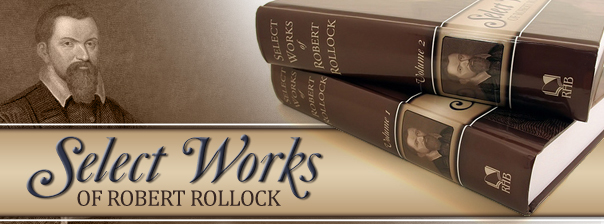
The long-overdue republication of Robert Rollock’s “Select Works” introduces us to one of the greatest Reformed thinkers of the sixteenth century. Robert Rollock (c.1555-1598), first principal of Edinburgh University, able preacher and philosopher, and a renowned biblical commentator in his own day, was a seminal Reformed theologian particularly as an early exponent of covenant theology in Scotland. His treatises on God’s effectual calling and the passion, resurrection, and ascension of Christ are themselves worth the purchase of this two-volume “Select Works.” These volumes represent the cream of sixteenth-century Reformed theology, and should be treasured by all who love biblical truth. May they whet the appetite for more of this prolific Scotsman, who wrote five volumes of sermons and nine commentaries.
But who is Robert Rollock?
“Robert Rollock (c. 1555 – 8 February 1599), the first principal of the university of Edinburgh, was the son of David Rollock of Powis, near Stirling.
He received his early education at the school of Stirling from Thomas Buchanan, a nephew of George Buchanan, and, after graduating at St Andrews, became a regent there in 1580. In 1583 be was appointed by the Edinburgh town council sole regent of the towns college (Academia Jacobi Sexti, afterwards the university of Edinburgh), and three years later he received from the same source the title of principal, or first master, and was engaged in lecturing on philosophy.
When the staff of the young college was increased by the appointment of additional regents, he assumed with consent of the presbytery the office of professor of theology. From 1587 he also preached regularly in the East Kirk every Sunday at 7 am, and in 1596 he accepted one of the eight ministerial charges of the city. He took a prominent part in the somewhat troubled church politics of the day, and distinguished himself by gentleness and tact, as well as ability. He was appointed on several occasions to committees of presbytery and assembly on pressing ecclesiastical business. He was elected moderator of the General Assembly held at Dundee in May 1597. In 1598 he was translated to the parish church of the Upper Tolbooth, Edinburgh, and immediately thereafter to that of the Grey Friars (then known as the Magdalen Church). He died at Edinburgh on the 8th of February 1599.
Rollock wrote Commentaries on the Epistles to the Ephesians (590) and Thessalonians (1598) and Hebrews (1605), the book of Daniel (1591), the Gospel of St John (1599) and some of the Psalms (1598); an analysis of the Epistle to the Romans (1594), and Galatians (1602); also Questions and Answers on the Covenant of God (1596), and a Treatise on Effectual Calling (1597).
Soon after his death eleven Sermons (Certaine Sermons upon Several Places of the Epistles of Paul, 1599) were published from notes taken by his students. His Select Works were edited by W Gunn for the Wodrow Society (1844-1849).
A Life by George Robertson and Henry Charteris was reprinted by the Bannatyne Club in 1826. See also the introduction to the Select Works, and Sir Alexander Grant’s History of the University of Edinburgh.”
Pruning for Fruit-Bearing
Posted: August 9, 2009 Filed under: Sundays with Spurgeon Leave a commentEvery branch in me that beareth not fruit he taketh away: and every branch that beareth fruit, he purgeth it, that it may bring forth more fruit. (John 15:2)
This is a precious promise to one who lives for fruitfulness. At first it seems to wear a sharp aspect. Must the fruitful bough be pruned? Must the knife cut even the best and most useful? No doubt it is so, for very much of our Lord’s purging work is done by means of afflictions of one kind or another. It is not the evil but the good who have the promise of tribulation in this life. But, then, the end makes more than full amends for the painful nature of the means. If we may bring forth more fruit for our Lord, we will not mind the pruning and the loss of leafage.
Still, purging is sometimes wrought by the Word apart from trial, and this takes away whatever appeared rough in the flavor of the promise. We shall by the Word be made more gracious and more useful. The Lord who has made us, in a measure, fruit-bearing, will operate upon us till we reach a far higher degree of fertility. Is not this a great joy? Truly there is more comfort in a promise of fruitfulness than if we had been warranted riches, or health, or honor.
Lord Jesus, speedily fulfill Thy gracious word to me and cause me to abound in fruit to Thy praise!

 Gospel-Centered Musings

