MANILA CONFERENCE ON THEOLOGY 2009
Posted: February 24, 2009 Filed under: Conferences 3 CommentsCheck-out the MANILA CONFERENCE ON THEOLOGY 2009.
Selected Texts on Logic
Posted: February 24, 2009 Filed under: Critical Thinking 1 CommentI am taking a class on Logic/Critical Thinking this week at PRTS, or at least trying to take the class. Anyways, if you are interested in studying the topics for yourself, here are the list of titles my professor gave us yesterday.
Clark, Gordon H. Language and Theology. Phillipsburg: Presbyterian & Reformed Publishing Co., 1980. An historical overview of philosophy of language with a positive statement of his view and understanding of logic.
Copi, Irving M. Introduction to Logic. New York: The Macmillan Company, current edition. This is the standard text used in almost all Introduction to Logic courses in the Universities of America. If you use the book you should skip the section on symbolic logic and even truth tables if you wish to avoid the math.
Fisher, Alec. Critical Thinking: An Introduction. Edinburgh: Cambridge University Press, 2001. This is the text book for this class. It is well conceived in format and covers all the basics in critical thinking.
Poythress, Vern S. Philosophy of Science and the Sovereignty of God. Phillipsburg: Presbyterian & Reformed Publishing Co., 1976. Theological discussion of logic throughout the book with an appendix dedicated to the discussion.
Runkle, Gerald. Good Thinking: An Introduction to Logic. Chicago: Holt, Rinehart and Winston, Inc., current edition. This is a self-help text in critical thinking. It is the one I recommend to people with no background in logic. The answers to the exercises are provided so that one can check their work. I would recommend again that you skip the section on symbolic logic.
Tagliapietra, Ron. Better Thinking & Reasoning. Greenville, S. C.: Bob Jones University Press, 1995. I reviewed this book for a journal. Its strength is that it uses Biblical materials and ideas. In my judgment it is not broad enough in scope to make a person proficient in logic but it does cover the basics.
Greenville Presbyterian Theological Seminary Interviews Dr. Beeke
Posted: February 23, 2009 Filed under: Dr. Joel Beeke 1 Comment1. From your vantage point, how would you assess the health and vigor of the Reformed churches in North America at this time? What is the basis of your opinion?
Let me begin with your second question. Are these bodies true churches? First, do these churches exhibit the marks of a true church: namely, faithful preaching of the Word, right administration of the sacraments, and the due exercise of church discipline. Second, we must also assess them in terms of their well-being or degree of purity. What I mean by this is how truly the doctrine of the gospel is taught by the ministers and embraced by the members, and how faithful the public worship is according to the Word of God. Every church falls short of perfection, but how pure are these churches? How far do they go toward being what a local church ought to be?
We must never forget that it is possible to be a good, faithful member of a solid, Reformed, confessional church without personally and experientially knowing biblical, sovereign-grace truth. Healthy churches have many members who can explain how they have personally come to know the Lord Jesus and how they continue to live out of Him in daily, practical Christian living. By the blessing of the Holy Spirit, healthy churches foster large dosages of head-heart-hand theology.
I fear that in the larger Reformed and Presbyterian churches of North America, what some would call the mainline churches that come from a Reformed background, the “unchurching” of these bodies by modernism and liberalism begun in the twentieth century is continuing today. Pastors who do not believe what is taught in Scripture and who have not experienced its truths personally and savingly cannot preach the Word faithfully. In the absence of faithful preaching, the sacraments have no definite content or purpose, and church discipline seems to be used only against those who rebuke the leaders of these bodies and call them to repentance. However, even in these larger, older bodies some individuals and local churches still hold fast to the essentials of the faith, fighting against the running tide of unbelief.
The situation is much better in some of the smaller, older bodies such as the Associate Reformed, Reformed Presbyterian, and Free Reformed Churches, and newer ones such as the Orthodox Presbyterian Church, the Presbyterian Church in America, the United Reformed Churches, the Presbyterian Reformed Churches, the Heritage Reformed Congregations, and some Reformed Baptist groups. Despite debates over such things as paedocommunion and Federal Vision theology in some of these denominations, many churches continue to affirm the basic doctrines of the Reformed faith. They are growing in size as new congregations are planted and older ones are revitalized. It appears that in a number of these churches God is blessing book ministries and conferences to foster more Reformed and Puritan-minded, experiential theology. Some very encouraging things are happening. As I travel around North America doing conferences and preaching in a variety of Reformed, Presbyterian, and Reformed Baptist churches, I often think that the godly are becoming more godly and the ungodly are becoming more ungodly. Conferences are growing in numbers and in quality. God’s people are showing hunger for experiential truth, so that they might know Christ better and be more conformed to Him in daily living.
To determine the relative purity of these smaller bodies as a whole would require careful research and detailed assessment of each one, and we don’t have the space to do that here. I am aware that there are some disturbing trends with regard to the centrality of preaching, the importance of doctrinal knowledge and confessional fidelity, and the conduct of public worship in some congregations of even several of these smaller denominations. Reformed worship developed as a vehicle to serve the Reformed faith, and it is hard to see how doctrinal orthodoxy can long endure where there is ignorance, indifference, or antagonism regarding the historic principles and usages of Reformed worship.
Church discipline continues to be highly problematic under the present circumstances in North America. Its purposes are not understood, and its methods are not well known or widely respected; unhappy members easily flee church discipline and find refuge in churches of other denominations. Some of the most conservative Reformed Christians seem to have forgotten that schism is a grievous sin, and the number of Reformed microdenominations continues to grow.
2. What do you see as some of the more important challenges for the church to address in our world today?
The single most important challenge is to continue preaching the authentic, Reformed, experiential gospel of Jesus Christ, and turn a deaf ear to voices that proclaim that some seismic shift in modern culture demands a new or different gospel. We must dare to believe that in spite of 2,000 years of such shifts and changes the gospel of Christ has ever been “the power of God unto salvation” (Rom. 1:16).
Second, we need to recover a sense of the wholeness of the Reformed faith as a system of doctrine, manner of worship, and a way of life, and also as a position from which to evangelize the whole world and challenge “every high thing that exalteth itself against the knowledge of God” (2 Cor. 10:5). We need to practice the Lordship of Christ as preachers and teachers, as believers and followers of Christ, and as citizens of the kingdom of God.
Third, we need to refire and refuel the passion for evangelism, church planting, and missions that burned so brightly in the churches of the Reformation and afterwards in the eighteenth and nineteenth centuries. Investment of energy and resources in other lines of Christian work or activity can be a distraction from these central and urgent tasks. The huge investment of millions of dollars by churches and individual donors in recent political campaigns is astonishing, if one knows how difficult it can be to raise funds to plant new churches or send missionaries abroad. Are political or social issues more important than the preaching of the gospel and the growth of the church.
Fourth, we must strive to overcome the negativism associated with conservative Christianity in our country today. It may not be possible in this world for us to rise above being “a sect that everywhere is spoken against” (Acts 28:22), but we can see to it that those who visit our churches are surprised by the fervent preaching of the beauty and riches of Christ, the free offer of grace, the sureness of God’s promises, and the practicality of truth and godliness. “Let the beauty of the LORD be upon us” (Ps. 90:17). We may find, by the Spirit’s blessing, more people in the world beating a path to our doors.
3. How can Reformed seminaries best equip their ministerial students to address these challenges today?
Reformed seminaries have always done their best work when they have given their students a good grounding in Bible knowledge, historic Christian doctrine and experience, and the basic skills of good exegetes and preachers. It is more important to furnish our students with the knowledge and skills to find their own answers to contemporary problems or questions in Scripture and Reformed theology than to give them canned answers to repeat mindlessly and endlessly.
That said, we need to have teachers who are not only well grounded in Reformed faith, order, and living, but who are also mentoring biblical piety and alive to both the universal needs of human life and the particular needs of our time and place. The Bible places little value on mere knowledge without understanding. Church history and Christian biography stand alongside experimental and practical theology as rich resources for such understanding and wisdom. In fact, every part of the seminary curriculum should be taught with an eye to the abiding or current relevance and practicality of the subject in hand.
In sum, our seminaries need to give thorough instruction, maintain high standards, and foster a concern for practical usefulness. Part of the task is to make students aware that they must prepare themselves not simply to pass exams but to meet the challenges, foreseeable and unforeseen, of the many years of ministry ahead of them.
4. What are the similarities and differences, as you see them, between Greenville Presbyterian Theological Seminary and Puritan Reformed Theological Seminary?
I view no seminary in North America as similar to our school as Greenville Presbyterian Theological Seminary. We are so grateful for the cooperation between our schools. I count it an honor and privilege to teach periodically at Greenville and have recommended it to many potential students over the years. I am also grateful for how Greenville assisted us in the early years by providing degrees for students who completed our courses.
Both schools are unswerving in their allegiance to Scripture and the Reformed confessions. Both schools cherish the heritage of Calvin and the Reformers, the Puritans of England, and the fathers of Scottish Presbyterianism.
Both schools emphasize the centrality of preaching, and preaching with application. Both schools are committed to high standards of academic excellence and ministerial preparedness. Faculty members of both institutions know, love, and appreciate each other. I have a long established friendship with Dr. Pipa, in particular. He and other faculty members from Greenville are loved and valued in many of the churches that support our seminary.
These two schools differ, certainly, with regard to the confessional and cultural milieu in which they have flourished. Puritan Reformed Seminary is the product of a Dutch Reformed and Puritan-minded community in North America determined to preserve its theological and spiritual heritage brought to these shores from the Netherlands and through the reading of considerable Puritan literature. Greenville Seminary is located in the heart of the historic and distinctive Presbyterianism of the American South, with roots running back before the American Revolution.
It would be foolish to discount these factors of spiritual and cultural heritage in the life and work of these schools. It remains to be seen in the long run if the distinctive heritage of each school serves as a strength or a weakness. It will prove to be a weakness if it serves only to feed a narrow and inward-looking sectarianism that unchurches all Christians who may stand outside or apart from it. It will be a strength if it affords us a stable and well-identified position from which to reach out and contribute something valuable to the wider Christian community, and to meet the spiritual challenges of the day.
I am happy that it appears thus far that both schools are reaching out. Our vision at PRTS is to take Reformed, Puritan, experiential truth around the globe to penetrate as many denominations as possible. Presently we serve close to 100 students who hail from about 15 countries and from nearly 30 denominations. Greenville’s paradigm and statistics would be nearly identical to this, I should think.
5. What advice would you give to young men who discern a call to the ministry?
First, seriously examine your call. Elsewhere I have written that a ministerial calling is a holy calling that involves a holy life, a holy desire for the work of the ministry, a holy compulsion to proclaim the gospel, a holy fitness for the work, holy struggles with the weightiness of the work, holy confirmation by the approbation of believers and providential events, and a holy love and burden for the spiritual welfare of people.
Second, do not be hasty. An inward call from God will only grow stronger as time passes, and as more time passes, the greater the clarity of the call becomes. Wait on the Lord continually, by prayer and the searching of the Scriptures. Seek wise counsel in making plans, choosing a ministry path, or deciding where to train. If you are married, your partner should affirm and share your sense of call, something only the Holy Spirit can impart, in His own good time.
Third, remember that Christian service is not merely a profession or career. What you are as both a Christian and a human being is even more important than where you train or what degrees you obtain. By the Spirit’s grace, seek to learn and grow in being a true follower of Jesus Christ. Search the Scriptures. Learn koine Greek or, if that is not possible, classical Greek. Take courses that can assist you for seminary studies (Western history, philosophy, logic, speech, Latin, etc.). Fellowship with the wisest and maturest of believers. Read the best books—the great classics of the past. Learn how to think, meditate, and write well. Volunteer for ministry opportunities, such as speaking at youth conferences, teaching Sunday School, or ministering to the homeless. Be an active member of the local church, making diligent use of the means of grace. Grow and ripen as a human being. Profit from every life experience, good or bad, as a way to grow in grace.
Fourth, be practical. Learn to be organized and to manage your time well. Get into the workplace and master the skill of earning a living. Learn to manage your personal finances, to live within your means and avoid debt. Learn how to listen and how to work hard and well. Submit to the discipline of accepting any assigned task, no matter how unpleasant or demanding it may be. Learn how to learn—that is, where to find the knowledge, and how to master the skills needed to get the job done.
Finally, develop your people skills along the way. Study human nature and behavior. Visit the sick. Acquire the common graces of good grooming, good manners, and Christian courtesy. Cultivate a healthy lifestyle with regard to diet, sleep, and exercise. The ministry involves diligent work, hardships of many kinds, heavy demands on skill and resources, and constant encounters with human and personal complicating factors. Give your all to the Lord and His cause, and pray continually for wisdom.
6. What books have you recently written for lay Christians?
A few months ago, Ligonier’s Reformation Trust published Living for the Glory of God: An Introduction to Calvinism, which seeks to show the biblicalness, doctrinal soundness, experiential warmth, and practical applications of Calvinism in twenty-eight different aspects. I’ve drawn on friends like Sinclair Ferguson, Derek Thomas, and Michael Haykin to assist me in producing this popular book on comprehensive Calvinism.
Last month, Day One and Reformation Heritage Books co-published 365 Days with Calvin, in which I edited Calvin for contemporary readability and added a closing section of applications to each day’s selection.
I have also recently written enlarged editions of Family Worship and The Family at Church: Listening to Sermons and Attending Prayer Meetings.
Of particular interest to conference attendees, will be The Soul of Life: The Piety of John Calvin, a 240-page popular paperback due out at the end of this month. These books will be available at the conference, the GPTS online bookstore (www.presbyterianbookshop.org) and Reformation Heritage Books (www.heritagebooks.org.)
Closing Statement: Debate on Calvinism
Posted: February 23, 2009 Filed under: Uncategorized Leave a commentOkay last video I promise, but this is great!
Jerry Falwell Identifies Calvinism as Heresy
Posted: February 23, 2009 Filed under: You might be a Fundamentalist if Leave a commentYou might be a Fundamentalist if you… enjoy this one.
Cross Examination on 1 Cor. 3 and Purgatory
Posted: February 23, 2009 Filed under: You Might be a Calvinist if... Leave a commentYou might be a Calvinist if… you find this video below enjoyable.
And another one…
Blessing on Littleness
Posted: February 22, 2009 Filed under: Sundays with Spurgeon Leave a commentHe will bless them that fear the Lord, both small and great. (Psalm 115:13)
This is a word of cheer to those who are of humble station and mean estate. Our God has a very gracious consideration for those of small property, small talent, small influence, small weight. God careth for the small things in creation and even regards sparrows in their lighting upon the ground. Nothing is small to God, for He makes use of insignificant agents for the accomplishment of His purposes. Let the least among men seek of God a blessing upon his littleness, and he shall find his contracted sphere to be a happy one.
Among those who fear the Lord there are little and great. Some are babes, and others are giants. But these are all blessed. Little faith is blessed faith. Trembling hope is blessed hope. Every grace of the Holy Spirit, even though it be only in the bud, bears a blessing within it. Moreover, the Lord Jesus bought both the small and the great with the same precious blood, and He has engaged to preserve the lambs as well as the full-grown sheep. No mother overlooks her child because it is little; nay, the smaller it is, the more tenderly does she nurse it. If there be any preference with the Lord, He does not arrange them as “great and small” but as “small and great.”
Matt Chandler on Silly Preaching
Posted: February 21, 2009 Filed under: Video of the Week Leave a commentJohn Owen on Apostasy – Part Ten
Posted: February 20, 2009 Filed under: John Owen on Apostasy Leave a commentIX. Apostasy into Profaneness and Sensuality of Life- The causes and occasions of it- Defects in public teachers and guides in religion
Theses:
That which yet remaineth to be considered under this head of backsliding from the commands of the gospel and the obedience required of them is of a worse kind and of a more pernicious consequence; and this is that open apostasy into profaneness and sensuality of life which the generality of them who are called Christians are in most places of the world visibly fallen into.”[1]
Summary:
Chapter nine is different from the previous chapters (which have dealt with the issues of apostates, the causes and reasoning, believers fighting against apostasy, etc), as he now focuses on dealing with the actual minister and men in the church offices that fall into apostasy. Owen begins the chapter by looking at the ministry of the church for the gospel. Throughout this section, Owen shows the importance of the purity of the church and its fight against those who fall into apostasy. He does this by focusing on the duties that lie in the ministry of one who lives the life of work for the gospel. Owen’s focus is placed upon remaining pure in that which the gospel portrays. He makes the case that the purity of the gospel is the root of the church in its teaching and preaching, revealing those that fall from this, who often then fall into apostasy. This is seen in how preachers and teachers of the Word sometimes end up not teaching the whole counsel of God, and as well, often fall away from prayer in personal ministry. This is where the minister can fall when not preaching all of the truth, as that only leads to ignorant teaching that creates more apostates. Owen says it best as he makes the point that the most powerful revival and bringing people back to the gospel comes with the preaching of the whole truth as it is represented in the Scriptures, and not picking and choosing what one wants to use. This is seen at the end of this chapter when Owen states:
It cannot with any modesty be denied but that by reason of these and the like miscarriages in the spiritual guides of the people, the generality of Christians have been either led or suffered insensibly to fall into the present apostasy. When God shall be pleased to give unto the people who are called by his name, in a more abundant manner, “pastors after his own heart, to feed them with knowledge and understanding;” when he shall revive and increase a holy, humble, zealous, self-denying, powerful ministry, by a more plentiful effusion of his Spirit from above; then, and not until then, may we hope to see the pristine glory and beauty of our religion restored unto its primitive state and condition… And to suppose that it can be done any other way, that the world of professed Christians shall be recovered unto holy obedience by any other means but the ministerial dispensation of the word, is to render it a thing altogether useless. Here, then, must begin the cure of that lethargy in sin that the world is fallen into, — namely, in the renovation of a powerful evangelical ministry, or the due discharge of that office by them that are called thereunto or possess the place of it, if ever it be effected unto any purpose in this world.[2]
Outline:
I. Apostasy in Ministry
A. The Ministry of the Church for the Gospel
B. The Ministry and its Duties
1. Keeping the Gospel Pure
2. Keeping the Gospel the Root of the Church
3. Keeping the Gospel the center of Preaching
My Favorite Theologians
Posted: February 19, 2009 Filed under: Just for Fun 2 CommentsSoteriology – John Calvin
Apologetics – Francis Schaeffer
Theology Proper – A. W. Pink
Prolegomena – Karl Barth or Cornelius Van Til
Christology – John Wesley
Anthropology – Jonathan Edwards
Eschatology – George Eldon Ladd
Ecclesiology – have none!
Let me know what is yours!?
Bill Clinton the Calvinist
Posted: February 18, 2009 Filed under: Just for Fun Leave a commentSee here.
What Book am I Reading this Week?
Posted: February 17, 2009 Filed under: Book of the Week 1 Comment
More Precious Than Gold: 50 Daily Meditations on the Psalms
Book Description from Crossway: In his third book of daily meditations, Sam Storms urges readers to not just enter into God’s Word but to take the next step toward knowing him and his Word better. And the book of Psalms, Storms believes, is a great place to start, because Psalms is so popular and so very relevant to our experiences today.
In More Precious Than Gold, Storms combines years of life experience and his biblical and theological training to bring readers 50 brief, daily meditations that are both stylistically accessible and theologically substantive. Each meditation includes a historical or theological reflection on the psalm in context, a story that brings it alive, and creative tools to support the key idea. Storms also interweaves the words of such luminaries as Charles Spurgeon, Jonathan Edwards, and John Piper to help readers better understand the concepts that are featured throughout Psalms: worship, prayer, joy, forgiveness, steadfast love, mercy, sin’s consequences, the law of the Lord, and our relationship with our enemies.
Like the Psalter, Storms doesn’t shy away from the tough issues. Instead, he encourages readers to experience through these daily meditations what he and generations of Christians have found to be true: that the whole of the Christian faith is about lifting God higher and magnifying his name—even during difficult times.
Reading on Sunday’s
Posted: February 16, 2009 Filed under: You Might be a Calvinist if... 1 CommentYou might be a (Strict Sabbatarian) Calvinist if… you only read my blog six days a week.
Average a day 200.
Number on Sunday this week… 34.
Mercy to the Undeserving
Posted: February 15, 2009 Filed under: Sundays with Spurgeon Leave a commentHe that trusteth in the Lord, mercy shall compass him about. (Psalm 32:10)
O fair reward of trust! My Lord, grant it me to the full! The truster above all men feels himself to be a sinner; and lo, mercy is prepared for him: he knows himself to have no deservings, but mercy comes in and keeps house for him on a liberal scale. O Lord, give me this mercy, even as I trust in Thee!
Observe, my soul, what a bodyguard thou hast! As a prince is compassed about with soldiery, so art thou compassed about with mercy. Before and behind, and on all sides, ride these mounted guards of grace. We dwell in the center of the system of mercy, for we dwell in Christ Jesus.
O my soul, what an atmosphere dost thou breathe! As the air surrounds thee, even so does the mercy of thy Lord. To the wicked there are many sorrows, but to thee there are so many mercies that thy sorrows are not worth mentioning. David says, “Be glad in the Lord, and rejoice, ye righteous; and shout for joy, all ye that are upright in heart.” In obedience to this precept my heart shall triumph in God, and I will tell out my gladness. As Thou hast compassed me with mercy, I will also compass Thine altars, O my God, with songs of thanksgiving!
Predictions for this Weekend’s NBA All-Star Events
Posted: February 14, 2009 Filed under: Just for Fun Leave a commentH-O-R-S-E
Nick: O. J. Mayo
Me: Joe Johnson
Haier – Shooting Stars
Nick: Phoenix Suns
Me: San Antonio Spurs
Play Station Skills Challenge
Nick: Derrick Rose
Me: Mo Williams
Foot Locker Three-Point Shootout
Nick: Danny Granger
Me: Jason Kapono
Spirit Slam Dunk Contest
Nick: Dwight Howard
Me: Dwight Howard
All-Star Game
Nick: East
Me: East
All Star MVP
Nick: LeBron James
Me: LeBron James
(Nick is my NBA analysis)
John Owen on Apostasy – Part Nine
Posted: February 13, 2009 Filed under: John Owen on Apostasy Leave a commentVIII. Apostasy from the Holiness of the Gospel; The Occasion and Cause of It- Of that which is gradual, on the pretence of somewhat else in its room
Theses:
“There is… a falling away from the gospel with respect unto the holiness of its precepts, which are to be the matter, as they are the rule, of our obedience… yea, an apostasy from the holiness of the gospel is, on many accounts, more dreadful and dangerous than a partial apostasy from its truth; for as it is more spreading and catholic than that is, and of less observation or esteem, so it is usually more irrecoverable, most men under it being greatly hardened through the deceitfulness of sin.”[1]
Summary:
In chapter eight Owen deals with how man does not follow the commands that the gospel makes clear, which then results in apostasy. In several sections, Owen begins the chapter with explaining the dangers that lie in apostasy when one leaves the gospel. He makes his case with showing, first, how the gospel calls one to live a life of holiness, and secondly, how living a life of holiness is a requirement of the gospel. Owen then discusses several topics: the forms in which apostasy can occur, different areas of the Roman Catholic Church, issues in human morality, and how man tries to make himself perfect in order to live for the gospel, but falls without the Spirit of truth of the gospel. He uses these points to show the way that man lives in order to tell themselves that they are in right standing with the gospel, and yet fall short of what it requires. That is why once again Owen ends with gospel- gleaming truths that bring the believer to read the importance of the gospel and what it requires in the heart and in the life of ones who claims to know it. To finish, Owen brings forth three areas that are required by the one who confesses to believe in the gospel of Jesus Christ:
1. The gospel requires maintaining a life of holiness in the world.
2. The gospel requires maintaining a continual life that lives out holiness.
3. The gospel requires maintaining a life that fights for holiness in the world.[2]
Outline:
I. Apostasy from the Commands of the Gospel
A. The Dangers of Apostasy from the Gospel
1. Living for the Gospel leads to Holiness
2. Holiness is Required From the Gospel
B. Two Forms of Apostasy
C. Apostasy in the Church of Rome
D. Apostasy from Morality
E. Apostasy from Perfectionism
F. Holiness Required from the Gospel
1. Not Loving the World
2. Habitual Obedience
3. Leaving the Gospel, becomes closer to the World
Devotional(s)
Posted: February 12, 2009 Filed under: Devotional(s) Leave a commentSomeone asked me the other day, “What do you do or use for a devotional? They went on to ask, “What I would recommend doing for a devotions?” So, I have decided to turn it into a blog post and give my answers here.
#1 Morning – My Bible reading plan for this year I found of Justin Taylor’s blog, and use it because I can read, I can listen to it and have it directly sent to my RSS feeder. You can as well see here. Emily and I decided this year to read through the Bible chronologically because we had never done it, so that is what I picked for this year. If I was to suggust one to anyone, it would be first and foremost this, The ESV: Chronological Reading Guide.
#2 Noon – I read the Ligonier Ministries Blog because of the number of articles that are often deep in theological matter and mind stimulating. They often place a number of R.C. Sproul’s past works in shorter segments that are easily readable and thought provoking that one can easily learn much from.
#3 Afternoon – I listen to the The Al Mohler Program. I am however a day behind because I download them by podcast on iTunes, but enjoy being up-to-date on “hot” issues dealing with the culture and church today.
#4 Evening – A book… either reading, skimming, or speed reading through something that I either have to write a review for, or a paper on for seminary. I’ll quickly read a book or part of one in the evening.
#5 Weekly – Just recently (last week) did I start working my way through a few books that I want to read only once a week, to learn from that are easily done in a weekly format. These tend to be Lord’s Day reading in which I learned from my roommate who tends to do the same thing, spending the day reading material after church during the afternoons. I however am taking these next 8 to 7 months before I get married to spend reading once a week a book on marriage and on doctrine.
Weekly read with Emily – This Momentary Marriage, by John Piper (14-weeks)
Weekly read for myself – A Sketch of the Christian Catechism, by William Ames (52-weeks)
Servants & Stewards: 2009 Band of Bloggers Fellowship
Posted: February 11, 2009 Filed under: Band of Bloggers Leave a commentGoing to The Gospel Coalition Conference in April? You blog? Hope to see you there! Click below for more information.

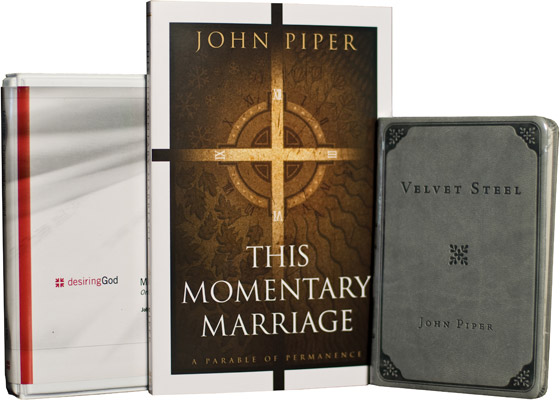
Marriage Gift Set
Posted: February 10, 2009 Filed under: John Piper Leave a commentBeing that I just got engaged a month ago yesterday, Em and I decided to pick up this set by Desiring God and work through for the next 14 weeks. Take a look here below.
“Covenant keeping, not the effects of being ‘in love’, is the main point of marriage…and tough-minded covenant keeping is the best soil for the long-term flourishing of tender affections.” – John Piper
The Desiring God Marriage Gift Set brings together a biblical call for an unyielding commitment to covenant keeping and a tender display of John Piper’s affections for his wife Noël.
The set Includes
- This Momentary Marriage: A Parable of Permanence (Book)
- Velvet Steel (Poetry Book)
- Marriage, Christ, and Covenant: One Flesh for the Glory of God(Audio CDs)
Heidelberg Catechism
Posted: February 9, 2009 Filed under: Reformation Heritage Books Leave a comment
You might be a Calvinist if… your going to buy this! (Release Date: February 11, 2009)
In The Church’s Book of Comfort, Willem van ’t Spijker and his team of scholars present an introductory investigation into the history, theology, and impact of the Heidelberg Catechism. The authors give careful attention to the background of the Reformation in Germany, the production of the Catechism, and the lives of those involved in making the Catechism. Interesting details are given about the practice of using catechisms before 1563, and the reception of the Heidelberg Catechism among the Reformed churches. Emphasis is also placed on the practice of Catechism preaching and the efforts to increase theological education among congregations. Readers will see the rich theological dimensions of the Catechism and its call for experiential religion. The Heidelberg Catechism has long been known for its warm display of orthodox doctrines, and this helpful book further displays the importance of this classic confessional statement.
The Heidelberg Catechism has always been and continues to be one of the best-known confessional statements of the Western church. Many associate it with catechetical instruction or the broader teaching role of the church. How did this particular Catechism acquire and retain such popularity? The present volume answers this question in an easy-to-follow and user-friendly manner by exploring the historical background and theology of this book of the church’s comfort. It offers the reader new and exciting insights. For the first time ever all persons involved in its compilation are portrayed. Particular attention is given to its reception and influence in the Netherlands through preaching and catechetical instruction. In addition this book addresses the question as to why this Catechism continues to be enormously relevant. This splendidly illustrated edition is eminently suitable as a guide to the use of the Heidelberg Catechism.
Joyful Security
Posted: February 8, 2009 Filed under: Sundays with Spurgeon 2 CommentsI will uphold thee with the right hand of my righteousness. (Isaiah 41:10)
Fear of falling is wholesome. To be venturesome is no sign of wisdom. Times come to us when we feel that we must go down unless we have a very special support. Here we have it. God’s right hand is a grand thing to lean upon. Mind, it is not only His hand, though it keepeth heaven and earth in their places, but His right hand: His power united with skill, His power where it is most dexterous. Nay, this is not all; it is written, “I will uphold thee with the right hand of my righteousness.” That hand which He uses to maintain His holiness and to execute His royal sentences—this shall be stretched out to hold up His trusting ones. Fearful is our danger, but joyful is our security. The man whom God upholds, devils cannot throw down.
Weak may be our feet, but almighty is God’s right hand. Rough may be the road, but Omnipotence is our upholding. We may boldly go forward. We shall not fall. Let us lean continually where all things lean. God will not withdraw His strength, for His righteousness is there as well. He will be faithful to His promise, and faithful to His Son, and therefore faithful to us. How happy we ought to be! Are we not so?
Coming Back in Print The Freedom of the Will
Posted: February 7, 2009 Filed under: Jonathan Edwards 1 Comment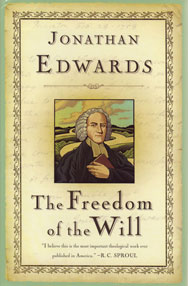 The Freedom of the Will set to RELEASE Feb. 11th. RHB’s line of SDG titles are being one by one reprinted for those who loved great work. This one however is going to be released in the next month! Also if you would like a PDF of their newest catalog, here ya go… Feb. 2009 Tolle Lege.
Many scholars believe this work, published in 1754, is the most important argument against Arminianism published in America. Freedom of the Will is divided into four parts. The first deals with terminology; the nature and determi- nation of the will; the meaning of necessity, impossibility, and contingency; the distinction between natural and moral necessity; and the nature of moral agency and liberty. The second considers the possibility of self-determination. The third analyzes divine agency regarding human beings and the world. In the conclusion, Edwards anticipates the recep- tion the work will receive.
Noteworthy is Edwards’s essential agreement with the empiricist John Locke that the question of whether or not the will was “free” was badly posed; the real issue, he said, is whether the person is free. The majority of the work, however, deals with the will’s freedom (in contrast to the freedom of the whole person) as it seeks to refute the Arminian notion of the will. For Edwards, the errors of the Arminians essentially resulted from denying God’s absolute sovereignty; in contrast to Calvinist orthodoxy, Arminians insisted that secondary causes could operate in the individual apart from the influence of the divine will. This notion of the will’s freedom had Pelagian roots, which Edwards rightly exposed. Furthermore, the refusal of the Arminians to acknowledge the individual’s total corrup- tion promoted further error. The will cannot be free as the Arminians would have it, Edwards argued, for true free- dom can only belong to God, who is self-sustaining and therefore free from other influences.
John Owen on Apostasy – Part Eight
Posted: February 6, 2009 Filed under: John Owen on Apostasy Leave a commentVII. Instance of a peculiar defection from the truth of the gospel; With the reasons of it
Theses:
“Besides the reasons insisted on, which have a general influence into all apostasies from the doctrine or mystery of the gospel, each especial defection in every kind hath reasons and causes peculiarly suited unto its rise and furtherance… And every age giveth us, in one place or another, renewed evidence, that, — where either secular interest or weariness of the truth, through the love of the present world and hatred of holiness or strict evangelical obedience, doth give a propensity unto a declension from any doctrines of the gospel unto persons whose grandeur and outward advantages are sufficient to attract a compliance from the minds of men under the power of ambition, or any importunate desire of earthly things, — multitudes of all sorts suppose there is nothing left for them but to crowd who shall come nearest the leaders in the apostasy. And it is not seldom that, meeting with new temptations, they outrun both them and themselves also into such extremes as at first they designed not; for hence it is that so many do even at present issue their recessions from the truth, under the conduct of those “ignes fatui” or erratic exhalations of countenance and favor, in the undesigned bogs of Popery on the one hand, or Socinianism on the other.”[1]
Summary:
Chapter seven shows the gospel as the center of belief. Simply put into five main sections, Owen gives a number of doctrines that he is convinced are impossible to ignore, or not believe, by anyone who calls themselves a believer of the gospel. Owen deals with the person (namely Rome) who makes less of the need of Christ as their priest and mediator in order to lift man’s religion higher. He takes the time to show how Christ’s work and victory over sin is a necessity in order to receive the great grace of God to wash away sins. Halfway through this chapter is found the greatest gospel truth, as Owen takes the time to explain that the ignorance of man often forgets the importance of the righteousness of God. Given here are three key thoughts of living a gospel-centered life, which are important for one to continue in obedience everyday so as not to fall into apostasy:
1. Owen gives a section describing exactly what God’s righteousness is.
2. How the Law of God requires righteousness from man.
3. Then how the righteousness of Christ is provided in the gospel because of the work of Jesus Christ.
Owen then ends with a brief section on the importance of knowing the Scriptures so that one does not fall away from these truths that lie in it.[2]
Outline:
I. Apostasy from the Truths of the Gospel
A. Ignorance of the Need of Christ
B. Ignorance of Christ Work
C. Ignorance of Christ Grace over Sin
D. Ignorance of God’s Righteousness
1. The Law Requires
2. The Gospel Gives
E. Ignorance of Knowing the Scriptures
What is Immortality?
Posted: February 5, 2009 Filed under: Questions & Answers Leave a commentWhich of the following definitions best answers the question?

 Gospel-Centered Musings