Ligonier Academy of Theological and Biblical Studies
Posted: February 4, 2009 Filed under: Just for Fun Leave a commentAnyone have an extra 10k laying around? Introducing Ligonier Academy of Biblical and Theological Studies! I want to go!!!
preaching the gospel you substitute your knowledge…
Posted: February 4, 2009 Filed under: Gospel Quote of the Week Leave a commentIf in preaching the gospel you substitute your knowledge of the way of salvation for confidence in the power of the gospel, you hinder people from getting to reality. – Oswald Chambers
What does it mean practically to keep the Sabbath holy?
Posted: February 3, 2009 Filed under: John Piper, Mark Driscoll, Video of the Week 5 CommentsAlso, read Mark Driscoll’s post yesterday on the Sabbath.
Presby Spears
Posted: February 2, 2009 Filed under: You might be a Presbyterian if Leave a commentYou might be a Presbyterian if… you have something in common with Brittany Spears.

God Always Hears
Posted: February 1, 2009 Filed under: Sundays with Spurgeon Leave a commentMy God will hear me. (Micah 7:7)
Friends may be unfaithful, but the Lord will not turn away from the gracious soul; on the contrary, He will hear all its desires. The prophet says, “Keep the doors of thy mouth from her that lieth in thy bosom. A man’s enemies are the men of his own house.” This is a wretched state of affairs; but even in such a case the Best Friend remains true, and we may tell Him all our grief.
Our wisdom is to look unto the Lord and not to quarrel with men or women. If our loving appeals are disregarded by our relatives, let us wait upon the God of our salvation, for He will hear us. He will hear us all the more because of the unkindness and oppression of others, and we shall soon have reason to cry, “Rejoice not against me, O mine enemy!”
Because God is the living God, He can hear; because He is a loving God, He will hear; because He is our covenant God, He has bound Him-self to hear us. If we can each one speak of Him as “My God,” we may with absolute certainty say, “My God will hear me.” Come, then, O bleeding heart, and let thy sorrows tell themselves out to the Lord thy God! I will bow the knee in secret and inwardly whisper, “My God will hear me.”
John Owen on Apostasy – Part Seven
Posted: January 30, 2009 Filed under: John Owen on Apostasy Leave a commentVI. Pride and vanity of the mind, sloth and negligence, love of the world, causes of apostasy- The work of Satan and judgments of God in this matter
Theses:
“The innate pride and vanity of the minds of men is another means whereby they are disposed and inclined unto an apostasy from the profession of evangelical truth.”[1]
Summary:
In the sixth chapter of Owen’s work, he delves into the topic of man’s own flesh and mind and how that causes apostasy. Here Owen goes through the way man’s thought process happens, and deals with a number of areas in which the nature of man’s mind hinders the person from seeing the truth of the gospel. He makes this clear when he states in the beginning of the chapter:
He mind of man is naturally lifted up with high thoughts in itself and of itself… In all things the mind of man would be its own measure, guide, and rule, continually teeming with these two evils: — 1. It exalts imaginations of its own, which it loves, applauds, dotes on, and adheres unto…. 2. It makes itself the sole and absolute judge of what is divinely proposed unto it, whether it be true or false, good or evil, to be received or rejected, without desire or expectation of any supernatural guidance or assistance; and whatever is unsuited unto its own prejudicate imaginations, it is ready to scorn and despise.[2]
Owen’s purpose throughout this chapter is to reveal to the reader how man’s mind is unable to judge and discern the difference between what is truthful in the gospel, and their own line of thinking in which they have taught themselves to be so-called “correct.” He then shows how the corruption of the mind happens, and the process that the unbeliever goes through when they corrupt their mind by their own self. Doing this, he moves to three more areas of how man thinks: 1. Dealing with how man’s mind is limited without the Spirit of Truth, 2. Man’s reasoning behind its corruption and total depravity, and 3. Man’s making of their own doctrines in order to justify their continual living in sin.[3]
From there, Owen’s second half of chapter six shows the issue of how man’s mind without the Spirit will try to make his own assurance. Here Owen deals with how man will tell themselves a number of different lies in order to make themselves feel secure in their own flesh. This shows the false hope and the false reasoning behind man’s mind when working without the Spirit (as he discussed previously in the chapter). Lastly, Owen touches on two different areas which can contribute to feeding man’s mind with constant lies: 1. Wordiness, and 2. Satan. However, Owen does not leave his chapter without showing the Sovereignty of God and the Supremacy of Christ being infinitely superior to that of man’s sin. After dealing with two heart-breaking realities that trap man into continual sin, he emphasizes that God is not conquered by these realities. Finishing this thought, he shows the sovereignty of God in the truth that although He will allow those apostates to continue in their lives, His justice reigns supremely among all of creation and will have the final word when all is said and done.
Outline:
I. The Flesh of Man Causes Apostasy
A. Man’s Thought of Himself
1. Man’s Mind
2. Man’s Limitedness
3. Man’s Reason for Depravity
4. Man’s Making for Doctrine
B. False Assurance
1. Neglecting of the Spirit
2. False Security
C. Love of the World
D. Satan Drawing Men into Apostasy
E. God’s Final Victory
The Red Letters: The Sayings and Teachings of Jesus
Posted: January 29, 2009 Filed under: Book Review Leave a commentBook Review: The Red Letters: The Sayings and Teachings of Jesus
My Thoughts: I remember those old KJV Bibles that read on the side “RED LETTERS,” setting them apart as different or extra special because they emphasized that the red letters found within were the words spoken by Jesus and no one else. So at first glance of this title – The Red Letters – I was intrigued as to how these words would be presented. As I read it, I realized that the book was different than I expected, but was so in a good way! The organization of the content that Timothy Beals has done is great. He broke things down into two main sections in dealing with Jesus’ sayings and teachings. It proved to be a great way to read Jesus’ words directed to His disciples, and His commandments that we as believers are to live out in this world. This short 150 page book is also great to read as a devotional alongside your daily Bible reading. There is a small section at the back of the book that provides an area in which you can jot down your personal reflections and thoughts, as the words of Christ mould and guide you to living for the glory of God.
 Book Description: Presents Jesus’ own words from the Gospels, topically arranged but without any commentary, so that people may hear his message directly.
While the entire Gospel narrative is essential to Christian theology, Jesus’ own words distinctively teach us how to live and how faith makes a difference in one’s life. The Red Letters gives a clear overview of Christianity’s foundational message in a unique way: allowing Jesus to speak for himself, without any human commentary.
This incisive book simply includes all of Jesus’ words from the Gospels, arranged by topic and rendered in the ESV translation. For everyone who would like to rediscover the heart of Christianity—or perhaps discover it for the first time—as Jesus Christ himself communicated it.
A Short Excerpt from “The Presence of the Future”
Posted: January 28, 2009 Filed under: Eschatology Leave a commentI start an interesting class today Eschatology. Believing a Pre-mil, it should be quite interesting to say the least. I hope to keep my mind open, and thoughts to myself for most of the class. In my undergrad I was forced into studying the theology of this area in great measure being that I disagreed so strongly with a Pre-trib. view on end times. However, I believe the theology of end times to be quite a minor area of debate and nine times out of ten not to be discussed due to the number of major areas that are more important to the gospel. Anyways the class should be interesting being that I will be sitting along side 18 other students that none of take a historical approach when coming to the Book of Revelation (Thanks for leaving me hanging Shawn & Nate). With the 1st day of class I was preparing myself with reading overviews online, papers and a few systematic theology books on the different views when I came across this beautiful section on, “The Presence of the Future.”
The supernatural character of the present Kingdom is confirmed by the words found in association with it. A number of verbs are used with the Kingdom itself as the subject.
The Kingdom can draw near to men (Matt. 3:2; 4:17; Mark 1:15; etc.); it can come (Matt. 6:10; Luke 17:20; etc.), arrive (Matt. 12:28), appear (Luke 19:11), be active (Matt. 11:12). God can give the Kingdom to men (Matt. 21:43; Luke 12:32), but men do not give the Kingdom to one another. Further, God can take the Kingdom away from men (Matt. 21:43), but men do not take it away from one another, although they can prevent others from entering it. Men can enter the Kingdom (Matt. 5:20; 7:21; Mark 9:47; 10:23; etc.), but they are never said to erect it or to build it. Men can receive the Kingdom (Mark 10:15; Luke 18:17), inherit it (Matt. 25:34), and possess it (Matt. 5:4), but they are never said to establish it. Men can reject the Kingdom, i.e., refuse to receive it (Luke 10:11) or enter it (Matt. 23:13), but they cannot destroy it. They can look for it (Luke 23:51), pray for its coming (Matt. 6:10), and seek it (Matt. 6:33; Luke 12:31), but they cannot bring it. Men may be in the Kingdom (Matt. 5:19; 8:11; Luke 13:29; etc.), but we are not told that the Kingdom grows. Men can do things for the sake of the Kingdom (Matt. 19:12; Luke 18:29) but they are not said to act upon the Kingdom itself. Men can preach the Kingdom (Matt. 10:7; Luke 10:9), but only God can give it to men (Luke 12:32).
The Presence of the Future. George Eldon Ladd. Wm. B. Eerdmans Pub. Co. Grand Rapids, MI. Page 193.
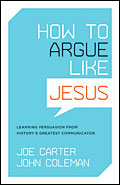
How to Argue like Jesus: Learning Persuasion from History’s Greatest Communicator
Posted: January 27, 2009 Filed under: Book of the Week, Book Review 1 CommentBook Review: How to Argue like Jesus: Learning Persuasion from History’s Greatest Communicator
 My Review: Living in Grand Rapids, MI I often get a lot of flack about my last name, which I am most often called as if it was my first name. The number of ways that the traditional Dutch circles write out or pronounce my name is absolutely ridiculous. Here are some of the examples of what I’ve seen and heard:
DeWalt (which is not even Dutch, but French!)
De Vault
De Walt
De walt
De Wald
It seems that no matter where I go, people in my city try to make me Dutch! If I had a dollar for every time someone tried to persuade me to change the spelling of my name, my whole seminary bill would be paid! The same goes for many more areas, but this is one that seems to be so important to these Dutch that they feel they must somehow persuade me to change so as to fit into their community. My name is spelled “Dewalt,” which is pronounced “Da-walt.” Dewalt is German for “The Family of the Forest.” I guess my ancestors lived out in the woods, which is something that hasn’t changed much to this day. The point of all of this is that even in something as simple as a name, I encounter many people that are awful at communicating what they want to, especially in areas of persuasion. It is not just Dutch people in my community of course; it goes for myself as well. I find myself trying to communicate the way I want to or the way I think I need to, and very often do so in order to get what I think is best or to come out on top of the conversation.
- Thinking about your own communication, answer these few questions in your mind right now:
- When was the last time you thought of your conversation as bearing the image of your heavenly Father?
- Was your last conversation centered on the person and work of Christ?
- Does the message that comes from your lips portray the image in which you are to walk?
These are just some of the thoughts that Joe Carter and John Coleman write about in their book, How to Argue Like Jesus. In a world where words are spoken and written more than ever and easier than ever, it is extremely important to think about what you are saying. There is much communication in today’s world, but unfortunately words and conversations also tend to have less meaning than ever. This is why it is vital that believers learn to carefully and effectively communicate, reflecting Christ as we do so, as we draw from His own words and the example He gave us.
In this work, Carter and Coleman teach how Jesus Himself used the great gift of communication to reach out to others, and they look specifically at Jesus’ use of the rhetoric, which is a form of speech that is often lost today. They also show that Jesus was the master of communication, in that He Himself knew perfect communication and how to relate to people and persuade them to His Father like no other.
Christians need to work more at cultivating our own words and language, especially in the area of how we use our communication for the Kingdom of God, and this is the perfect book to help educate and encourage one to do so.
Book Description: Uses Jesus’ words and actions found in the New Testament to systematically evaluate his rhetorical stylings, drawing real lessons from his teachings that today’s readers can employ.
Jesus of Nazareth never wrote a book, held political office, or wielded a sword. He never gained sway with the mighty or influential. He never took up arms against the governing powers in Rome. He was a lower-class worker who died an excruciating death at the age of thirty-three. Yet, in spite of all odds—obscurity, powerlessness, and execution—his words revolutionized human history.
How to Argue Like Jesus examines the life and words of Jesus and describes the various ways in which he sought—through the spoken word, his life, and his disciples—to reach others with his message. The authors then pull some very simple rhetorical lessons from Jesus’ life that readers can use today.
Both Christian and non-Christian leaders in just about any field can improve their ability to communicate effectively by studying the words and methods of history’s greatest communicator.
What are you a member of?
Posted: January 26, 2009 Filed under: You Might be a Calvinist if..., You might be a Fundamentalist if 1 CommentYou might be a Calvinist if… you are a member of The Gospel-Coalition.
You might be a fundamentalist if… you are a member of the Christian Coalition of America.
Care of Our Feet
Posted: January 25, 2009 Filed under: Sundays with Spurgeon Leave a commentHe will keep the feet of his saints. (1 Samuel 2:9)
The way is slippery and our feet are feeble, but the Lord will keep our feet. If we give ourselves up by obedient faith to be His holy ones, He will Himself be our guardian. Not only will He charge His angels to keep us, but He Himself will preserve our goings.
He will keep our feet from falling so that we do not defile our garments, wound our souls, and cause the enemy to blaspheme.
He will keep our feet from wandering so that we do not go into paths of error, or ways of folly, or courses of the world’s custom.
He will keep our feet from swelling through weariness, or blistering because of the roughness and length of the way.
He will keep our feet from wounding: our shoes shall be iron and brass so that even though we tread on the edge of the sword, or on deadly serpents, we shall not bleed or be poisoned.
He will also pluck our feet out of the net. We shall not be entangled by the deceit of our malicious and crafty foes.
With such a promise as this, let us run without weariness and walk without fear. He who keeps our feet will do it effectually.
The John Piper Small Group Series Trailer
Posted: January 24, 2009 Filed under: John Piper, Small Groups Leave a commentSee here.
John Owen on Apostasy – Part Six
Posted: January 23, 2009 Filed under: John Owen, John Owen on Apostasy Leave a commentV. Darkness and ignorance another cause of apostasy
Theses:
“THE second spring or cause of defection from the gospel in any kind, is that spiritual darkness and ignorance which abides in the minds of men under the profession of the truth. The gospel may fall under a double consideration: First , Of the things themselves that are contained, revealed, and proposed therein; — these are the material objects of our faith. Secondly , With respect unto the doctrinal way of their declaration.”[1]
Summary:
Owen’s initial focus in chapter five is to show what it is exactly that the individual does that brings him to apostasy. In doing so, he shows the purpose of God revealing Himself to mankind so that they can renew themselves into the image of God and not that of their own sinful nature. Owen then moves into the truths of the gospel that bring comfort to the believer: 1. Being Chosen, and 2. Being Preserved. However, without the Spirit – and therefore only having head knowledge of these things – often (actually, in most cases) this all brings out what Owen calls skepticism. Halfway through this chapter Owen digs into the core of the issue, being that the reason of apostasy is man’s ignorance due to having no experience of the actual gospel doctrines in their heart. For this very reason man easily can fall away from the gospel – that which they had thought they knew, but have never been saved by. It is hard to discern things in the world when the “new nature” of a believer is only in the head and has not shaped and formed the person’s heart. The conclusion of this chapter is where John Owen then shows that it is the Holy Spirit that does this very work of placing the gospel in the center of one’s life, heart, and of living, which keeps them from falling away from it.
Outline:
I. Spiritual Darkness Causes Apostasy
A. The Purpose of the Gospel
1. To See God’s Glory
2. To Know Gods Glory
B. No Spirit Leads to the lack of Knowing Truth
1. Truths to Comfort Believers
2. God has Chose His People
3. The Natural Mind Leads to False Religion
4. The Truth Leads to Right Religion
C. Man’s Ignorance
1. Head Knowledge of the Word
2. Gospel Gives True Knowledge of Word
The Philosophical Presuppositions of Contextualization
Posted: January 22, 2009 Filed under: Questions & Answers 1 CommentQuestion: Dewalt, what are the philosophical presuppositions of contextualization, and where and how can it be useful; what place would a biblical program of hermeneutics give to contextualization or what would be its substitute.
Answer:
Contextualization is different today then it was when it started. Contextualization is the process of assigning the meaning of a text, passage to culture and people. To me, that sounds like doing great application. However when Contextualization started, it was from the roots of rationalism and mainly Relativism in which the Reformed circles was scared of, and disliked. These starters so-to-speak of contextualization allowed words to change and the meaning of text change. This brought a different meaning to the Scriptures and allowed for multiple meanings to be taught in their circles.
As far as what would be its’ substitute, I am going to take a “non-traditional reformed view.” I believe whole heartily and would die on the grounds of what the actual definition of “contextualization” is. I would say that proper contextualizing is applying the application of the text to the listener that is hearing the teaching and preaching of the Word. To the traditional reformed circles, I say this is doing proper application in their teaching and preaching. We don’t give the same applications form a text to a crowd of prisoners, homeless, windows, poor, church circles, or new believers. However that seems to be the case that I see among the conservative Reformed circles (we can meet on this is you would like). Contextualizing is giving the right kind of application to the right group in which is being taught to. I know, the roots of it may be scary, but I am not fighting for “contextualization” as it started, but fighting for proper application in which reaches cultures, peoples, nations, cities, people groups and individuals that are all different in themselves. I say it like this, One observation of the test, One meaning of the text, Many applications of the text.
Bad Conscience
Posted: January 21, 2009 Filed under: Gospel Quote of the Week Leave a comment“The torture of a bad conscience is the hell of a living soul.” – John Calvin
The Principle that Scripture has a Single Meaning?
Posted: January 20, 2009 Filed under: Questions & Answers 4 CommentsQuestion: Dewalt can you please defend the principle that Scripture has a single meaning? How do you go about trying to draw out that single meaning? Illustrate in the case of Genesis 22. Can you have a single meaning here and still bring in Christ?
Answer:
Scripture has one single meaning? Yes! To the dispensationalist, the die on that hill (which I love) but only understand it to mean original writer to original reader. However, the church today can see the one-single-meaning of the text (original writer to original reader) but more so, see how it fits into all of the Scriptures. What was said to Moses or Abraham, writer to reader is our first and foremost meaning of Scripture, but seeing how that is played out in all of Scripture and our biblical theology progresses in time with promises in covenants are where dispensationalist fall. Let me give an example:
Dispensationalism – One meaning- Meaning 1. A is to the reader then as it is today. (One-fold)
Reformed/Covenantism – One meaning- Meaning 1.A is to the reader then as it is today, 1.B is to the reader sees the OT in the NT, 1.C is to the reader as we see today through out all of Scriptures. (Multi-fold)
How I draw this out and you ask for Gen.22 so I’ll try to do that, however other passages would be easier.
Gen. 22 The Sacrifice of Isaac
1.A is that Abraham was asked to sacrifice his son, and God provided redemption else where.
1.B is that in the New Testament and today’s church we can see some similarities that lie in this event that seem to be a shadow and a type of example of which God did with his Son, Jesus Christ in dying at the cross.
Now, have we in the reformed camp change the one meaning no, but do we seem systematically in how Scripture has one progression in to show its goal of redemption throughout all of the cannon, yes.
Skipping and Evangelism
Posted: January 19, 2009 Filed under: You Might be a Calvinist if..., You might be a Fundamentalist if Leave a commentYou might be a (Dutch/Hyper) Calvinist if… you skip the Lord’s Supper because you don’t want the church to see the plates be passed by you.
You might be a Fundamentalist if… when you evangelize, you asked someone, “Do you want to go to heaven?”
Christ and His Children
Posted: January 18, 2009 Filed under: Sundays with Spurgeon Leave a commentWhen thou shalt make his soul an offering for sin, he shall see his seed. (Isaiah 53:10)
Our Lord Jesus has not died in vain. His death was sacrificial: He died as our substitute, because death was the penalty of our sins. Because His substitution was accepted of God, He has saved those for whom He made His soul a sacrifice. By death He became like the corn of wheat which bringeth forth much fruit. There must be a succession of children unto Jesus; He is “the Father of the everlasting age.” He shall say, “Behold, I and the children whom Thou hast given me.”
A man is honored in his sons, and Jesus hath His quiver full of these arrows of the mighty. A man is represented in his children, and so is the Christ in Christians. In his seed a man’s life seems to be prolonged and extended; and so is the life of Jesus continued in believers.
Jesus lives, for He sees His seed. He fixes His eye on us, He delights in us, He recognizes us as the fruit of His soul travail. Let us be glad that our Lord does not fail to enjoy the result of His dread sacrifice, and that He will never cease to feast His eyes upon the harvest of His death. Those eyes which once wept for us are now viewing us with pleasure. Yes, He looks upon those who are looking unto Him. Our eyes meet! What a joy is this!
Book Review: The Unwavering Resolve of Jonathan Edwards, by Dr. Steve J. Lawson
Posted: January 17, 2009 Filed under: Book of the Week, Book Review 1 Comment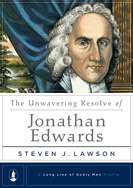 Jonathan Edwards has been called the greatest American Theologian of all time and is well known for both the tremendous amount of works that he has written, and his wonderful sermons that – in the past, and still today – help shape individuals’ lives closer to the image of Christ. There have been countless books written about Jonathan Edwards and the things he taught, yet this latest work stands out and differs as it focuses strictly on Edwards’ resolutions, which he wrote just after his conversion. Throughout the nine chapters of The Unwavering Resolve of Jonathan Edwards, Dr. Lawson shows the importance of living our lives Soli Deo Gloria, and how Jonathan Edwards did exactly that, as seen through his writings and his personal life. One of the greatest things Dr. Lawson conveys is how Edwards’ writings brought conviction to the hearts of many during his time, and continues to do so even today!
I first met Dr. Lawson at a small Pastor’s Conference in Grand Rapids over a year ago and was amazed as he preached the Word of God with an authority and a fire that many lack in the pulpit today. I was even further amazed when I got the opportunity to sell him a number of books from RHB and he told me that he writes his books – every single one – by hand! Writing four titles in the last three years – two of which are well over 500 pages – by hand, floored me. I can barley write a letter today without my hand hurting, even with the use of Microsoft Word! Yet, in our computer-dependent 21st century, here is one who writes a book by hand. In his writing process, it is evident that he also devotes much time to thoroughly study as he writes; delving deep into the research. This is clearly seen while reading Dr. Lawson’s books, namely this series entitled A Long Line of Godly Men.
Today’s culture seems to have influenced the setting aside of morals and ethics, impacting the church in America in a negative way, as the truths which lie in the Scriptures are often no longer being lived out. Dr. Lawson reveals how Edwards’ resolutions focus on bringing back the conviction of the heart and show how men and women can live for the glory of God today. To begin, Lawson looks at how the believer ought to live out a life of holiness (which is demanded of them) for Christ in a way that is honorable to Him. From there Lawson focuses on a number of areas in which many struggle. He shows how Edwards’ life and writings help the believer to live a life that represents that which Christ personally displayed, and how to make it a priority to live a life of faith that glorifies God, looks forward to eternity, practices discipleship, practices love, and examines itself for the kingdom of God.
This work on Edwards and his writing of the resolutions can be used to help encourage, shape, and bring about the kind of life that the Lord intended for His saints to live as they are faced with the sinful lusts of this world. This is a great book for anyone to read! You can buy from RHB here.
About the Author : Steven J. Lawson is the senior pastor of Christ Fellowship Baptist Church in Mobile, Alabama. Dr. Lawson serves on the board of directors of The Master’s College and on the ministerial board for Reformed Theological Seminary, and teaches with Dr. John MacArthur at the Expositor’s Institute. In addition, Dr. Lawson has written numerous books, including Foundations of Grace and Famine in the Land: A Passionate Call for Expository Preaching.
Our Trip back to Michigan Together after Our Engagement
Posted: January 16, 2009 Filed under: Emily and I Leave a comment(Post by Emily Harlan)
Another chapter to this adventure we call life! D, and I woke up on Tuesday, and went to lunch with D’s mom and his friend Chris. We left for Toledo, Ohio where a friend from BBC lives now with his family as he interns at church. Keep in mind that we are driving separately since we arrived in Ohio at different times. My wonderful fiancé` who is always planned down to the minute had us leaving his house to arrive in Toledo at 5 pm to meet for dinner than attend a high school basketball game. We started off on the bitter cold (-1 degrees) afternoon and got onto the Ohio turnpike. We were on the turnpike about 35 minutes when D lets me know that he wanted to stop off at the Service Plaza for a restroom break, so we pulled off, went in and spent some time walking around enjoying our time together. We head back to the cars and start to get in our cars when I realize that I cannot unlock my car! (My car has an automatic car remote thing, and no key to unlock. I know, dumb, but I have never owned one for my car.) My remote buttons for my car were not working! We tried everything but to no avail. Our only option was to go to the nearest convenience store to buy a new little battery for my car remote. So we get in his truck and drive to the nearest town, 35 minutes away, and get there when it hits us that since we are on the turnpike we have to pay each time we get on and off the pike.
So D and I get the battery, replace it, and then as we are driving away from Wal-Mart another fact hits us….the service center was on the westbound turnpike…we will have to drive past the service plaza and go the nearest town to get off the east bound, and then get back on the westbound to get to the service plaza! To our dismay the nearest exit past the service plaza was the very town we got ON the turnpike at the beginning of the trip 35 minutes past the eastbound plaza. As my fiancé is always quick to see God’s sovereignty in all things, it was hard on his patience this time to have to drive back and forth back and forth paying tolls and wasting gas money to get this taken care of. Finally we get back to the service plaza and try my key remote but soon realized that my car was dead! (Earlier in the day as we were driving D had called me to tell me I needed my lights on since the weather was bad. Well my car’s lights automatically go on as soon as dusk hits so I had to manually turn them on, but I had forgotten to turn them off because I was not used to having to do it!!)
So, since I had left them on we had no life in the car to even get the remote to work on the power locks! As you can imagine this did not sit well with my beloved Dewalt as we were now royally late for this appointment with our friends still an hour away! So another detail I have forgotten to add is this, since we were just running into the service plaza for a quick stop, I had left my cell phone and wallet in my now, locked, and dead car. So thankfully, I do have AAA but I didn’t have the number or my account number, so we trudged despondently into the service plaza to get a phone book and get the number for AAA. We get in and try and find a phone book and find the number after some difficulty by the staff to even find one! After a very complicated conversation with the AAA dispatchers we got service to come and help us in 45 minutes. We decided to just go on ahead and eat dinner at the plaza as we waited and as we sat down to our greasy calzones from a fast food restaurant we bowed our heads to say blessing. Dewalt started talking and stopped at about, “Dear Father we tha….” And chuckles and continues, “…Well Lord this is really hard right now for me….I guess we are thankful for your will and that you have helped us keep safe and got us help when we needed. We also thank you for this ordained time to spend time with each other to learn more about each other and to love you. Keep us safe for the rest of the night, we love you and thank you for Your Son, Christ, Amen.”
We both smiled as we looked at each other and just chuckled at the complete absurdity of the whole situation but knew that we couldn’t change it and just accepted the time together as we waited for the tow truck with the jumper cables and the car unlocker.
Finally my car was unlocked and jumped and we were able to head back onto the road to Toledo, but before we headed off we stood in the cold holding each other and stopped to thank the Lord one more time for his provision and for a safe ride the rest of the way home. So, Thank the Lord for little times where he tests our patience and love for each other and Himself!!
Hermeneutics and Some Problems
Posted: January 15, 2009 Filed under: Questions & Answers Leave a commentQuestion: Michael would you please describe and defend to me the view of hermeneutics current in the Reformation and show how it is different from views found by those in Emergent Church.
Answer:
Views in the current Reformation – Was one that during the end of the Middle Ages came back to the importance of the authority of Scripture, namely John Wycliffe. John saw the importance of the text of the cannon being reliable and firm in its’ authority among its’ day. The reformers saw the importance of using the logic of Scripture and comparing Scripture along side the rest of Scripture for hermeneutics. A number of men to look at on this are Calvin, Luther, Owen, Brakel and the Westminster Divines. In the “just” of what these men did though, was finding the truth in which lied in the Bible and even though it was not the popular belief at the time, stood for that. All of these men saw of importance maintaining a humble attitude when approaching the Scriptures and allowing the Holy Spirit to shape and mold their theology according to the Lord’s.
The Views in which Differ today in the Emergent Church – Views today in the emergent church however are exactly what the Reformers went against, namely the mystical idea of Scripture. Although the middle ages kept the Scripture from the individual, today postmodern age allows the Scripture to be in the hands of many, but allowing many meanings to a verse, a word, a passage and the whole of the Bible. Instead of having one way of study, one way of finding the truth in the gospel, they have simply allowed a way that not only allows multiple meanings but not multiple religions to live how they want, do what they and read what they want, and not follow the Law of the Lord. The major issue with the emergent church is they do not have a different hermeneutic, they have several different hermeneutics which change from person to person and church to church. So explain one difference is impossible to categorize them as a whole, however the problem is that truth is not there. Rationalism has taken a new toll on the postmodern mind which then allows one to believer what ever he well pleases, and doesn’t allow the Spirit like the Reformers did to humble their minds and conform the heart to the bible.
Save Only Our Own Unbelief
Posted: January 14, 2009 Filed under: Gospel Quote of the Week Leave a commentNo man is excluded from calling upon God, the gate of salvation is set open unto all men: neither is there any other thing which keepeth us back from entering in, save only our own unbelief. – John Calvin
Greetings Friends and Family!
Posted: January 13, 2009 Filed under: Emily and I 1 Comment
(Post by Emily Harlan)
We hope that all is well with you all, and that your families are doing well! Both Dewalt (or Mike to some) and I wanted to share the tremendously exciting news with all of you at the same time, so here is a little bit of what is going on in our lives at the moment! Yesterday January 9, 2009 Dewalt asked for my hand in marriage in a snowy park in Sandusky, Ohio. He made it a very romantic day and even though he said he didn’t know what he was doing, he made it perfect by taking us up north to Lake Eerie to eat at a grill on the lake, and then drove to a park covered in snow to ask to marry me! Of course, I am elated to say that I accepted and believe that after the last 4 years of knowing each other, he and I will be spending our next 9 months or so planning for the day that will start the rest of lives together as best friends in love, partners in ministry and of course husband and wife! Of course there was so much excitement as we tried to get a hold of the majority or our friends and family but if in the excitement someone wasn’t contacted directly by one of us PLEASE know that we tried our best to tell who we could, but we were smiling so much and high on life at the time it was hard to think straightJ!! I hope that you all will be able to attend and know that we will be getting more information out in due time. Of these 2 things we do know for sure: both date and place. It will be taking place, Lord willing 10-10-09, and in Grand Rapids, MI.
Also, if you all could pray for Dewalt and I as we start this new adventure in life, we would both appreciate it! We both know that the Lord placed us together to love and serve Him and we plan on doing that together for the rest of our lives!! As of right now, Dewalt still has about 2 years of seminary/graduate school left in Grand Rapids, and I am working at a mental health facility in the residential unit for teenagers and pursuing a teaching position in G.R. We plan on staying there in MI for a while but who knows what the Lord has for us! So we both want to extend our thanks and appreciation to all of you for the part you have played in our lives individually and together as a couple! We pray that we see you all very soon! May the Lord bless you!
In Christ,
Emily and Dewalt

 Gospel-Centered Musings